
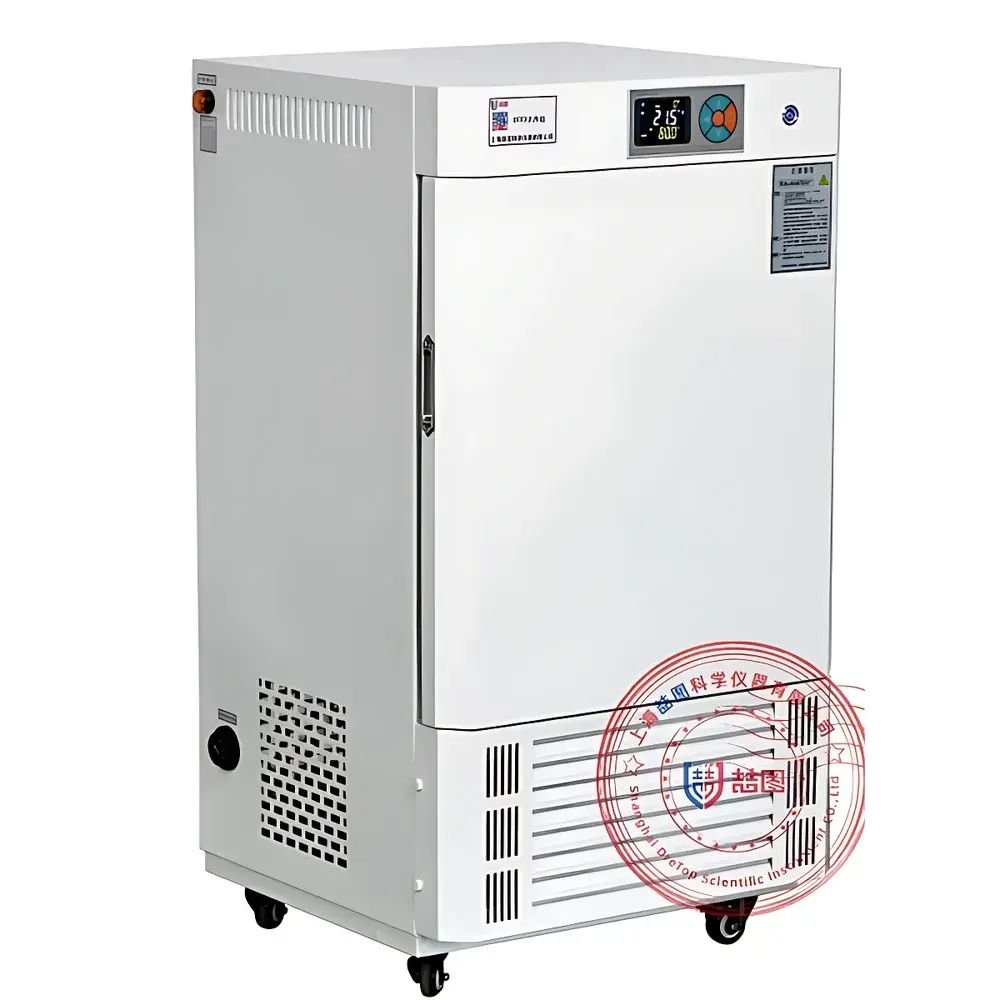
DRETOP BD6-70 Integrated BOD Incubation and Analysis System
| Brand | DRETOP |
|---|---|
| Origin | Shanghai, China |
| Model | BD6-70 |
| Instrument Type | Laboratory BOD Analyzer |
| Principle | Mercury-Free Pressure-Difference Method (Dissolved Oxygen Depletion) |
| Incubation Temperature Range | 0–65 °C |
| BOD Measurement Range | 0–4000 mg/L |
| Resolution | 0.01 mg/L |
| Accuracy | ±8% |
| Temperature Uniformity | ±0.5 °C |
| Temperature Resolution | 0.1 °C |
| Max. Sample Channels | 6 |
| Incubation Chamber Dimensions (W×D×H) | 450 × 320 × 500 mm |
| Data Storage Duration | 10 years |
| Battery Life | ≥2 years |
| Power Supply | AC 220 V, 50 Hz |
Overview
The DRETOP BD6-70 Integrated BOD Incubation and Analysis System is a purpose-engineered laboratory instrument that unifies precise biochemical oxygen demand (BOD) quantification with controlled environmental incubation in a single compact platform. It operates on the mercury-free pressure-difference principle—measuring the differential gas pressure generated by microbial oxygen consumption in sealed BOD bottles over time—thereby eliminating hazardous mercury-based manometry while maintaining compliance with standard BOD testing protocols (e.g., ISO 5815-1:2019, ASTM D5210-19). Unlike standalone incubators or discrete BOD analyzers, the BD6-70 integrates temperature-regulated chamber control (0–65 °C), six independent sensor channels, and real-time data acquisition into one validated workflow. This architecture supports standardized 5-day BOD5 assays as well as extended incubation periods (1–30 days), making it suitable for routine wastewater effluent monitoring, drinking water quality verification, and research-grade biodegradability studies in municipal, industrial, and academic laboratories.
Key Features
- Mercury-free pressure-difference BOD detection system—eliminates toxic mercury hazards and complies with global RoHS and REACH directives.
- Six independent, electrically isolated measurement channels—enables concurrent analysis of up to six samples without cross-talk; each channel initiates and terminates autonomously.
- Precision temperature control with ±0.5 °C uniformity across the 450 × 320 × 500 mm stainless-steel chamber; microprocessor-driven PID algorithm ensures stability under variable load conditions.
- 30-segment programmable incubation profile—supports multi-step thermal conditioning (e.g., acclimation → standard 20 °C incubation → post-incubation cooling) with automatic transition logic.
- Robust mechanical design: electrophoretically coated steel exterior, mirror-finish 304 stainless-steel interior, adjustable shelf spacing, and magnetic door seal for consistent thermal integrity and ease of maintenance.
- Comprehensive power resilience: built-in parameter memory retention, auto-recovery after power interruption, and compressor protection circuitry (start-delay, stop-interval, overheat cutoff).
Sample Compatibility & Compliance
The BD6-70 accommodates standard 580 mL BOD bottles conforming to APHA Standard Methods 5210B and ISO 5815-1. Its pressure-difference transducers are calibrated for aqueous matrices including domestic sewage, industrial effluents, surface water, and treated wastewater—with no requirement for pre-dilution across the full 0–4000 mg/L range. The system meets functional requirements for GLP-compliant environmental testing laboratories and supports audit-ready operation through timestamped data logging, user-accessible calibration history, and optional RS485 interface for integration into LIMS environments. While not FDA 21 CFR Part 11–certified out-of-the-box, its data storage architecture (10-year retention, non-volatile memory) and traceable measurement records align with foundational data integrity expectations for regulatory submissions.
Software & Data Management
All BOD measurements are displayed in real time on a high-contrast capacitive touchscreen interface with intuitive icon-based navigation. Raw pressure differentials, calculated BOD concentrations (mg/L), and kinetic curves are stored locally with date/time stamps, operator ID fields, and batch identifiers. Data export is supported via USB flash drive (FAT32 format) in CSV and PDF report formats—including automatically generated trend plots with linear/nonlinear regression overlays. Optional RS485 communication enables bidirectional protocol exchange (Modbus RTU) for centralized data aggregation, remote diagnostics, and scheduled firmware updates. Internal battery-backed clock maintains time synchronization during mains failure, ensuring continuity of temporal metadata critical for BOD5 validation.
Applications
- Routine compliance monitoring of wastewater treatment plant influent/effluent per national discharge standards (e.g., China’s GB 8978-1996, EU Urban Wastewater Treatment Directive).
- Biodegradability screening of surfactants, pharmaceuticals, and industrial chemicals under OECD 301 series test guidelines.
- Research on microbial community activity in sediment-water interfaces, biofilm reactors, and constructed wetlands.
- Quality assurance in drinking water distribution systems—assessing assimilable organic carbon (AOC) potential via low-level BOD kinetics.
- Teaching laboratories for environmental science curricula—demonstrating respiration kinetics, temperature dependence of microbial metabolism, and method validation principles.
FAQ
What BOD standard methods does the BD6-70 support?
The system implements the pressure-difference variant of the dilution method described in ISO 5815-1:2019 and ASTM D5210-19, with operational alignment to APHA 5210B for sample preparation and incubation duration.
Can the BD6-70 perform BOD5 and BOD20 simultaneously?
Yes—each of the six channels operates independently; users may assign differing incubation durations (1–30 days) and start times per sample without affecting other ongoing assays.
Is external calibration required before each use?
No—factory calibration is retained in non-volatile memory; however, periodic verification using certified zero-oxygen and saturated-oxygen reference solutions is recommended per ISO/IEC 17025 internal quality control protocols.
Does the system meet electromagnetic compatibility (EMC) requirements for laboratory deployment?
It conforms to IEC 61326-1:2013 Class B emission limits and basic immunity criteria for industrial/scientific equipment, verified per manufacturer test reports.
What maintenance intervals are specified for long-term reliability?
Annual inspection of pressure transducer seals, quarterly cleaning of air intake filters, and biannual verification of incubation chamber temperature uniformity using NIST-traceable PT100 probes.







