
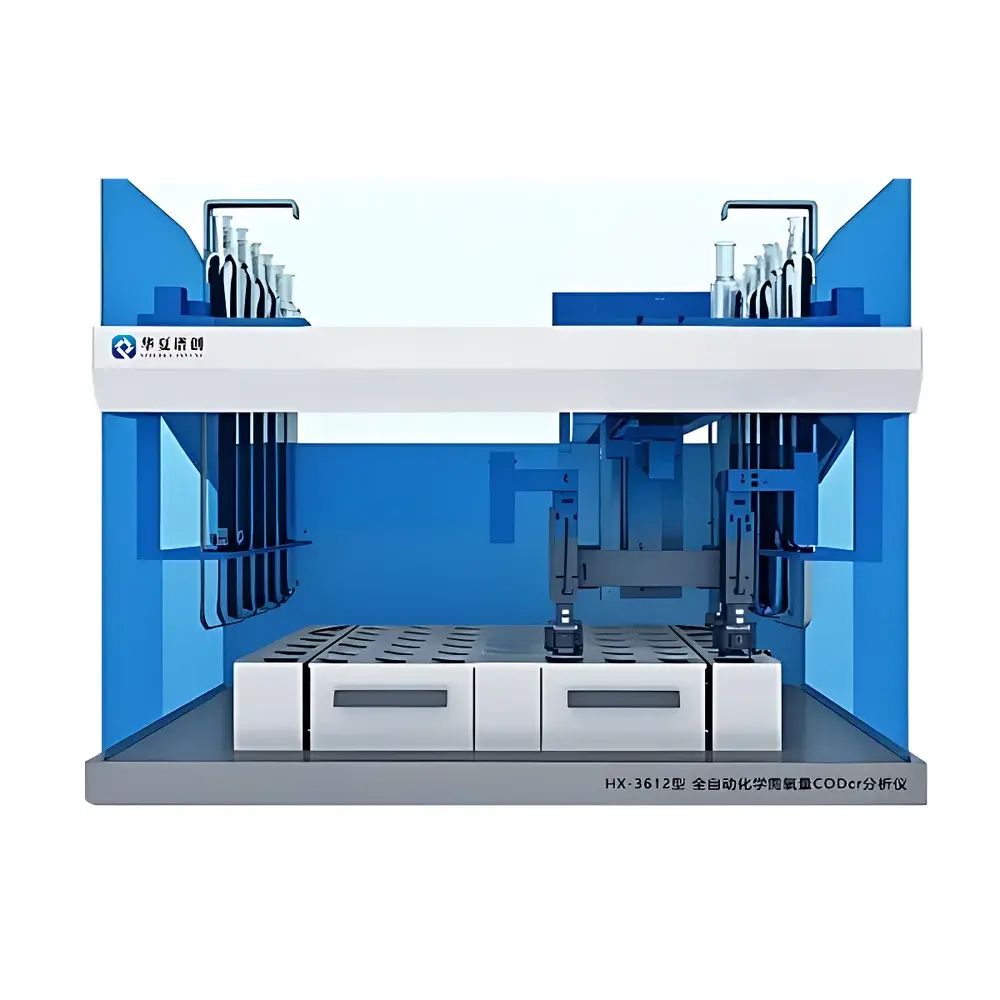
Spectra Invent HX-3612 Automated CODcr Analyzer
| Brand | Spectra Invent |
|---|---|
| Model | HX-3612 |
| Detection Principle | Potassium Dichromate Reflux Titration (Compliant with HJ 828–2017) |
| Application | Surface Water, Domestic Wastewater, Industrial Effluent |
| Instrument Type | Benchtop Laboratory COD Analyzer |
| Sample Throughput | Batch-mode automated analysis |
| Reagent Handling | Nine independent peristaltic pumps with feedback-controlled volumetric dispensing |
| Endpoint Detection | Optical colorimetric titration (simulated human visual discrimination) |
| Data Output | Local database storage + LIMS integration |
| Safety Compliance | Mercury-free handling protocol support, enclosed digestion/delivery path, fume-resistant reagent manifold |
| Origin | Zhejiang, China |
| Regulatory Alignment | Designed for GLP/GMP-aligned laboratories |
Overview
The Spectra Invent HX-3612 Automated CODcr Analyzer is a fully integrated benchtop system engineered for precise, reproducible, and operator-safe determination of Chemical Oxygen Demand (CODcr) in environmental water matrices. It implements the standardized open-reflux potassium dichromate oxidation method specified in China’s national standard HJ 828–2017 — equivalent in principle to ISO 6060 and ASTM D1252 (Method B). The instrument automates the complete analytical workflow: sample aspiration, reagent addition (HgSO4, K2Cr2O7, Ag2SO4/H2SO4, ferroin indicator, and (NH4)2Fe(SO4)2), controlled thermal digestion (reflux at 150 °C ± 2 °C for 120 min), post-digestion cooling, and endpoint-sensitive potentiometric-colorimetric titration. By eliminating manual pipetting, open-vessel handling, and subjective endpoint judgment, the HX-3612 reduces inter-operator variability, improves measurement repeatability (RSD < 3.5% at 100 mg/L COD), and minimizes occupational exposure to Cr(VI), Hg(II), and concentrated sulfuric acid.
Key Features
- Single-touch batch operation: Initiate multi-sample analysis with one command; system autonomously manages sample positioning, reagent delivery, digestion timing, cooling cycles, and titration.
- 9-channel independent peristaltic pumping architecture: Enables contamination-free, programmable dosing of nine distinct reagents — including HgSO4 stabilizer, K2Cr2O7 oxidant, Ag2SO4/H2SO4 catalyst, ferroin indicator, and titrant — with volumetric accuracy ≤ ±0.8% across 0.1–20 mL ranges.
- Optical endpoint detection: Uses high-stability RGB photometric sensing to monitor Fe2+/Fe3+ redox transition during titration, replicating trained analyst visual assessment per HJ 828–2017 Annex C, with digital signal processing for objective inflection-point identification.
- Integrated 3-axis robotic manipulator: Precisely handles standard 250-mL digestion flasks and condenser assemblies; accommodates up to 12 samples per run without manual intervention.
- Programmable thermal control: PID-regulated heating block maintains reflux temperature within ±2 °C tolerance over full 120-minute cycle; active air-cooling subsystem reduces post-digestion wait time by >40% versus passive methods.
- Embedded LIMS-ready data engine: Auto-generates ISO/IEC 17025-compliant result reports (PDF/CSV), timestamps all critical events (e.g., reagent dispense, digestion start/end, titration curve capture), and supports secure API-based upload to enterprise laboratory information management systems.
Sample Compatibility & Compliance
The HX-3612 accepts untreated or filtered aqueous samples within pH 2–10 and turbidity < 100 NTU, including surface water, municipal wastewater influent/effluent, and pretreated industrial discharges (e.g., food processing, textile dyeing, pharmaceutical manufacturing). It complies with HJ 828–2017’s matrix-specific interference mitigation protocols — notably chloride masking via HgSO4 stoichiometric dosing and Ag2SO4-catalyzed oxidation of refractory organics. All fluidic pathways are constructed from PTFE, borosilicate glass, and chemically resistant elastomers to withstand prolonged exposure to 98% H2SO4 and Cr(VI) solutions. The system meets IEC 61010-1:2010 safety requirements for laboratory electrical equipment and incorporates dual-level fume containment for digestion chamber exhaust.
Software & Data Management
The embedded Windows IoT-based control interface provides role-based access (Operator, Supervisor, Administrator) with configurable audit trails per FDA 21 CFR Part 11 Subpart B. Each analysis session logs operator ID, timestamped reagent lot numbers, calibration verification results, raw titration curves (absorbance vs. volume), and calculated COD values with uncertainty estimation (k = 2). Data export supports CSV, PDF, and XML formats compliant with ISO/IEC 17025 Clause 7.7. Optional software modules enable trend analysis, QC charting (X-bar/R), and automated method validation reporting aligned with ISO/IEC 17025:2017 Annex A.
Applications
- Regulatory compliance monitoring for municipal wastewater treatment plants (WWTPs) reporting to MEE (Ministry of Ecology and Environment).
- Industrial effluent characterization prior to discharge permit renewal under China’s Pollutant Discharge Permit System.
- Research-grade COD profiling in environmental engineering labs studying biodegradability kinetics or advanced oxidation process (AOP) efficiency.
- Quality assurance for drinking water source protection programs evaluating organic loading from agricultural runoff.
- Contract testing laboratories requiring ISO/IEC 17025-accredited COD data for third-party certification.
FAQ
Does the HX-3612 require manual calibration before each batch?
No. The system performs automatic zero-point and span verification using certified reference materials (CRMs) prior to every analytical sequence, with results logged in the audit trail.
Can it handle high-chloride samples (>2000 mg/L Cl⁻)?
Yes — the HgSO4 dosing algorithm adjusts stoichiometrically up to 5000 mg/L Cl⁻; users may optionally pre-dilute or apply chloride correction factors per HJ 828–2017 Section 8.3.
Is remote monitoring supported?
Yes — via Ethernet-connected web interface (HTTPS) enabling real-time status viewing, queue management, and alarm notifications (SMTP/SNMP) without local login.
What maintenance intervals are recommended?
Peristaltic pump tubing replacement every 3 months or 500 runs; optical sensor cleaning weekly; annual thermocouple and photodiode verification using NIST-traceable standards.
Does it comply with international standards beyond HJ 828–2017?
Its methodology is technically equivalent to ISO 6060:1989 and ASTM D1252-12 Method B; validation documentation supports cross-referencing for EU WFD (2000/60/EC) and US EPA Method 410.4 alignment.
Related Products







