
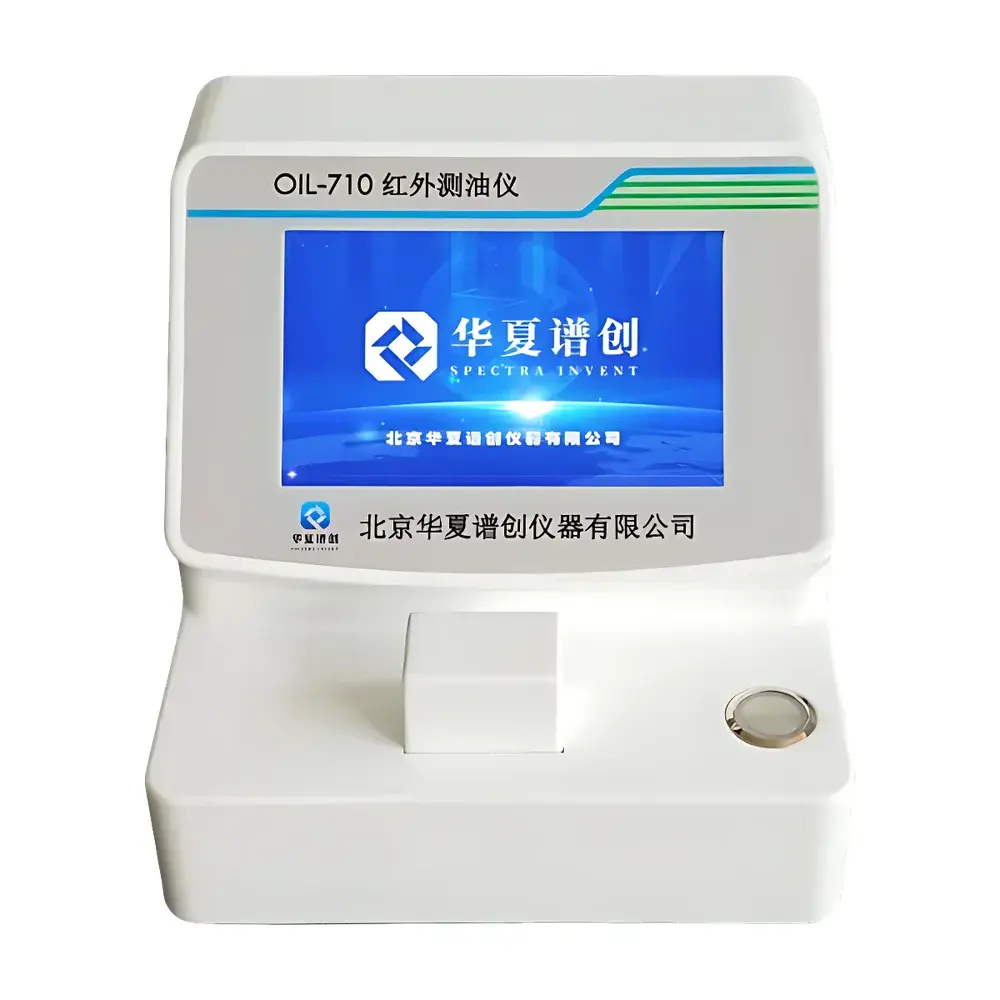
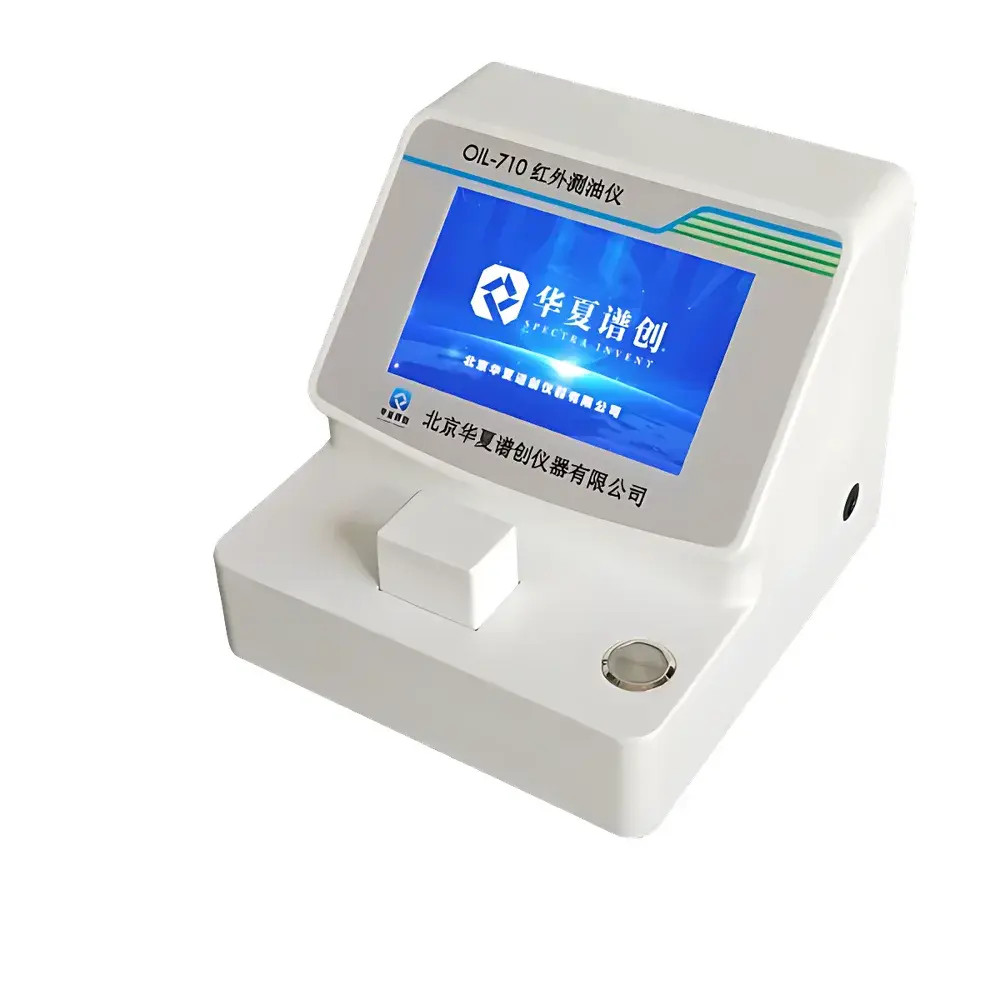
Spectra Invent OIL-710 Portable Infrared Oil-in-Water Analyzer
| Brand | Spectra Invent |
|---|---|
| Origin | Zhejiang, China |
| Manufacturer Type | Authorized Distributor |
| Country of Manufacture | China |
| Model | OIL-710 |
| Instrument Type | Portable |
| Measurement Principle | Infrared Spectrophotometry (C–H Stretch Absorption at 2930 cm⁻¹, 2960 cm⁻¹, and 2850 cm⁻¹) |
| Measurement Range | 0.0–1000 mg/L |
| Detection Limit | 0.1 mg/L |
| Accuracy | ≤ ±5% RSD |
| Measurement Cycle Time | 10 seconds per sample |
| Compliance | Designed to meet core requirements of EPA Method 1664A, ISO 9377-2, and HJ 637–2018 (China) |
Overview
The Spectra Invent OIL-710 is a field-deployable, benchtop-compatible infrared oil-in-water analyzer engineered for rapid, quantitative determination of total petroleum hydrocarbons (TPH) and mineral oil content in aqueous matrices. It operates on the principle of dual-beam Fourier-transform infrared (FTIR)-compatible absorption spectroscopy—specifically targeting asymmetric and symmetric C–H stretching vibrations in aliphatic hydrocarbon chains at standardized wavenumbers (2960 cm⁻¹, 2930 cm⁻¹, and 2850 cm⁻¹). This spectral selectivity enables discrimination of non-polar extractable organics from interfering polar compounds (e.g., surfactants, humic substances), delivering chemically specific quantification without chromatographic separation. The instrument is calibrated using n-hexadecane or mineral oil standards traceable to NIST SRM 2781, ensuring metrological consistency across environmental laboratories and wastewater treatment facilities.
Key Features
- Portable form factor with integrated rechargeable Li-ion battery (≥6 hours continuous operation), enabling real-time analysis at discharge points, stormwater outfalls, or remote sampling sites.
- Dual-path optical system with temperature-stabilized silicon carbide IR source and thermopile detector, minimizing drift and enhancing long-term signal stability.
- Pre-programmed calibration curves for common reference standards (n-hexadecane, mineral oil, and diesel fuel), supporting method-specific reporting per regulatory frameworks.
- Automated solvent extraction interface compatible with standard EPA-approved solvents (e.g., tetrachloroethylene, hexane), including built-in solvent blank correction and baseline normalization.
- Ruggedized aluminum alloy chassis rated IP54 for dust and splash resistance, validated for operation in ambient temperatures from 5 °C to 40 °C and relative humidity up to 85% non-condensing.
- Onboard data logging for ≥10,000 measurement records with timestamp, operator ID, and QC flagging (e.g., absorbance ratio validation, pathlength verification).
Sample Compatibility & Compliance
The OIL-710 accepts liquid samples pre-extracted using standard liquid–liquid extraction protocols. Compatible matrices include surface water, groundwater, industrial effluents, cooling tower water, and membrane bioreactor (MBR) permeate. It supports both direct measurement of solvent extracts and optional integration with automated extraction modules (e.g., SPE or liquid–liquid extraction manifolds). The instrument’s algorithm implements absorbance ratio checks (A2930/A2960, A2930/A2850) to detect spectral interference from aromatic or oxygenated hydrocarbons—functionality aligned with EPA Method 1664A’s interference rejection criteria. While not certified as GLP-compliant out-of-the-box, its audit-ready data structure—including electronic signatures, change logs, and calibration history—facilitates validation under ISO/IEC 17025 or internal QA/QC programs.
Software & Data Management
The OIL-710 interfaces via USB-C or Bluetooth 5.0 with SpectraLink Desktop Suite (v3.2+), a Windows-based application supporting method setup, calibration management, report generation (PDF/CSV), and LIMS export (ASTM E1384-compliant XML schema). All raw interferograms and processed spectra are stored with metadata (sample ID, date/time, operator, solvent lot, cuvette pathlength). Audit trail functionality records user actions, parameter modifications, and calibration events with immutable timestamps—meeting foundational requirements of FDA 21 CFR Part 11 for electronic records when deployed with organizational SOPs governing electronic signatures.
Applications
- Regulatory compliance monitoring for NPDES permits and local wastewater discharge limits.
- Leak detection and source tracking in petrochemical facilities, refineries, and storage terminals.
- Performance evaluation of oil–water separators, API tanks, and coalescing filters.
- Field screening during environmental site assessments (ESAs) and Phase II investigations.
- Process water quality control in food & beverage, pharmaceutical, and metalworking industries.
- Research-grade TPH quantification in limnological and marine sediment porewater studies.
FAQ
What extraction solvents are validated for use with the OIL-710?
Tetrachloroethylene (PERC) is the primary solvent recommended for full compliance with EPA Method 1664A. Hexane and Freon-113 alternatives are supported via user-defined calibration; however, their use requires method verification per laboratory SOP.
Can the OIL-710 differentiate between crude oil and refined petroleum products?
No—its quantification is based on total C–H bond density and does not resolve compositional differences. For speciation, GC-FID or GC-MS analysis is required.
Is third-party certification available for ISO/IEC 17025 accreditation?
Yes—Spectra Invent provides optional factory-issued calibration certificates traceable to NIST, along with validation documentation packages for IQ/OQ/PQ execution.
How often must the instrument be recalibrated?
A full calibration check is recommended before each analytical batch; daily verification using a mid-range standard (e.g., 50 mg/L) is required for routine QC.
Does the OIL-710 support multi-point calibration curves?
Yes—up to 8-point linear or quadratic calibration curves can be defined and stored per method, with automatic outlier detection and forced-zero intercept options.
Related Products







