
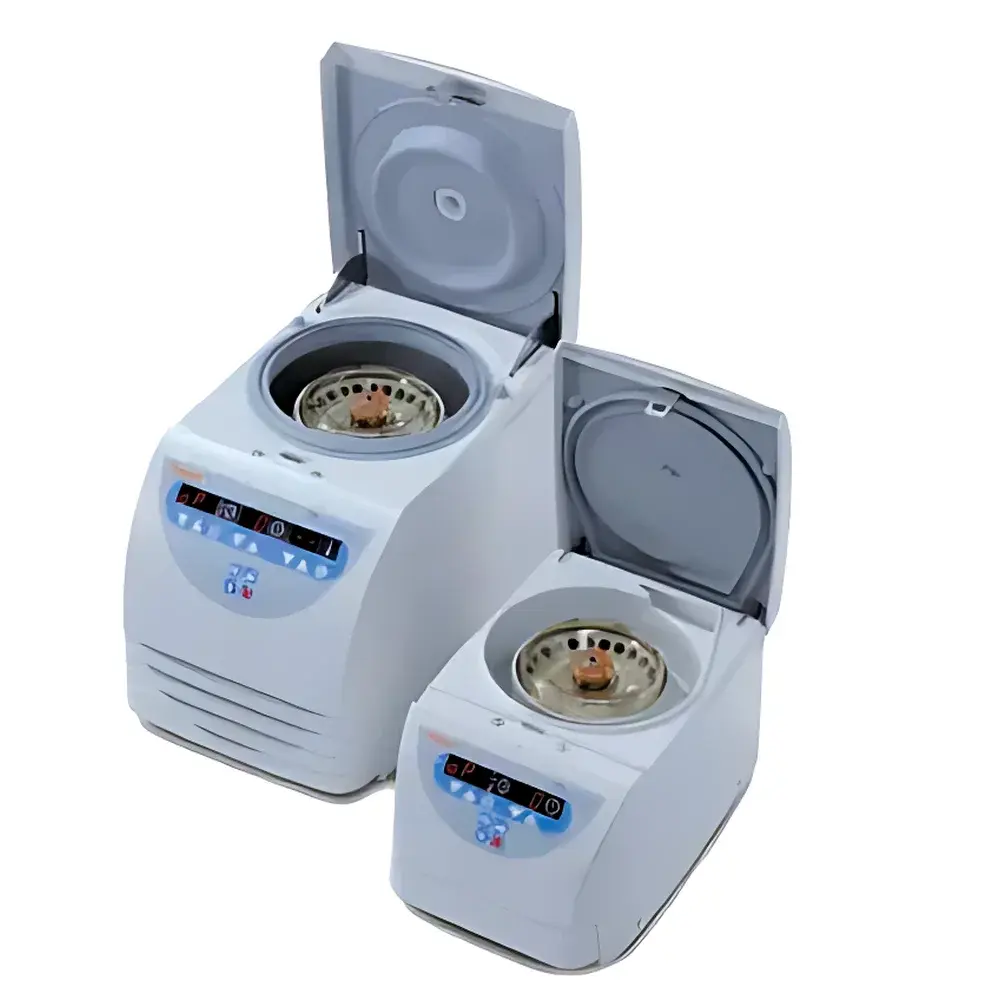
Sorvall Legend Micro 17/21 Benchtop Microcentrifuge Series
| Brand | Thermo Fisher Scientific |
|---|---|
| Origin | Germany |
| Model | Legend Micro 17 / Legend Micro 17R / Legend Micro 21 / Legend Micro 21R |
| Max RCF | 17,000 × g / 21,000 × g |
| Max Speed | 13,300 rpm / 14,800 rpm |
| Capacity | 24 × 1.5 mL / 2.0 mL tubes |
| Drive System | Brushless frequency-sensing direct-drive motor |
| Temperature Range (Refrigerated models) | –9 °C to 40 °C |
| Noise Level | ≤56 dB(A) |
| Acceleration/Deceleration Time | 11–13 s |
| Safety Features | Automatic rotor recognition, lid interlock, imbalance detection, self-diagnostic system, electronic circuit protection |
| Compliance | IEC 61010-1, EN 61326-1 (EMC), FDA 21 CFR Part 11-ready software architecture |
Overview
The Sorvall Legend Micro 17/21 Benchtop Microcentrifuge Series represents a legacy of precision engineering in compact centrifugation, developed by Thermo Fisher Scientific following the integration of Sorvall and Heraeus centrifuge technologies. Designed for high-throughput molecular biology, clinical diagnostics, and pharmaceutical research laboratories, this series employs a brushless frequency-sensing direct-drive motor to deliver stable, vibration-free operation without carbon brushes—eliminating mechanical wear and enabling true maintenance-free performance over extended service life. Each model operates on the principle of radial force generation via controlled angular acceleration, achieving precise separation of nucleic acids, proteins, cellular organelles, and particulates from small-volume samples (0.2–2.0 mL). The Legend Micro platform supports both ventilated (non-refrigerated) and refrigerated configurations (designated “R” models), with active pre-cooling capability and ±1 °C temperature accuracy across the full operating range (–9 °C to 40 °C), ensuring thermal stability critical for heat-sensitive biomolecules.
Key Features
- Brushless frequency-sensing direct-drive motor: Delivers silent operation (10,000 hours of runtime.
- Intelligent rotor recognition: Automatically detects installed rotor type and enforces speed/RCF limits per ISO 21501-4-compliant safety protocols.
- ClickSeal™ biocontainment rotors: Hermetically sealed 24-position rotors with integrated latching mechanism prevent aerosol escape during high-speed runs—validated per EN 149:2001 FFP2-equivalent containment standards.
- Dual-mode time control: Programmable run durations from 1–99 minutes, plus quick-spin (hold) and continuous-run modes for protocol flexibility.
- Integrated electronic imbalance detection: Real-time monitoring of mass distribution during acceleration/deceleration; automatic shutdown if deviation exceeds ±2 g threshold.
- Full diagnostic self-test: On-power-up validation of lid lock integrity, temperature sensor calibration, motor encoder function, and brake responsiveness.
- Ergonomic footprint: Compact dimensions (225 × 243 × 352 mm for non-refrigerated units; 330 × 295 × 445 mm for refrigerated) optimize bench space in BSL-2 and GLP-compliant labs.
Sample Compatibility & Compliance
The Legend Micro series accommodates standardized microtubes (0.2 mL PCR strips, 0.5 mL, 1.5 mL, and 2.0 mL conical tubes) via interchangeable rotor configurations—including dual-row 18-position rotors for differential pelleting and specialized hematocrit rotors compliant with CLSI H47-A3 guidelines. All rotors are manufactured from aerospace-grade aluminum alloy (EN AW-7075-T6) and undergo hydrostatic pressure testing at 1.5× maximum rated RCF. The system meets IEC 61010-1:2010 (Safety Requirements for Electrical Equipment for Measurement, Control, and Laboratory Use) and EN 61326-1:2013 (EMC immunity and emissions). Refrigerated models incorporate eco-friendly R290 refrigerant and comply with EU F-Gas Regulation (EU) No 517/2014. Data audit trails generated via optional Thermo Fisher Connect™ software satisfy FDA 21 CFR Part 11 requirements for electronic records and signatures in regulated environments.
Software & Data Management
Control is executed via an embedded microprocessor with a high-contrast LED display showing real-time RCF, speed, time remaining, temperature (refrigerated models), and error codes. While the base unit operates standalone, optional integration with Thermo Fisher Connect™ enables remote monitoring, method synchronization across instrument fleets, and export of CSV-formatted run logs—including timestamps, operator ID, rotor serial number, and environmental parameters. Audit trail functionality captures all parameter changes, start/stop events, and calibration actions with immutable digital signatures, supporting GLP/GMP traceability requirements. Firmware updates are performed via USB port using signed binaries validated against SHA-256 checksums.
Applications
- Plasmid DNA miniprep and column-based purification workflows requiring consistent 17,000–21,000 × g pelleting.
- RNA isolation protocols where low-temperature stabilization (–9 °C) minimizes RNase activity during spin-down steps.
- Clinical microbiology: Rapid sedimentation of bacterial pellets from blood culture broths prior to MALDI-TOF MS analysis.
- Proteomics sample prep: Clarification of lysates before LC-MS injection; recovery of membrane fractions via differential centrifugation.
- qPCR setup: Centrifugation of PCR plates (8×8 or 4×8 formats) to eliminate air bubbles and ensure uniform reagent distribution.
- Hematology: Hematocrit determination using capillary tube rotors calibrated per ISO 15189:2022 Annex B.3.
FAQ
Does the Legend Micro series support regulatory compliance for GxP environments?
Yes—when paired with Thermo Fisher Connect™ and configured with audit trail logging enabled, the system satisfies core elements of FDA 21 CFR Part 11, EU Annex 11, and ISO/IEC 17025:2017 for data integrity and instrument qualification.
Can I use third-party rotors or adapters with this centrifuge?
No. Only Thermo Fisher-certified rotors and accessories are supported. Non-OEM components void safety certifications and invalidate warranty coverage due to unverified mechanical integrity and imbalance tolerance.
What is the recommended calibration interval for temperature and speed verification?
Thermo Fisher recommends annual verification of temperature accuracy (using NIST-traceable thermistors) and rotational speed (via optical tachometer) as part of routine IQ/OQ/PQ validation—aligned with ISO/IEC 17025 Clause 6.4.3.
How does the ClickSeal™ rotor seal compare to conventional O-ring designs?
ClickSeal™ utilizes a dual-latch cam mechanism engaging machined aluminum flanges—achieving leak-tight containment at 21,000 × g without elastomeric degradation, unlike O-rings susceptible to cold-flow creep under sustained cryogenic stress.
Is firmware update capability available without connecting to a network?
Yes—updates are delivered via encrypted USB drives containing digitally signed firmware images, eliminating network exposure while maintaining cryptographic integrity verification at boot time.



