
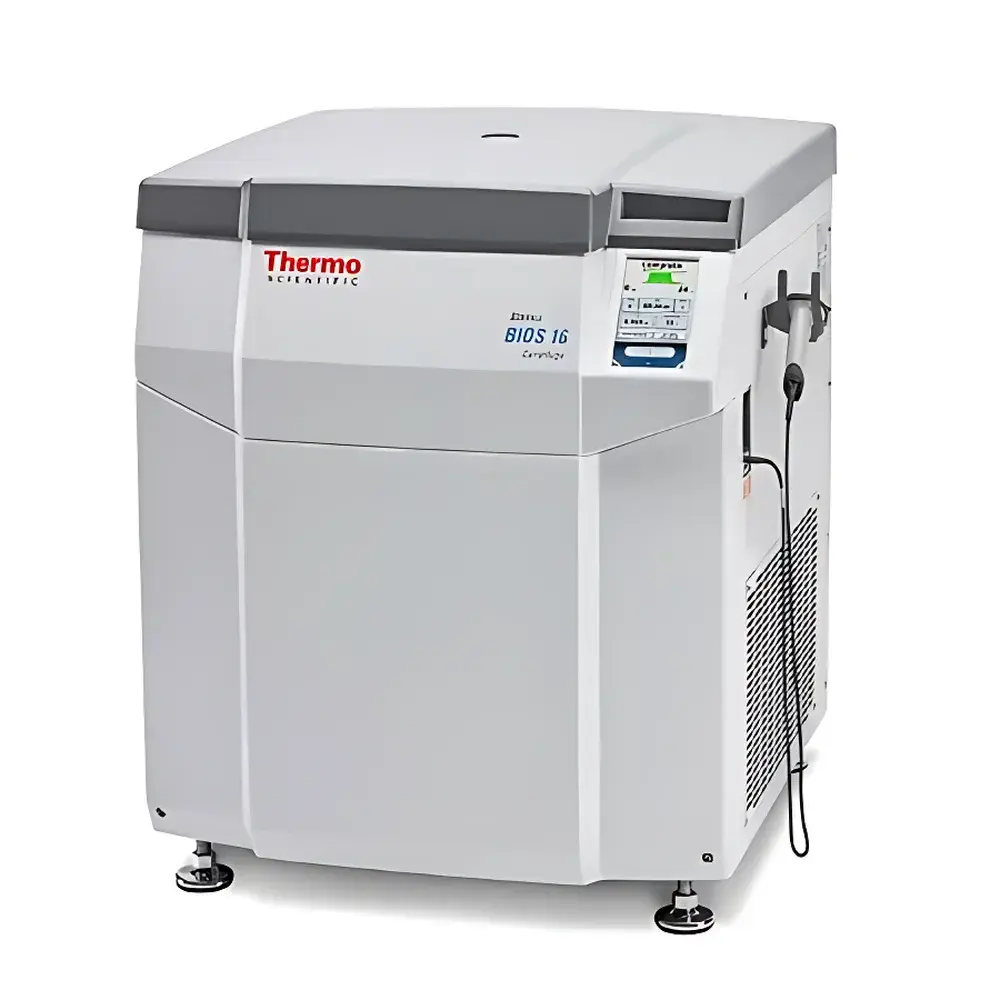
Thermo Scientific Sorvall™ BIOS 16 Biopharmaceutical Centrifuge
| Brand | Thermo Fisher |
|---|---|
| Origin | USA |
| Model | Sorvall™ BIOS 16 |
| Instrument Type | Floor-standing centrifuge |
| Speed Range | High-speed (up to 5400 rpm) |
| Cooling Function | Refrigerated centrifuge |
| Configuration | Horizontal rotor centrifuge |
| Separation Level | Cell/bacterial |
| Max Capacity | 8 × 2000 mL |
| Max Speed | 5400 rpm |
| Max RCF | 8500 × g |
| Dimensions (L×W×H) | 900 mm × 816 mm × 1015 mm |
| Weight | 465 kg |
| Temperature Range | −20 °C to +40 °C (adjustable in 1 °C increments) |
| Certifications | UL, CE, FDA-listed |
| Drive Technology | DuraFlex high-torque brushless motor |
| Control Interface | Centri-Touch™ touchscreen |
| Auto-ID | Yes |
| Auto-Door & Auto-Lid | Yes |
| ACE™ (Automatic Centrifugation Efficiency) Integration | Yes |
| Pre-cooling | Yes |
| Imbalance Tolerance | 125 g (opposite loads) |
| Step Runs | Up to 30 speed/time/temperature triplets, max 3 steps per program |
| Warranty | 2 years (unit), 5 years (powertrain & refrigeration) |
Overview
The Thermo Scientific Sorvall™ BIOS 16 Biopharmaceutical Centrifuge is a purpose-engineered floor-standing refrigerated centrifuge designed for robust, high-volume downstream processing in biopharmaceutical manufacturing and large-scale cell culture workflows. It operates on the principle of sedimentation-based separation under controlled gravitational force (RCF), enabling efficient harvesting, clarification, and primary purification of mammalian cells, microbial biomass, viral vectors, and other bioprocess intermediates. With a maximum capacity of 16 L per run (8 × 2000 mL), the BIOS 16 bridges the gap between laboratory-scale development and pilot- or clinical-scale production—delivering reproducible, scalable, and audit-ready performance without requiring process requalification. Its compact footprint (900 × 816 × 1015 mm) and integrated ergonomic design support seamless integration into GMP-compliant cleanrooms and ISO Class 5–7 environments. The unit complies with IEC 61010-1 (safety) and IEC 61000-6-3 (EMC), and is listed by UL, CE, and the U.S. FDA as a Class II medical device accessory for bioprocessing applications.
Key Features
- DuraFlex™ high-torque brushless drive system ensures long-term mechanical stability, minimal vibration, and precise speed regulation across extended operational cycles (up to 99 h 59 min 59 sec).
- Centri-Touch™ HD touchscreen interface supports glove-compatible operation, multilingual UI (English, German, French, Spanish, Chinese, Japanese), password-protected user accounts, and full audit trail logging—including operator ID, timestamp, parameter changes, and error events.
- Auto-ID™ rotor recognition automatically detects installed rotor type, validates maximum speed/RCF limits, and preloads validated protocols—reducing setup errors and safeguarding sample integrity.
- ACE™ (Automatic Centrifugation Efficiency) algorithm dynamically adjusts runtime based on real-time acceleration profiles and load inertia, ensuring consistent sedimentation outcomes despite minor variations in sample density or viscosity.
- Auto-Door™ and Auto-Lid™ mechanisms synchronize rotor lid positioning with chamber door motion—eliminating manual handling, reducing contamination risk, and improving workflow ergonomics.
- Eco-Spin™ wind-shielded rotors and automatic refrigeration shutoff upon door opening reduce energy consumption by up to 22% during non-operational intervals, supporting sustainability targets without compromising thermal stability.
Sample Compatibility & Compliance
The BIOS 16 accommodates four certified horizontal rotor configurations: 6 × 1000 mL, 8 × 1000 mL, 6 × 2000 mL, and 8 × 2000 mL—all compatible with Thermo Scientific™ Dura-Coat™ nickel-coated buckets for enhanced corrosion resistance and extended service life (>10,000 runs). Rotors are validated per ISO 15189 and ASTM E2500-13 for qualification of analytical instruments in regulated environments. The system supports 21 CFR Part 11-compliant data management when paired with Thermo Fisher Connect™ software, including electronic signatures, role-based access control, and immutable audit logs. All firmware and calibration records are traceable to NIST-traceable standards. The stainless-steel centrifuge chamber meets USP requirements for equipment used in sterile bioprocess operations.
Software & Data Management
Centri-Touch™ firmware includes embedded protocol storage (≥100 methods), on-board training videos, step-run programming (30 multi-step profiles), and real-time imbalance/over-temperature alerts with contextual guidance. Data export is supported via USB 3.0 and optional Ethernet connectivity, generating CSV- or PDF-formatted reports compliant with ALCOA+ principles (Attributable, Legible, Contemporaneous, Original, Accurate, Complete, Consistent, Enduring, Available). When integrated with Thermo Fisher Connect™ Cloud, users gain remote monitoring, predictive maintenance alerts, and automated backup to secure, HIPAA- and GDPR-aligned infrastructure.
Applications
- Harvesting CHO, HEK293, and insect cells from bioreactors (up to 16 L batch volume)
- Clarification of monoclonal antibody (mAb) and recombinant protein harvest streams
- Concentration and recovery of lentiviral and AAV vectors
- Primary isolation of exosomes and extracellular vesicles from conditioned media
- Downstream processing of microbial fermentation broths (E. coli, P. pastoris)
- GMP-compliant QC testing of cell banking and master cell bank (MCB) materials per ICH Q5D
FAQ
What regulatory standards does the Sorvall BIOS 16 meet for use in GMP environments?
It is UL- and CE-certified, FDA-listed, and fully compliant with 21 CFR Part 11 when configured with Thermo Fisher Connect™ software and appropriate access controls.
Can the BIOS 16 be validated for use in a regulated biomanufacturing facility?
Yes—Thermo Fisher provides IQ/OQ documentation packages, DQ templates aligned with ASTM E2500-13, and on-site validation support through certified Field Application Specialists.
Is pre-cooling capability available, and how precisely is temperature controlled?
Pre-cooling is standard; temperature is maintained within ±1 °C across the full range (−20 °C to +40 °C) using dual-stage refrigeration and real-time PID feedback.
How does the ACE™ function improve method reproducibility?
ACE™ continuously monitors rotor acceleration dynamics and adjusts runtime to deliver consistent sedimentation depth—critical for processes where pellet integrity and supernatant clarity must remain invariant across batches.
What is the warranty coverage for critical subsystems?
Two years for the complete instrument; five years for the powertrain (motor, shaft, drive electronics) and refrigeration system—reflecting the platform’s design for >15-year operational service life in continuous bioproduction settings.



