
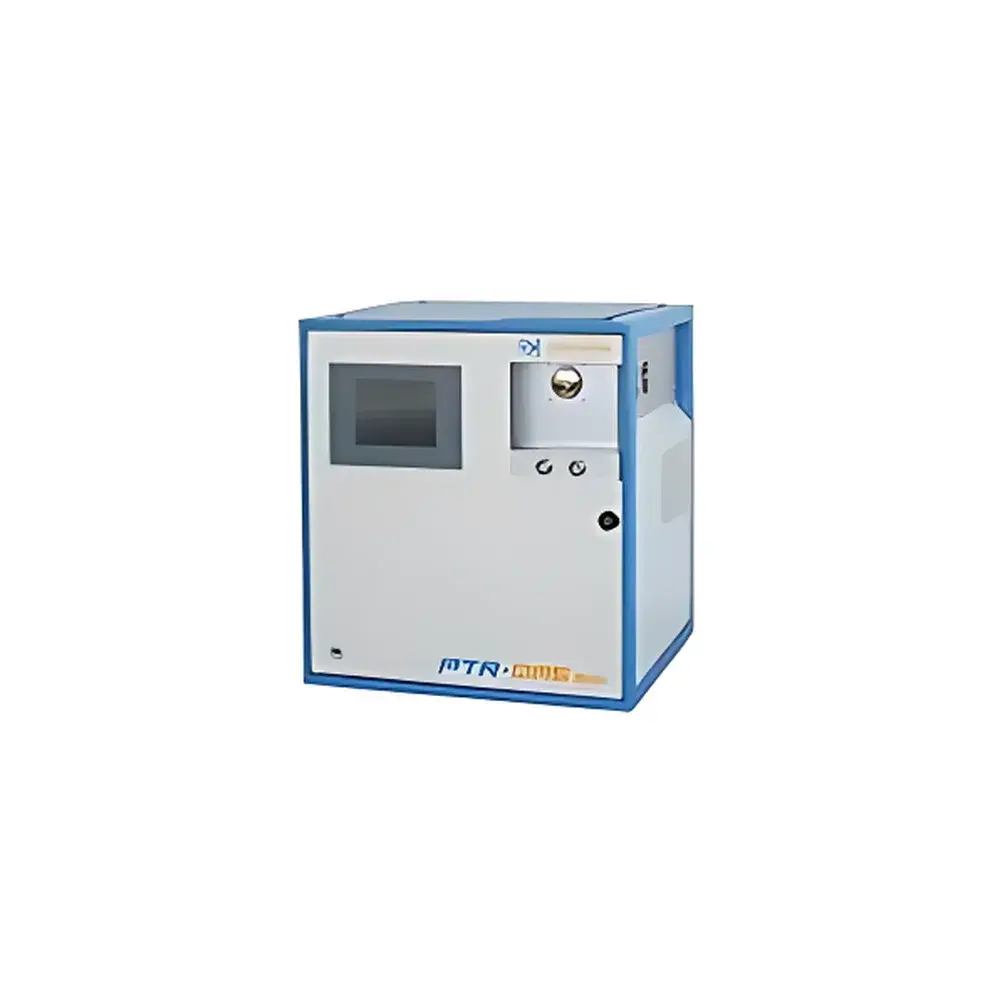
IONICON PTR-QMS 300 Compact Online VOCs Analyzer
| Brand | IONICON Analytik GmbH |
|---|---|
| Origin | Austria |
| Manufacturer Type | Authorized Distributor |
| Import Status | Imported |
| Model | PTR-QMS 300 |
| Price | Upon Request |
| Mass Range | 1–300 amu |
| Resolution | <1 amu |
| Response Time | 100 ms |
| Dwell Time per Mass | 2–60 ms |
| Detection Limit | 500 pptv (for selected VOCs) |
| Linear Dynamic Range | 500 pptv – 10 ppmv |
| Inlet Flow Rate | 50–500 sccm |
| Inlet Heating Range | Up to 150 °C |
| Reaction Chamber Heating Range | 40–130 °C |
| Power Supply | 100–230 V AC, max. 650 W |
| Dimensions (W×H×D) | 61 × 47 × 63 cm |
| Weight | 55 kg |
| Data Interface | Ethernet (RJ-45) |
Overview
The IONICON PTR-QMS 300 is a compact, benchtop-grade online volatile organic compounds (VOCs) analyzer engineered for real-time, quantitative trace gas monitoring in ambient air, industrial process streams, and laboratory research environments. It implements proton-transfer-reaction mass spectrometry (PTR-MS), a soft ionization technique based on the selective reaction of H3O+ reagent ions with VOCs possessing higher proton affinity than water. This enables near-fragment-free ionization, preserving molecular integrity and simplifying spectral interpretation. Unlike conventional GC-MS systems requiring chromatographic separation and sample preconcentration, the PTR-QMS 300 delivers direct, continuous, and calibration-based quantification without derivatization or trapping—making it ideal for dynamic emission studies, odor source identification, and rapid process feedback control.
Key Features
- Proton-transfer-reaction (PTR) ion source coupled with a quadrupole mass filter for high selectivity and robust mass discrimination
- Sub-second temporal resolution: 100 ms full-spectrum response time enables tracking of fast transient emissions (e.g., breath-by-breath analysis, engine start-up transients)
- Ultra-low detection limits down to 500 pptv (parts-per-trillion by volume) for key target VOCs such as formaldehyde, acetaldehyde, isoprene, and monoterpenes under optimized conditions
- Heated inlet system (up to 150 °C) and temperature-controlled reaction chamber (40–130 °C) minimize surface adsorption and ensure quantitative transfer of semi-volatile and polar compounds
- Compact footprint (61 × 47 × 63 cm) and integrated power management (100–230 V AC, ≤650 W) support deployment in mobile labs, cleanrooms, and space-constrained monitoring stations
- Real-time data acquisition via standard Ethernet interface; compatible with time-synchronized networked sensor arrays and SCADA integration
Sample Compatibility & Compliance
The PTR-QMS 300 accepts gaseous samples directly from ambient air, stack effluents, headspace vials, or gas chromatography effluents (with appropriate flow splitting). Its soft ionization mechanism ensures minimal fragmentation across a broad range of oxygenated, aromatic, and terpenoid VOCs—supporting unambiguous compound identification when combined with retention time correlation or isotopic labeling strategies. The instrument complies with ISO 16000-6 for indoor air VOC measurement principles and supports audit-ready operation under GLP and GMP frameworks through timestamped raw data logging, user-access controls, and optional 21 CFR Part 11–compliant software modules. All internal surfaces contacting sample gas are electropolished stainless steel or inert-coated, minimizing memory effects and ensuring long-term stability in demanding field applications.
Software & Data Management
Controlled via IONICON’s proprietary LabVIEW-based TOF-DAQ or PTR-MS Control Suite (v5.x+), the PTR-QMS 300 provides intuitive instrument setup, automated calibration routines, and real-time mass spectral visualization. Raw data files (.bin or .csv) store full mass spectra at user-defined acquisition rates (1–10 Hz), with embedded metadata including temperature, pressure, flow rate, and detector gain. Batch processing tools enable background subtraction, peak integration using Gaussian fitting, and quantification against multi-point external standard curves. Export formats include ASCII, MATLAB (.mat), and netCDF for interoperability with atmospheric chemistry models (e.g., GEOS-Chem, CAMx) and statistical platforms (R, Python pandas). Audit trails record all parameter changes, user logins, and calibration events—meeting requirements for regulatory reporting and third-party validation.
Applications
- Ambient air quality monitoring: Real-time tracking of biogenic and anthropogenic VOCs in urban, rural, and forested environments
- Industrial hygiene and workplace exposure assessment: Continuous monitoring of solvent vapors, cleaning agents, and off-gassing materials
- Food and flavor science: Headspace VOC profiling during fermentation, roasting, and packaging stability testing
- Medical breath research: Non-invasive detection of disease biomarkers (e.g., acetone for diabetes, aldehydes for oxidative stress)
- Environmental process control: Emission verification from wastewater treatment plants, composting facilities, and coating lines
- Research-grade reaction kinetics: Time-resolved study of VOC oxidation pathways in smog chambers and flow reactors
FAQ
Does the PTR-QMS 300 require daily calibration?
No—routine calibration is typically performed weekly using certified gas standards (e.g., NIST-traceable VOC mixtures in nitrogen); drift correction is supported via internal H3O+ signal normalization and periodic zero-air checks.
Can it detect formaldehyde and other highly polar VOCs?
Yes—the heated inlet (up to 150 °C) and controlled reaction chamber temperature prevent condensation and wall losses, enabling reliable quantification of formaldehyde, acetaldehyde, and glyoxal at sub-ppbv levels.
Is the system compatible with existing environmental monitoring networks?
Yes—Ethernet connectivity supports Modbus TCP and custom API integration; output formats align with EN 14625 and EPA Method TO-15/TO-17 data exchange protocols.
What maintenance intervals are recommended?
Ion source cleaning every 3–6 months (depending on sample matrix); quadrupole tuning annually; vacuum pump oil replacement every 6 months; full system performance verification per ISO/IEC 17025 guidelines.
Does it meet EU CE and US FCC electromagnetic compatibility requirements?
Yes—the PTR-QMS 300 carries CE marking per Directive 2014/30/EU (EMC) and 2014/35/EU (LVD), and conforms to FCC Part 15 Class A limits for industrial equipment.




