
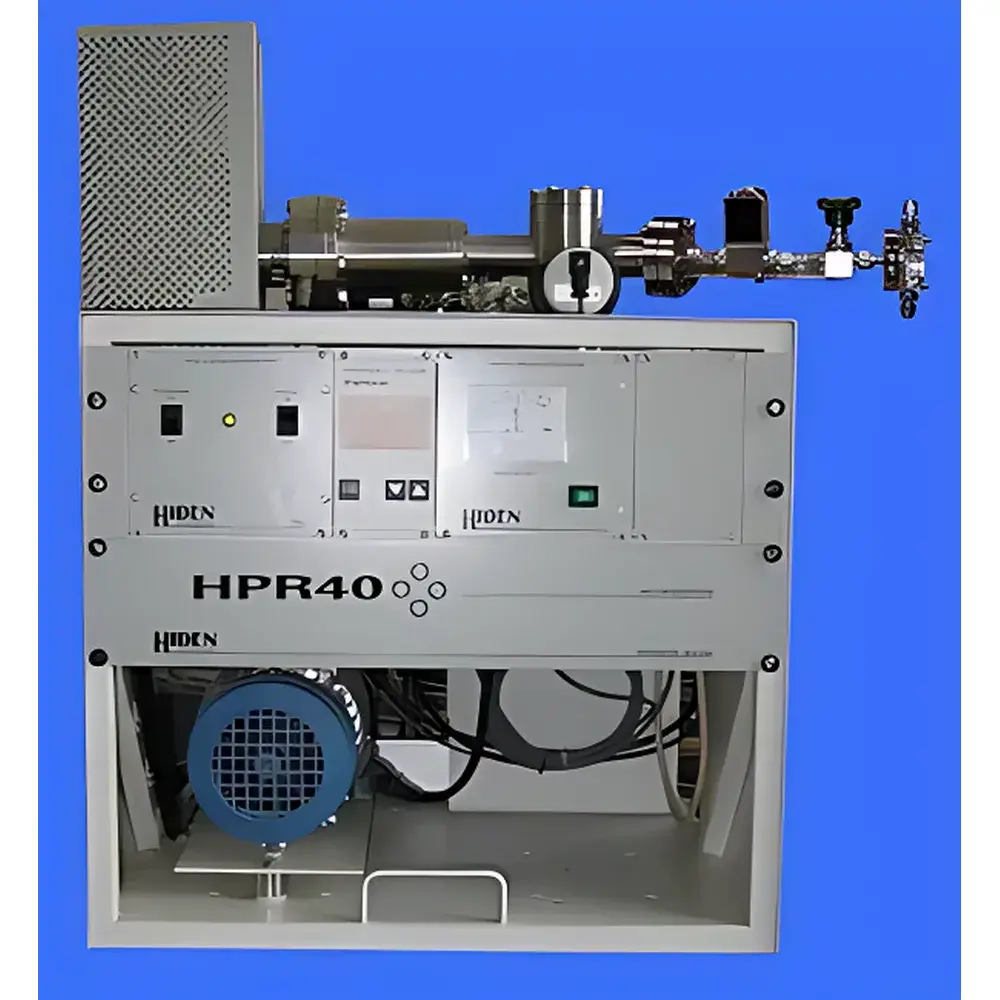
Hiden HPR-40 Membrane Inlet Mass Spectrometer (MIMS)
| Brand | Hiden |
|---|---|
| Origin | United Kingdom |
| Model | HPR-40 |
| Mass Range | 200 / 300 / 510 amu (selectable) |
| Detection Limit | 5 ppb |
| Stability | < ±0.5% peak height over 24 h |
| Ion Source | Liquid Nitrogen-cooled cold trap |
| Inlet Options | 4-channel or 8-channel multiplexed membrane probes |
| Vacuum Protection | Penning gauge + interlock system |
| Control Interface | RS232, RS485, Ethernet LAN |
| Software | MASsoft v6.x |
| Compliance | Designed for GLP/GMP-aligned workflows |
Overview
The Hiden HPR-40 Membrane Inlet Mass Spectrometer (MIMS) is a benchtop process mass spectrometry system engineered for real-time, quantitative analysis of dissolved and headspace gases in liquid-phase and heterogeneous reaction environments. Based on the principle of selective permeation through hydrophobic silicone rubber membranes, the HPR-40 enables direct, non-invasive sampling of volatile and semi-volatile species—including O2, CO2, CH4, H2, N2, NO, N2O, and low-molecular-weight organics—without requiring gas extraction, phase separation, or derivatization. Its core architecture integrates a differentially pumped quadrupole mass analyzer with a temperature-stabilized ion source, liquid nitrogen-cooled cryo-trap, and modular membrane probe interface—delivering high specificity, sub-ppb detection sensitivity, and exceptional signal stability (>24 h) under continuous operation. The system is purpose-built for dynamic, time-resolved monitoring in biogeochemical, electrochemical, fermentation, and environmental research settings where temporal resolution and chemical fidelity are critical.
Key Features
- Three deployment configurations: compact benchtop unit, mobile cart-mounted system, and integrated control console—optimized for lab flexibility and field-deployable operation.
- Selectably configurable mass range options: 200 amu, 300 amu, or 510 amu—enabling coverage from permanent gases to larger organic volatiles and intermediates.
- High-sensitivity membrane probe with integrated silicone rubber permeation layer—designed for rapid equilibration (<30 s response time) and minimal biofouling in aqueous matrices.
- Optional membrane recirculation module for extended-duration experiments—maintaining consistent probe performance during multi-day or week-long monitoring campaigns.
- Dual-stage vacuum protection: Penning cold cathode gauge coupled with hardware interlocks ensures automatic valve closure upon overpressure events or probe failure.
- Liquid nitrogen-cooled ion source cold trap—reduces background hydrocarbon interference, suppresses water cluster formation, and improves signal-to-noise ratio for trace analytes.
- Vacuum manifold isolation valve—enables remote, rapid system venting and probe servicing without breaking main chamber vacuum.
- Multi-probe inlet capability: 4-channel or 8-channel multiplexed configuration supports parallel sampling from multiple reactors, wells, or environmental zones.
Sample Compatibility & Compliance
The HPR-40 is validated for direct interfacing with aqueous, slurry, and semi-solid samples across pH 3–10 and temperatures up to 60 °C. It complies with ISO/IEC 17025 principles for analytical instrument validation and incorporates design elements aligned with Good Laboratory Practice (GLP) and Good Manufacturing Practice (GMP) frameworks. MASsoft software provides full 21 CFR Part 11 compliance—including electronic signatures, role-based user permissions, automated audit trails, and data integrity safeguards. System calibration protocols support traceability to NIST-traceable gas standards, and routine performance verification aligns with ASTM D6348 (for dissolved gas analysis in water) and ISO 15681-2 (for nutrient and gas monitoring in aquatic systems).
Software & Data Management
MASsoft v6.x is a dedicated, Windows-based acquisition and analysis platform offering real-time spectral visualization, quantitative peak integration, time-series trending, and automated calibration curve generation. It supports synchronized acquisition from multiple probes, programmable scan sequences (e.g., dwell-time optimization per mass), and export to CSV, ASCII, or HDF5 formats for downstream statistical modeling (e.g., PCA, PLS regression). Data security features include encrypted local storage, configurable backup intervals, and metadata tagging for experimental context (temperature, flow rate, probe ID, operator). Remote access via Ethernet allows centralized monitoring across distributed lab networks—critical for multi-site environmental studies or bioreactor farms.
Applications
- Environmental geochemistry: Real-time quantification of CH4, CO2, and N2O fluxes in soils, sediments, and groundwater plumes.
- Fermentation and bioprocess monitoring: Online tracking of metabolic off-gases (O2, CO2, ethanol, acetate) in microbial and yeast cultures.
- Electrochemical research: Differential Electrochemical Mass Spectrometry (DEMS) for identifying reaction intermediates during battery cycling, fuel cell operation, and electrolyzer testing.
- Aquatic ecosystem assessment: Dissolved gas profiling in rivers, reservoirs, and wastewater treatment lagoons to evaluate nitrification/denitrification kinetics.
- Microbial metabolism studies: Enzyme kinetics and substrate utilization assays via headspace gas evolution under controlled anaerobic/aerobic conditions.
- Biohydrogen production: Quantitative monitoring of H2 yield, purity, and co-product formation (e.g., CO, CH4) in photobiological and dark-fermentative systems.
FAQ
What types of samples can be analyzed directly with the HPR-40 MIMS?
Aqueous solutions, slurries, soil pore water, fermentation broths, and electrochemical cell electrolytes—provided the target analytes are membrane-permeable volatiles (typically 1.5).
Is calibration required before each analysis?
A full multi-point calibration is recommended prior to campaign initiation or after hardware maintenance; however, daily drift correction is achieved via internal reference gas pulses or stable background peaks (e.g., N2, O2).
Can the HPR-40 operate unattended for extended periods?
Yes—its thermal and vacuum stability, automated fault recovery (e.g., valve shutdown on probe failure), and MASsoft scheduler enable fully autonomous operation over 72+ hours with scheduled calibration and data export.
How does the liquid nitrogen cold trap improve analytical performance?
It condenses water vapor and polar organics upstream of the mass analyzer, reducing spectral interference, improving vacuum integrity, and enhancing sensitivity for low-abundance analytes such as NO or formaldehyde.
Does the system support regulatory-compliant reporting for environmental submissions?
MASsoft generates compliant reports with embedded metadata, electronic signatures, and version-controlled audit logs—meeting EPA Method 8260D, ISO 17025 documentation requirements, and EU Water Framework Directive reporting templates.





