
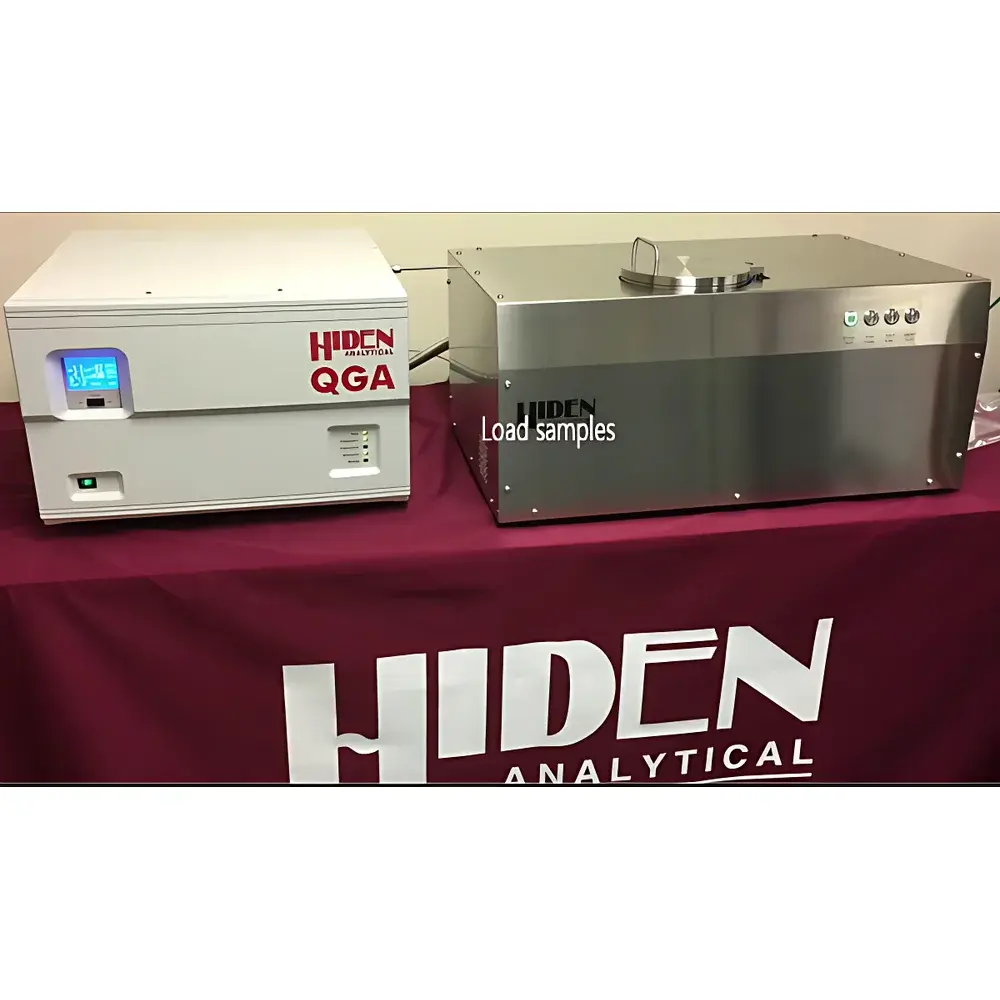
Hiden LAS Leak Analysis System
| Brand | Hiden |
|---|---|
| Origin | United Kingdom |
| Manufacturer Type | Authorized Distributor |
| Origin Category | Imported |
| Model | LAS |
| Pricing | Available Upon Request |
Overview
The Hiden LAS Leak Analysis System is a high-sensitivity, vacuum-based mass spectrometry (MS) platform engineered specifically for quantitative leak rate measurement in lithium-ion battery cells and modules. It operates on the principle of helium mass spectrometry—using helium as a tracer gas and detecting its partial pressure rise within a sealed test chamber via a quadrupole mass spectrometer. This method delivers trace-level detection capability essential for validating hermetic integrity in electrochemical energy storage devices. With a verified detection limit of <1 × 10⁻⁷ mbar·L/s, the LAS system meets the stringent requirements defined by international battery safety standards—including IEC 62660-1, UL 1642, and ISO 12100—where leakage thresholds below 1 × 10⁻⁶ mbar·L/s are mandated to prevent moisture ingress, electrolyte evaporation, or oxygen-induced side reactions.
Key Features
- Automated Test Sequencing: Fully programmable cycle control—from chamber evacuation and helium spray application to signal acquisition and pass/fail evaluation—enabling unattended operation across production shifts.
- High-Throughput Capability: Supports batch testing of up to 12 mid-size pouch or cylindrical cells per run using configurable multi-port manifold architecture; average test time per unit is under 90 seconds.
- Non-Destructive & Dry Testing Methodology: No solvent exposure, thermal stress, or internal pressure cycling; preserves cell integrity and avoids false positives from mechanical deformation or electrolyte displacement.
- Ultra-High Sensitivity Detection: Quadrupole mass spectrometer with optimized ion optics and low-noise electronics achieves stable baseline resolution at 4 amu (helium), enabling reliable quantification down to 5 × 10⁻⁸ mbar·L/s under controlled ambient conditions.
- In-Situ Calibration Support: Integrated reference leak port accepts certified standard leaks (e.g., 1 × 10⁻⁷, 1 × 10⁻⁸ mbar·L/s) for traceable calibration per ISO/IEC 17025 guidelines; calibration logs are timestamped and exportable for audit trails.
Sample Compatibility & Compliance
The LAS system accommodates a wide range of lithium battery formats—including cylindrical (18650, 21700), prismatic, and pouch cells—within its standard vacuum chamber (internal volume: 12 L, max. sample height: 150 mm). Fixturing options support both bare cells and assembled modules with integrated busbars or cooling plates. All hardware and software comply with CE marking directives (EMC Directive 2014/30/EU, Low Voltage Directive 2014/35/EU) and meet electromagnetic compatibility requirements for laboratory and cleanroom environments (Class B per EN 55011). Data handling adheres to ALCOA+ principles (Attributable, Legible, Contemporaneous, Original, Accurate, Complete, Consistent, Enduring, Available) and supports 21 CFR Part 11-compliant electronic signatures when deployed with validated LIMS integration.
Software & Data Management
Hiden’s proprietary LAS Control Suite provides intuitive workflow management through a Windows-based GUI. Real-time spectral visualization, automatic peak integration at m/z = 4, and dynamic background subtraction ensure robust signal-to-noise performance. Test results—including raw MS signals, calculated leak rates, environmental parameters (chamber temperature, base pressure), and operator ID—are stored in encrypted SQLite databases with optional network backup. Export functions support CSV, PDF, and XML formats compliant with ASTM E2500-13 for equipment qualification documentation. Audit trail functionality records all user actions, parameter changes, and calibration events with immutable timestamps—fully aligned with GLP and GMP quality systems.
Applications
- Final seal verification of dry-room-assembled lithium-ion cells prior to electrolyte filling
- Post-welding validation of aluminum/copper can seams and lid welds in cylindrical and prismatic designs
- Quality gate screening during module assembly to detect micro-leaks at busbar interface seals
- R&D investigations into packaging material permeability (e.g., Al-laminated pouch films) under thermal cycling stress
- Root cause analysis of field failures linked to moisture contamination (Karl Fischer correlation studies)
- Process capability assessment (Cpk) of sealing equipment across multiple production lines
FAQ
What tracer gas is used—and why helium?
Helium is selected due to its inertness, low atmospheric concentration (~5 ppm), small atomic mass (4 amu), and high diffusivity—enabling rapid penetration through sub-micron defects while minimizing interference from background gases.
Can the LAS system detect leaks in fully charged or electrolyte-filled cells?
Yes—provided cells remain mechanically intact and operate within safe voltage limits (<4.3 V); no electrical isolation is required as the test is purely pneumatic and non-invasive.
Is external helium supply mandatory?
A regulated helium source (Grade 5.0, dew point ≤ −70 °C) is required; onboard gas handling includes precision mass flow controllers and automated purge cycles to minimize consumption.
How does the LAS system handle ambient humidity fluctuations?
Integrated environmental monitoring (temperature, relative humidity, barometric pressure) feeds real-time compensation algorithms into leak rate calculations—ensuring metrological consistency across varying lab conditions.
Does the system support IQ/OQ/PQ documentation packages?
Yes—Hiden provides vendor-validated qualification protocols and templates aligned with ASTM E2500-13 and EU Annex 15, including risk assessments, URS mapping, and test scripts for full lifecycle compliance.





