
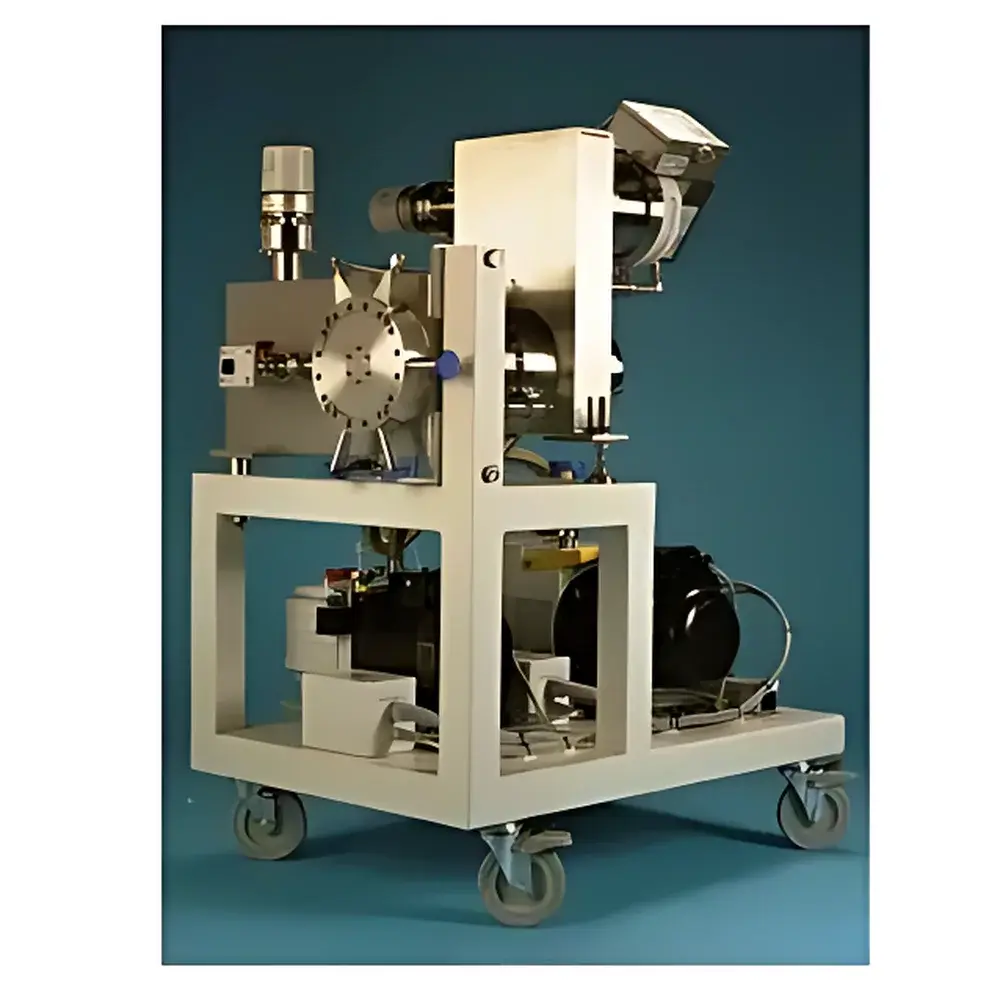
Hiden SpaciMS Spatially Resolved Mass Spectrometer
| Brand | Hiden |
|---|---|
| Origin | Austria |
| Model | SpaciMS |
| Inlet Channels | 16 |
| Axial Travel Range | 0–300 mm |
| Spatial Resolution | 0.1 mm |
| Application Domain | Catalytic Reactor Process Monitoring, Transient Gas Analysis, 3D Gas Composition Mapping |
Overview
The Hiden SpaciMS Spatially Resolved Mass Spectrometer is the world’s first commercially available instrument engineered to deliver true spatial and temporal resolution in gas-phase chemical analysis within heterogeneous reaction environments. Unlike conventional mass spectrometers that rely on single-point sampling, the SpaciMS employs a precision-engineered, motorized multi-channel probe assembly capable of programmable axial (Z-axis) translation and radial positioning—enabling real-time, non-intrusive mapping of gas composition and temperature gradients inside catalytic reactors, fixed-bed systems, and other confined process vessels. Its core measurement principle integrates quadrupole mass spectrometry with spatially encoded sampling, where ion currents are correlated to physical probe coordinates and synchronized thermocouple readings. This architecture supports quantitative, time-resolved analysis of transient species (e.g., CO, NOx, NH3, hydrocarbons) under dynamic operating conditions—critical for catalyst development, reactor optimization, and kinetic modeling in industrial R&D laboratories.
Key Features
- 16 independently addressable gas inlet channels, each equipped with individually controllable micro-valves and pressure-regulated flow paths for sequential or parallel sampling
- Z-axis motorized drive with 0.1 mm positional repeatability over a 300 mm travel range, enabling high-fidelity axial profiling without mechanical recalibration
- Integrated K-type thermocouple embedded at the probe tip for simultaneous in-situ temperature measurement at each sampling location
- Low-volume, low-dead-volume sampling capillaries (<5 µL internal volume per channel) minimize residence time and preserve transient species integrity
- Rugged stainless-steel probe housing rated for operation up to 800 °C ambient and compatible with vacuum-tight reactor flanges (CF-35/CF-50 standard)
- Fully software-synchronized acquisition: mass spectra, position data, and temperature timestamps are co-registered at sub-second intervals
Sample Compatibility & Compliance
The SpaciMS is designed for direct integration into laboratory-scale and pilot-plant catalytic test rigs—including monolith, pellet-packed, and wall-coated reactors. It accommodates reactive, corrosive, and condensable gas mixtures typical of automotive exhaust, Fischer–Tropsch synthesis, ammonia oxidation, and selective catalytic reduction (SCR) processes. All wetted materials conform to ASTM F899 stainless steel specifications; electrical interfaces comply with IEC 61000-6-4 (EMC) and IEC 61000-6-2 (immunity). The system supports GLP-compliant operation through audit-trail-enabled software logging (per FDA 21 CFR Part 11 requirements), including user access control, electronic signatures, and immutable raw data archiving.
Software & Data Management
Control and analysis are performed via Hiden’s proprietary QGA (Quantitative Gas Analysis) software suite, which provides real-time visualization of 2D/3D concentration isosurfaces, axial concentration profiles, and time-series overlays. The software supports automated method sequencing (e.g., “scan entire bed at 5 mm intervals every 2 s”), background subtraction using reference channel interpolation, and calibration against NIST-traceable gas standards. Export formats include CSV, HDF5, and MATLAB-compatible .mat files. Data structures adhere to ISA-88/ISA-95 metadata conventions for seamless integration with LIMS and MES platforms in regulated manufacturing environments.
Applications
- Mapping axial and radial distributions of intermediates and products in diesel oxidation catalysts (DOC) and lean NOx traps (LNT)
- Validating computational fluid dynamics (CFD) and microkinetic models with experimental 3D species concentration fields
- Studying coke formation dynamics and oxygen mobility in reforming catalysts under cyclic redox conditions
- Monitoring cold-start emissions behavior in close-coupled catalytic converters
- Quantifying steam-to-carbon ratios and cracking product evolution in fluid catalytic cracking (FCC) riser simulators
FAQ
How does SpaciMS differ from conventional process mass spectrometers?
Conventional online MS systems use fixed probes or multiplexed valves with shared sample lines—introducing lag, cross-contamination, and spatial averaging. SpaciMS eliminates these limitations by physically moving the probe tip with micron-level accuracy while maintaining continuous vacuum integrity and thermal equilibrium.
Can SpaciMS operate under high-pressure reactor conditions?
Yes—the sampling manifold includes pressure-reduction stages and heated transfer lines, supporting inlet pressures up to 30 bar (gauge) with optional high-pressure interface kits.
Is calibration traceable to international standards?
All quantitative calibrations are performed using certified gas mixtures traceable to NIST SRMs, with documented uncertainty budgets compliant with ISO/IEC 17025 requirements.
What reactor geometries are supported?
Standard configurations support cylindrical reactors with internal diameters from 10 mm to 100 mm; custom probe lengths and angular offsets are available for non-cylindrical or multi-zone reactors.
Does the system support remote operation and integration with PLCs?
Yes—QGA software provides OPC UA and Modbus TCP interfaces for bidirectional communication with Siemens, Rockwell, and Beckhoff PLCs, enabling fully automated reactor characterization campaigns.






