
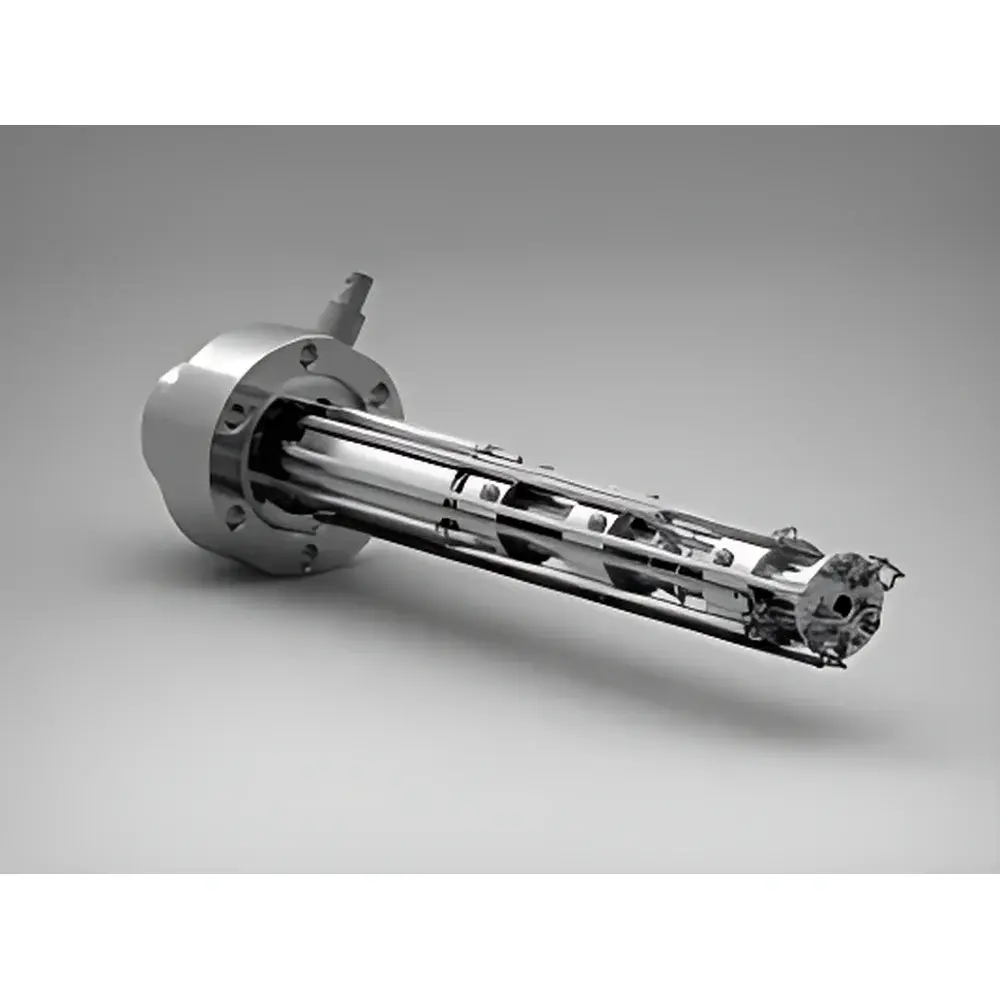
Hiden qRGA Residual Gas Analyzer for Tokamak Fusion Devices
| Brand | Hiden |
|---|---|
| Origin | United Kingdom |
| Model | qRGA |
| Mass Range | 1–200 amu |
| Ionization Mode | Threshold Ionization Mass Spectrometry (TIMS) |
| Electron Energy Resolution | 0.1 eV |
| Soft Ionization Range | 0–150 eV |
| Long-Term Stability | < ±0.5% peak height drift over 24 h |
| Detection Limit | ppm-level quantification |
| Shielding | Integrated radiation and magnetic shielding |
| Operational Mode | Dual-mode (conventional scanning + TIMS) |
Overview
The Hiden qRGA Residual Gas Analyzer is a compact, high-stability quadrupole mass spectrometer engineered specifically for real-time, in-situ gas composition monitoring in nuclear fusion research environments—particularly within tokamak vacuum systems. Operating on the principle of quadrupole mass filtering coupled with electron ionization (EI), the qRGA supports both standard mass scanning and Threshold Ionization Mass Spectrometry (TIMS), a selective ionization technique that exploits precise control of electron emission energy to discriminate between isotopes with near-identical mass-to-charge ratios—such as deuterium (D₂, m/z = 4) and helium-4 (⁴He, m/z = 4). This capability is critical for fuel cycle management, impurity tracking, and plasma-wall interaction studies where unambiguous isotopic identification directly informs operational safety and confinement performance.
Key Features
- Dual operational modes: simultaneous support for conventional full-scan mass analysis and TIMS mode with programmable electron energy control (0–150 eV in 0.1 eV increments)
- High electron energy resolution of 0.1 eV enables selective ionization of D₂ while suppressing ⁴He fragmentation overlap—essential for accurate deuterium recovery efficiency assessment
- Integrated radiation-hardened electronics and mu-metal magnetic shielding ensure stable operation in high-background neutron and magnetic field environments typical of tokamak experimental halls
- Long-term signal stability: ≤ ±0.5% peak height variation over 24-hour continuous acquisition under constant vacuum and temperature conditions
- Compact, bakeable (≤200 °C) stainless-steel construction compatible with UHV (<1×10⁻⁸ mbar) tokamak port interfaces
- Low-power, air-cooled design minimizes thermal load and infrastructure requirements in constrained diagnostic spaces
Sample Compatibility & Compliance
The qRGA is optimized for direct coupling to tokamak vacuum lines via standard CF-63 or ISO-KF 40 flanges. It analyzes neutral gas species without sample preparation—supporting reactive (e.g., H₂, D₂, T₂, H₂O, CO, CH₄), inert (He, Ne, Ar), and corrosive gases (O₂, N₂, air residuals) commonly encountered during plasma discharge, wall conditioning (glow discharge cleaning), and cryopump regeneration cycles. The instrument complies with IEC 61000-6-2 (immunity) and IEC 61000-6-4 (emissions) for electromagnetic compatibility in industrial research facilities. Its hardware architecture and firmware meet foundational requirements for integration into safety-critical diagnostics per IAEA Safety Standards Series No. SSG-59 (Nuclear Fusion Research Facilities), and its analog/digital signal chain supports traceable calibration per ISO/IEC 17025 when operated within an accredited laboratory quality system.
Software & Data Management
Control and data acquisition are managed via Hiden’s QGA software suite, a Windows-based platform supporting real-time spectral display, multi-channel time-series logging (≥1 kHz sampling), and automated sequence scripting for scheduled mass scans or TIMS sweeps. All raw data—including detector voltage, electron energy, lens voltages, and timestamped spectra—are stored in HDF5 format with embedded metadata (instrument ID, calibration date, operator tag, vacuum pressure). Audit trails record all parameter changes, user logins, and method executions—enabling compliance with GLP and GMP-aligned documentation practices. Export options include CSV, ASCII, and MATLAB-compatible .mat files; APIs (COM/ActiveX) allow integration with EPICS, LabVIEW, or Python-based control frameworks used in fusion facility central control systems.
Applications
- Real-time monitoring of deuterium recycling and helium ash accumulation during plasma discharges
- Quantification of water vapor and hydrocarbon outgassing from first-wall materials (e.g., tungsten, beryllium, carbon-fiber composites)
- In-situ validation of cryopump regeneration efficiency and getter pump saturation thresholds
- Leak detection and localization using tracer gases (e.g., He sniffer mode at m/z = 4)
- Gas injection system verification for fuelling (pellet injection, puffing) and impurity seeding (Ne, Ar, N)
- Post-discharge residual gas analysis for wall conditioning feedback and tritium inventory estimation (when deployed in D–T experimental phases)
FAQ
Is the qRGA suitable for tritium (T₂) detection in future D–T campaigns?
Yes—the mass range extends to 200 amu and includes m/z = 6 (T₂), with TIMS mode enabling discrimination from interfering species such as HD⁺ or C²⁺ fragments when operated with appropriate energy tuning and mass calibration.
Can the qRGA be integrated into existing tokamak control systems (e.g., EPICS)?
Yes—QGA software provides native EPICS IOC support and offers DLL-based programmatic access for custom integration with facility-wide control networks.
What vacuum interface options are available?
Standard configurations include CF-63, ISO-KF 40, and DN 100 ConFlat flanges; custom feedthroughs for differential pumping stages or RF-shielded cabling are available upon request.
Does the instrument require periodic recalibration?
Mass scale calibration is stable for ≥12 months under normal operating conditions; sensitivity calibration is recommended every 6 months using certified gas standards traceable to NIST SRM 1683a.
How is radiation damage mitigated in long-pulse tokamaks?
The analyzer uses radiation-tolerant components including ceramic-insulated electrodes, hardened CMOS detectors, and localized lead–copper shielding; lifetime degradation testing confirms >5 years operational integrity at neutron fluences up to 1×10¹³ n/cm² (E > 0.1 MeV).






