
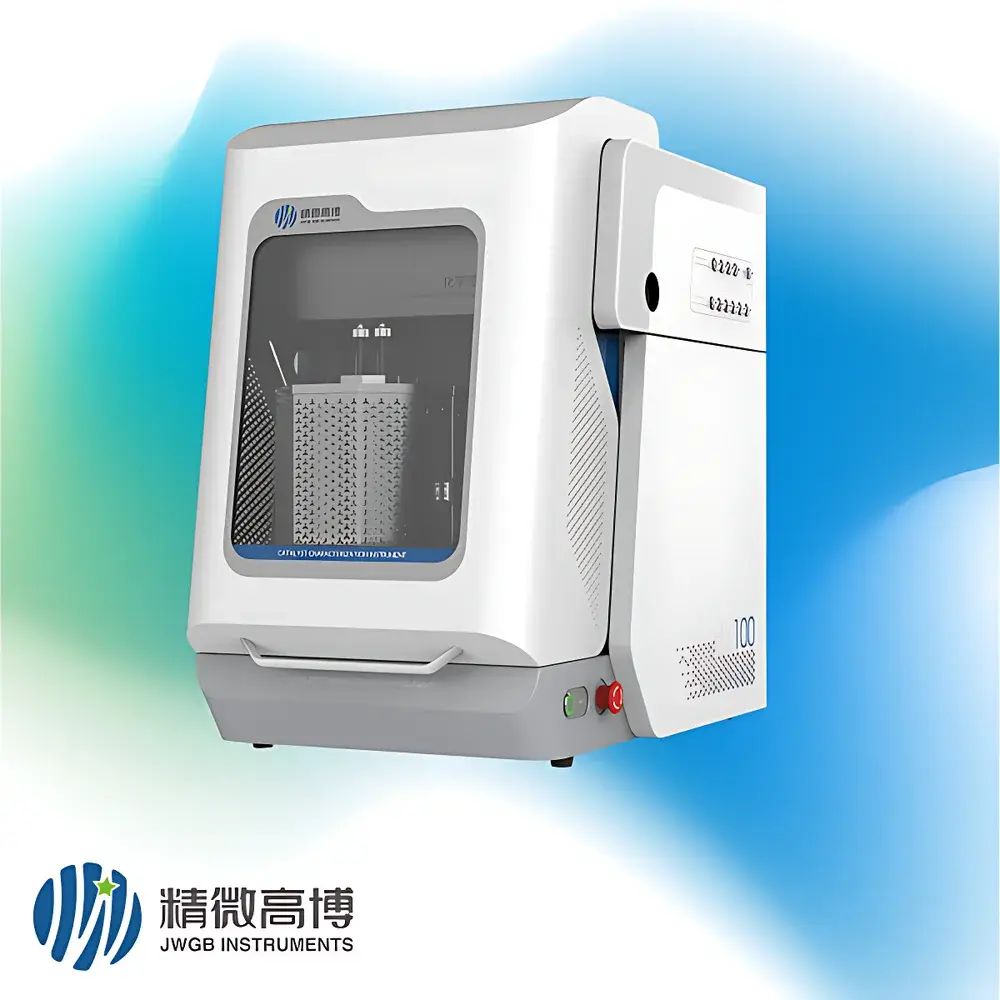
JWGB HX-100 Basic Chemisorption Analyzer
| Brand | JWGB |
|---|---|
| Origin | Beijing, China |
| Manufacturer Type | Direct Manufacturer |
| Product Category | Domestic |
| Model | HX-100 Basic Chemisorption Analyzer |
| Instrument Type | Chemisorption Analyzer |
| Measurement Principle | Continuous Flow Method |
| Gas Inlet Ports | Expandable to 12 |
| Heating Temperature Range | Ambient to 1200°C |
| Isothermal Stability | ±0.01°C |
| Ramp Rate | 1–50°C/min |
| Pressure Range | Atmospheric to 30 bar (optional up to 100 bar) |
| Analytical Functions | TPR, TPO, TPD, TPSR, Pulse Chemisorption, Pulse Calibration, Dynamic BET Surface Area |
| Sample Capacity | 0.1–1 g |
| Analysis Stations | 1 |
| Cooling Method | Forced-air rapid cool-down |
| Detection System | High-stability 4-filament TCD (Re-W wire, 200°C heated) |
| Gas Flow Control | 2–100 mL/min |
| Sample Tube Options | Quartz U-tube or bubble tube |
| Tubing Material | 316 stainless steel, 1/16″ OD |
| System Dead Volume | Minimized via low-volume valves and heated manifold |
| Cold Trap | Integrated desiccant trap downstream of sample tube |
| Quantitative Loop | Precision-calibrated pulse injection port |
| Low-Temp Option | –100°C to 1200°C (with cryo-cooler) |
| Dimensions | 43 × 64 × 62 cm (W × H × D) |
Overview
The JWGB HX-100 Basic Chemisorption Analyzer is a fully automated, benchtop-scale catalytic characterization system engineered for precision and operational efficiency in academic, industrial, and quality control laboratories. It operates on the continuous flow principle—where reactive gases are dynamically introduced over a catalyst bed under precisely controlled temperature, pressure, and flow conditions—enabling quantitative assessment of surface adsorption/desorption kinetics, active site density, and redox behavior. Unlike static volumetric systems, the HX-100’s flow-based architecture delivers high temporal resolution during transient experiments such as temperature-programmed desorption (TPD), reduction (TPR), oxidation (TPO), and surface reaction (TPSR). Its compact footprint (43 × 64 × 62 cm), single-analysis-station configuration, and modular thermal management make it particularly suited for labs requiring routine catalyst screening without sacrificing metrological integrity. The instrument integrates a 1200°C programmable furnace with ±0.01°C isothermal stability and ramp rates adjustable from 1 to 50°C/min—ensuring reproducible thermal protocols compliant with ASTM D7212 (for TPD), ISO 18385 (catalyst characterization), and IUPAC-recommended temperature-programmed methodologies.
Key Features
- Thermal Control Architecture: Dual-zone heated manifold with full insulation; all valves, fittings, and transfer lines maintained at constant temperature (up to 200°C) to prevent condensation and minimize memory effects.
- High-Fidelity Detection: Four-filament tungsten-rhenium TCD detector with independent heater control (200°C setpoint), delivering linear response across wide concentration ranges and long-term baseline stability essential for quantitative pulse titration.
- Modular Gas Handling: Base configuration supports six analysis gas inlets and four pulse gas lines; expandable to twelve total gas ports via field-installable manifold modules—enabling multi-step pretreatment sequences (e.g., calcination → reduction → adsorption → desorption) without manual intervention.
- Rapid Thermal Cycling: Forced-air cooling system reduces furnace cooldown time by >60% versus passive methods; enables back-to-back experiments within standardized turnaround windows required for GLP-compliant catalyst batch testing.
- Low-Dead-Volume Design: 1/16″ stainless-steel tubing, micro-bore solenoid valves, and integrated zero-volume calibration station ensure minimal peak dispersion and accurate retention time alignment—critical for kinetic modeling of surface processes.
- Safety-First Engineering: Independent furnace overtemperature cutoff, redundant pressure relief valves, check valves on all gas lines, TCD dry-burn protection circuitry, and real-time gas leak monitoring per ISO 10156 standards.
Sample Compatibility & Compliance
The HX-100 accommodates heterogeneous catalysts in powder, pellet, or extrudate form (0.1–1 g loading) using standard quartz U-tubes or bubble tubes—compatible with corrosive, reducing, and oxidizing atmospheres including H₂, O₂, CO, NH₃, NOₓ, and hydrocarbon mixtures. Its pressure rating extends from ambient to 30 bar (optional 100 bar upgrade), supporting high-pressure chemisorption studies aligned with industrial Fischer–Tropsch or ammonia synthesis conditions. All wetted materials—including 316 stainless-steel gas paths, Kalrez® seals, and high-purity quartz reactors—meet USP Class VI biocompatibility requirements and are certified for use in GMP-regulated environments. Data acquisition and reporting comply with FDA 21 CFR Part 11 through optional audit-trail-enabled software licensing, while thermal programming adheres to ASTM E1142 and ISO/IEC 17025 traceability frameworks.
Software & Data Management
JWGB’s proprietary ChemiSoft™ v4.2 provides intuitive, module-driven experiment sequencing: “Treatment” (for calcination/reduction), “TPD” (with derivative peak deconvolution), “Pulse” (for metal dispersion and active site quantification), and “Dynamic BET” (multi-point flow-based surface area estimation). Users define up to 99 temperature/flow/pressure segments per method, with real-time plotting of TCD voltage, thermocouple output, and mass flow controller readings. Raw data are stored in HDF5 format with embedded metadata (operator ID, timestamp, calibration history), supporting post-acquisition reprocessing and third-party integration via Python API. Export options include CSV, Excel, and ASTM E1572-compliant PDF reports—with optional digital signature and electronic record archiving for regulatory submissions.
Applications
- Quantification of metallic dispersion and active surface area in supported Pt, Pd, Ni, and Co catalysts via H₂ or CO pulse chemisorption.
- Acid site strength distribution analysis in zeolites and aluminosilicates using NH₃-TPD.
- Redox behavior mapping of transition metal oxides (e.g., CeO₂, V₂O₅) via H₂-TPR and O₂-TPO.
- Kinetic parameter extraction (activation energy, pre-exponential factor) from Arrhenius plots of desorption peaks.
- In situ pretreatment validation prior to catalytic activity testing in fixed-bed or microreactor systems.
- Stability assessment of catalysts under cyclic thermal stress (e.g., automotive three-way catalyst aging protocols).
FAQ
What pretreatment gases are supported?
The system supports H₂, O₂, He, Ar, N₂, CO, CO₂, NH₃, NO, SO₂, and custom gas blends—subject to compatibility with TCD filament chemistry and system pressure rating.
Can the HX-100 be interfaced with a mass spectrometer or GC?
Yes—standardized 6 mm vacuum flange and analog/digital signal outputs allow seamless coupling to external MS or GC systems for speciated effluent analysis.
Is low-temperature operation available?
An optional cryogenic cooling unit extends the operating range to –100°C, enabling studies of weakly adsorbed species (e.g., CO₂ on amine-functionalized sorbents) and cryo-TPD protocols.
How is calibration performed for pulse injections?
A dedicated quantitative loop station isolates the calibration volume from the reactor zone, eliminating sample contact during loop charging—ensuring stoichiometric accuracy per ISO 15901 Annex C.
Does the software support automated report generation for regulatory audits?
With the Compliance Edition license, ChemiSoft™ generates 21 CFR Part 11–compliant reports featuring electronic signatures, change logs, and immutable audit trails—validated for use in pharmaceutical and fine chemical QA/QC workflows.



