
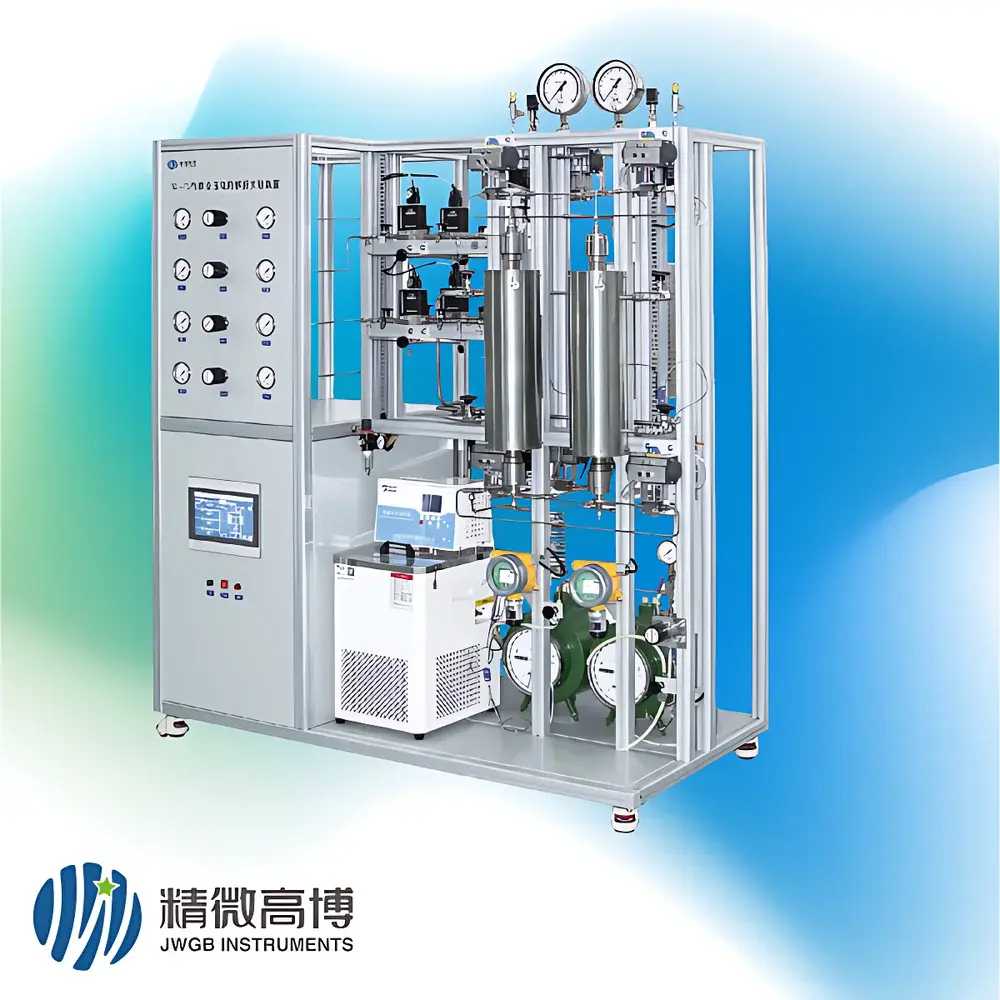
JWGB Custom-Built Variable-Temperature/Variable-Pressure Adsorption/Desorption Apparatus
| Brand | JWGB |
|---|---|
| Origin | Beijing, China |
| Manufacturer | JWGB Instrument Co., Ltd. |
| Type | Custom-Built Benchtop Microreactor System |
| Reactor Configuration | Tubular |
| Operating Pressure | High-Pressure |
| Volume Class | Small-Scale |
| Compliance | Designed for ASTM D3663, ISO 15901-2, and IUPAC physisorption/chemisorption methodology |
Overview
The JWGB Custom-Built Variable-Temperature/Variable-Pressure Adsorption/Desorption Apparatus is a purpose-engineered benchtop microreactor system designed for quantitative characterization of gas–solid interfacial interactions under precisely controlled thermodynamic conditions. Based on the μBenchCAT platform originally conceptualized by AMI Instruments (USA) and manufactured in Beijing by JWGB Instrument Co., Ltd., this apparatus implements gravimetric or volumetric (manometric) measurement principles—configurable per application—to determine adsorption isotherms, desorption hysteresis, surface area (BET), pore size distribution (DFT/NLDFT), and heat of adsorption (via van’t Hoff analysis across temperature series). Its core architecture supports dynamic and equilibrium-based protocols under inert, reducing, oxidizing, or reactive gas atmospheres—including H₂, CO, CO₂, NH₃, O₂, and hydrocarbons—at pressures ranging from ultra-high vacuum (UHV) to 20 MPa (200 bar), with temperature control spanning –196 °C (liquid nitrogen) to +800 °C using integrated furnace or cryostat modules.
Key Features
- Modular high-pressure tubular reactor core constructed from 316L stainless steel or Inconel 600, rated to 20 MPa and compatible with aggressive process gases.
- Independent dual-zone temperature control: one zone for sample bed (±0.1 °C stability), another for downstream lines and valves (to prevent condensation or cold trapping).
- Integrated pressure regulation via precision back-pressure regulators (BPRs) and piezoresistive transducers calibrated to ±0.1% FS accuracy.
- Mass flow controllers (MFCs) with digital communication (RS485/Modbus) for reproducible gas dosing and stepwise partial pressure increments.
- Optional in situ diagnostics: coupled thermocouple arrays, quartz crystal microbalance (QCM), or TCD/FID detectors for real-time effluent analysis.
- Gas purification train with heated getters and molecular sieves upstream of the reactor to ensure <1 ppm impurity levels.
Sample Compatibility & Compliance
The system accommodates powdered catalysts, extrudates, monoliths, MOFs, zeolites, activated carbons, and supported metal oxides (e.g., Pt/Al₂O₃, Ni/SiO₂, Cu-ZnO/Al₂O₃). Sample mass ranges from 10 mg to 2 g, depending on reactor geometry and pressure rating. All wetted parts comply with ASME B31.3 process piping standards; pressure vessels are CE-certified per PED 2014/68/EU. The apparatus supports method validation per ASTM D3663 (catalyst surface area), ISO 15901-2 (pore size distribution), and IUPAC recommendations for physisorption data reporting. Optional audit trail and electronic signature modules enable compliance with FDA 21 CFR Part 11 and GLP/GMP documentation requirements.
Software & Data Management
Control and data acquisition are managed through JWGB’s proprietary CatSoft v5.2 platform—a Windows-based application supporting script-driven experiment sequencing, real-time PID loop monitoring, and automated isotherm generation. Raw pressure, temperature, flow, and weight (if gravimetric option installed) signals are sampled at 10 Hz and logged with timestamped metadata (operator ID, calibration certificate IDs, environmental conditions). Export formats include CSV, Excel (.xlsx), and standardized PSI-MI XML for integration with LIMS or ELN systems. All software modules undergo annual verification against NIST-traceable reference standards; source code and validation reports available upon request for regulated environments.
Applications
- Characterization of CO₂ capture sorbents under flue-gas-relevant conditions (0.1–15 bar, 25–120 °C).
- Hydrogen storage capacity assessment of porous carbons and MOFs at cryogenic and ambient temperatures.
- Chemisorption titration for active metal dispersion and turnover frequency (TOF) calculation in heterogeneous catalysis.
- Accelerated aging studies of catalysts under cyclic pressure–temperature stress (e.g., start–stop conditions in PEM fuel cells).
- Water vapor adsorption/desorption hysteresis analysis for humidity-sensitive materials (e.g., silica gels, clays).
- Reaction calorimetry coupling for exothermic adsorption enthalpy determination via temperature-programmed desorption (TPD) integration.
FAQ
Can this system perform both static (volumetric) and dynamic (flow-through) adsorption measurements?
Yes. The apparatus is field-configurable for either manometric (static) or continuous-flow modes, with hardware reconfiguration supported by JWGB engineering services.
Is remote operation and monitoring supported?
Yes—CatSoft v5.2 includes optional OPC UA server functionality for secure SCADA-level integration and browser-based dashboard access via local network.
What safety certifications does the high-pressure module carry?
All pressure-containing components are CE-marked under PED 2014/68/EU and accompanied by full design calculations, material test reports (MTRs), and third-party inspection certificates from BV or TÜV.
How is calibration traceability maintained?
Each unit ships with a NIST-traceable calibration package including pressure transducer certificates (ISO/IEC 17025 accredited lab), temperature sensor calibration curves, and flow meter verification reports.
Does JWGB provide method development support for non-standard adsorbates (e.g., SO₂, NOₓ)?
Yes—custom gas handling modules, corrosion-resistant linings (Hastelloy C-276), and specialized detector interfaces are available as OEM-engineered options.



