
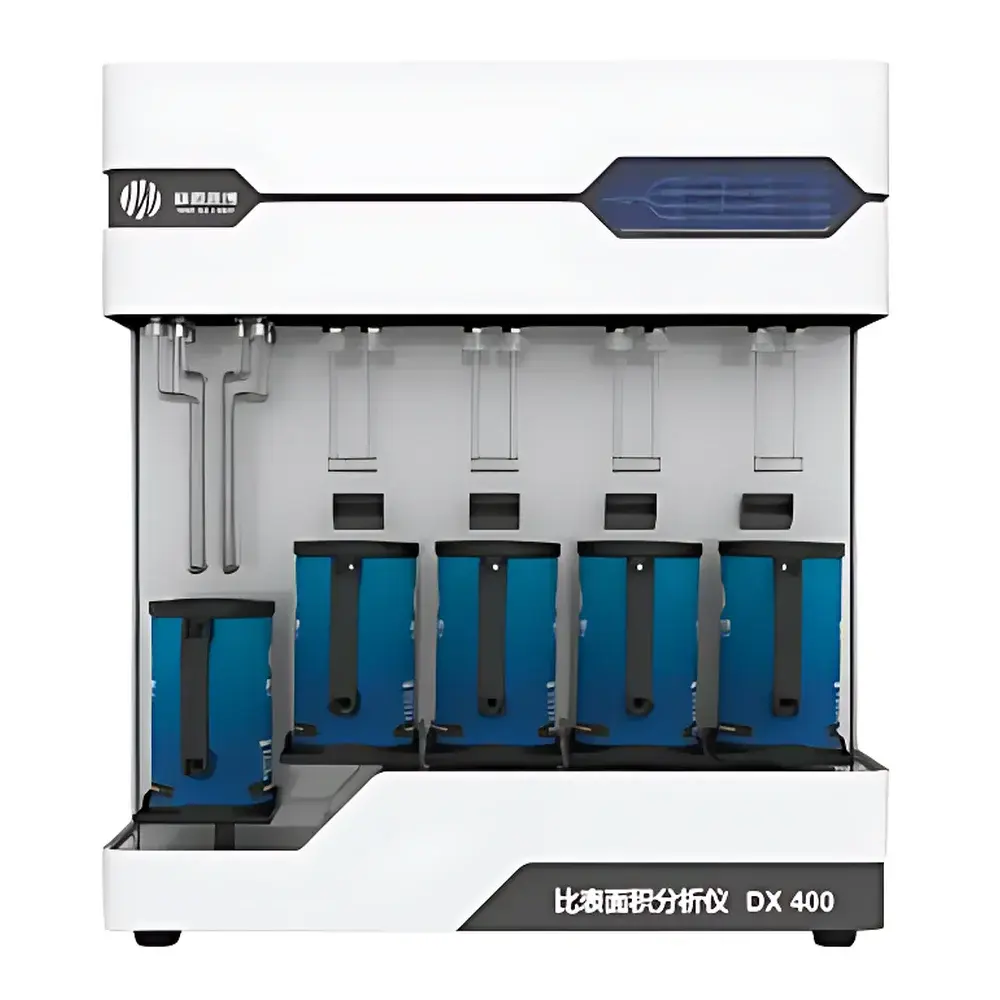
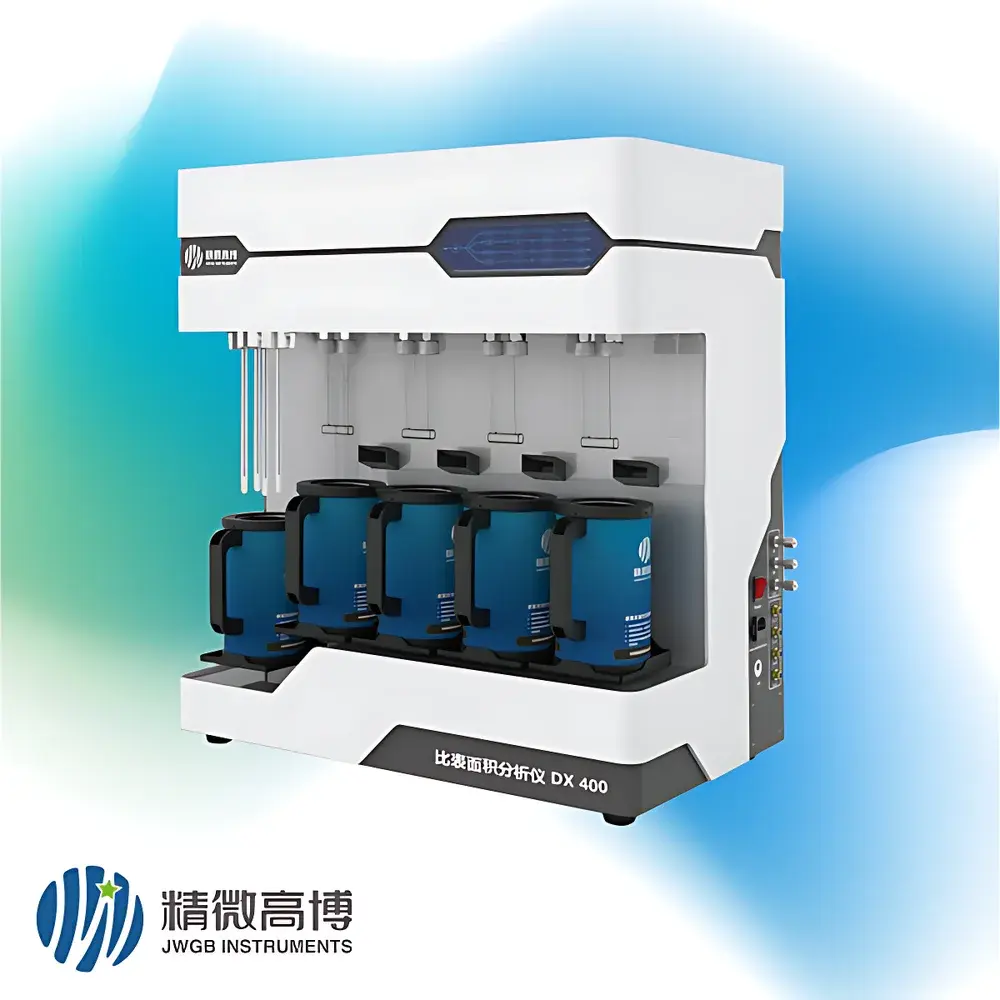
JWGB JW-DX400 Specific Surface Area Analyzer
| Brand | JWGB |
|---|---|
| Origin | Beijing, China |
| Manufacturer Type | Direct Manufacturer |
| Instrument Category | Domestic |
| Model | JW-DX400 Specific Surface Area Analyzer |
| Instrument Type | Specific Surface Area Analyzer |
| Operating Principle | Dynamic Flow (Carrier Gas) Method |
| Number of Analysis Stations | 4 |
| Measurable Surface Area Range | 0.01 m²/g to unlimited upper limit |
| Operating Pressure | Atmospheric pressure |
| Theoretical Basis | Dynamic Chromatographic Method |
Overview
The JWGB JW-DX400 Specific Surface Area Analyzer is an engineered solution for rapid, reliable determination of specific surface area in solid particulate materials using the dynamic flow (carrier gas) method—also known as dynamic chromatographic nitrogen adsorption. Unlike static volumetric or gravimetric techniques, this instrument operates under ambient pressure with a continuous flow of precisely controlled N₂/He mixed gas over the sample at cryogenic temperature (–196 °C, liquid nitrogen bath). Adsorption and desorption events are detected in real time via a high-stability thermal conductivity detector (TCD), where changes in gas-phase composition generate quantifiable chromatographic peaks. Peak area integration yields absolute nitrogen uptake, enabling surface area calculation via either the single-point direct comparison method or multi-point BET theory—fully compliant with ISO 9277:2010 and ASTM D3037–18 standards for gas adsorption analysis.
Key Features
- Four independent analysis stations enable parallel testing—maximizing throughput without cross-contamination or timing interference.
- Atmospheric-pressure operation eliminates need for vacuum pumps, reducing maintenance complexity and operational cost while maintaining robust reproducibility (RSD < 3% for repeated measurements on certified reference materials).
- Optimized thermal management ensures stable TCD baseline over extended runs; integrated auto-zero and gain calibration routines support long-term signal fidelity.
- Dedicated cryostatic design accommodates standard liquid nitrogen dewars with passive temperature stabilization—no active cooling required.
- Pre-configured method templates for battery cathode/anode materials (e.g., NMC, LFP, synthetic graphite), pharmaceutical excipients, catalysts, and activated carbons accelerate routine QA/QC workflows.
Sample Compatibility & Compliance
The JW-DX400 supports powders, granules, and porous monoliths with minimal pretreatment—typically degassing at 105–300 °C under inert gas flow (N₂ or Ar) for 1–4 hours depending on material hygroscopicity and surface chemistry. It is validated for use with low-surface-area samples (≥0.01 m²/g), including dense cathode materials (e.g., LiCoO₂), graphitic anodes, microcrystalline cellulose, and spray-dried lactose—materials often challenging for conventional static BET systems due to weak adsorption signals. All measurement protocols align with GLP documentation requirements; raw chromatograms, peak integration logs, and parameter audit trails are timestamped and exportable for regulatory review per FDA 21 CFR Part 11-compliant data handling practices.
Software & Data Management
The embedded Windows-based control software provides intuitive method setup, real-time chromatogram visualization, automated peak detection, and customizable report generation (PDF/CSV/XLSX). Each analysis session records full metadata—including gas flow rates, column temperature, detector voltage, degassing history, and operator ID—enabling full traceability. Data files adhere to ASTM E1447–22 metadata conventions and support post-acquisition reprocessing using alternative integration baselines or theoretical models (BET, Langmuir, t-plot). Exported datasets integrate seamlessly with LIMS platforms via ODBC drivers and support batch statistical analysis across production lots.
Applications
- Battery materials R&D and manufacturing: Quantitative QC of specific surface area for cathode precursors (Ni-rich NMC), silicon composites, and carbon-coated anodes—correlating surface area with slurry rheology, electrode density, and cycle-life performance.
- Pharmaceutical development: Surface area profiling of milled APIs and excipients to predict dissolution rate, blend uniformity, and tablet compaction behavior per USP <1031> guidance.
- Heterogeneous catalysis: Rapid screening of supported metal catalysts (e.g., Pt/Al₂O₃, Pd/C) to assess dispersion loss after thermal aging or reaction cycling.
- Environmental sorbents: Characterization of activated clays, biochars, and MOF-derived carbons for contaminant adsorption capacity modeling.
FAQ
What gases are required for operation?
High-purity helium (≥99.999%) as carrier gas and nitrogen (≥99.999%) as adsorbate—both supplied via standard lecture-bottle regulators with mass flow controllers calibrated to ±1% FS.
Is vacuum system integration possible?
No—the JW-DX400 is designed exclusively for atmospheric-pressure dynamic flow operation; no vacuum manifold, gauge, or pump is included or supported.
Can pore size distribution be derived from this instrument?
No; the JW-DX400 is configured solely for specific surface area determination via dynamic chromatography. Pore size analysis requires static physisorption (e.g., BJH, DFT) and is outside its measurement scope.
How is calibration verified?
Certified reference materials (e.g., NIST SRM 1990a, alumina powder with certified surface area of 99.8 m²/g) are run biweekly; deviation >2.5% triggers system diagnostic and recalibration protocol.
What sample mass is recommended?
Typically 0.1–1.0 g, adjusted to yield detectable peak area above instrument noise floor—automatically suggested by software based on expected surface area and material density.



