
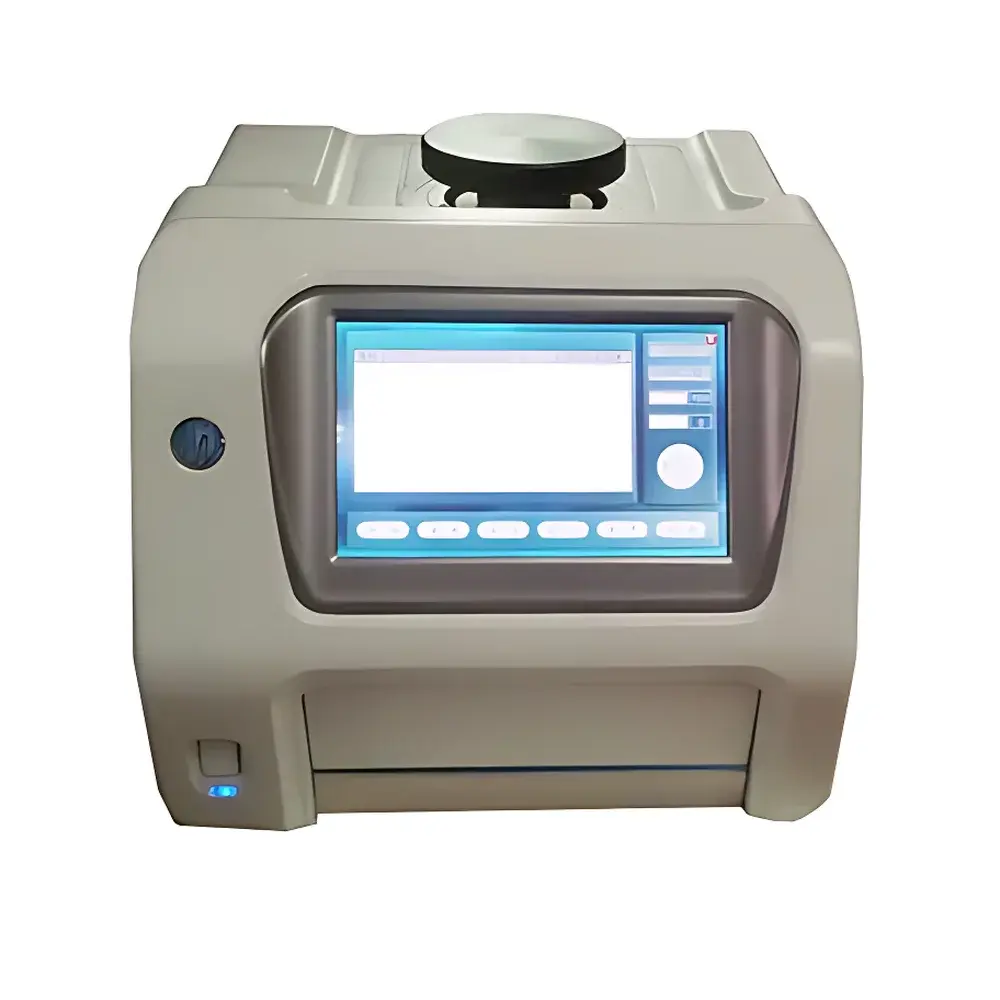
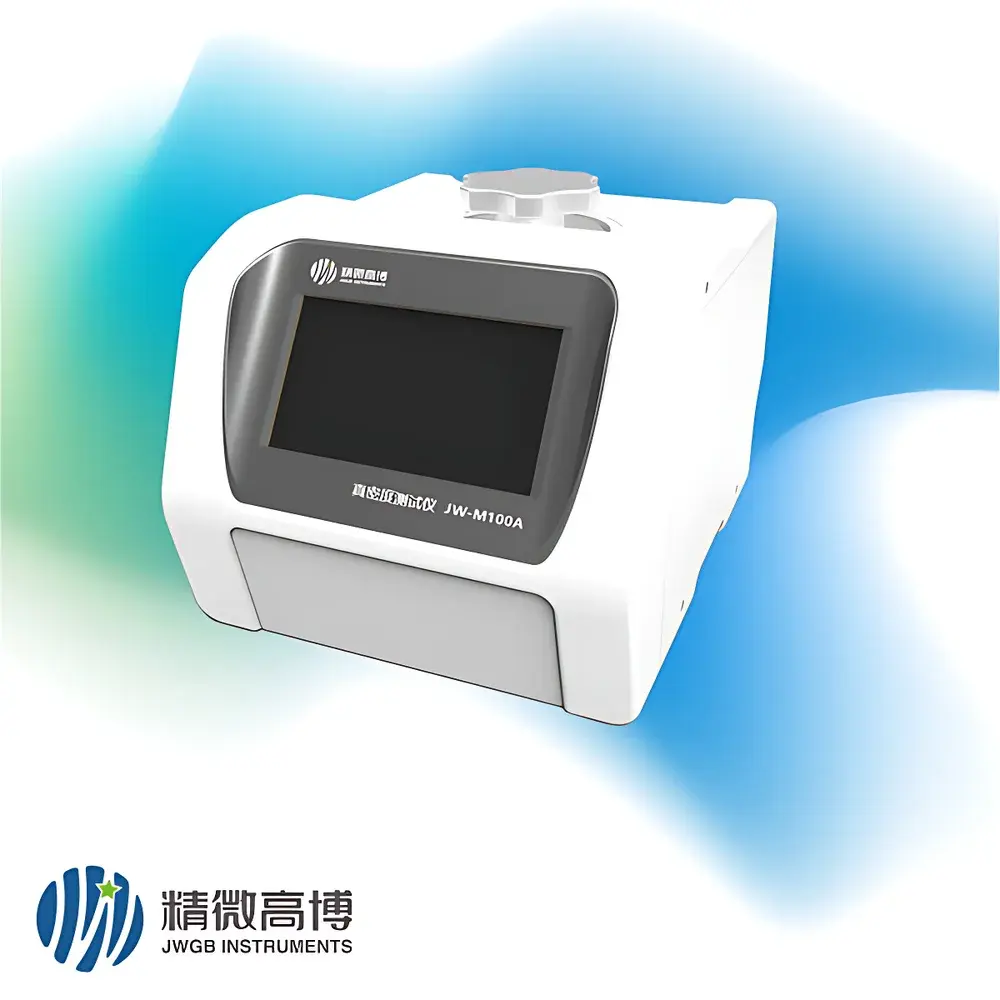
JWGB JW-M100A Automated True Density Analyzer
| Brand | JWGB |
|---|---|
| Origin | Beijing, China |
| Manufacturer Type | Direct Manufacturer |
| Product Category | Domestic |
| Model | JW-M100A Automated True Density Analyzer |
| Instrument Type | True Density Analyzer |
| Form Factor | Benchtop Laboratory Instrument |
| Sample Type | Solid Materials |
| Density Measurement Range | 0 g/mL to no known upper limit |
| Density Accuracy | ≤ 0.03% |
| Resolution | 0.00001 g/mL |
| Temperature Control Range | 0–50 °C |
| Minimum Sample Mass | 5 g |
| Principle | Gas Displacement (Helium, Nitrogen, or Air) |
| Analysis Stations | 1 |
| Pressure Sensor Accuracy | ±0.04% FS |
| Long-Term Stability | ±0.025% FS |
| Vacuum Source | Integrated Oil-Free Diaphragm Pump |
| Sample Cell Volumes | 10–120 mL (6 standard aluminum cells included) |
| Cycle Time | ≤ 2 minutes per analysis |
| Data Interface | Full-touch LCD panel with USB export |
| Compliance | CE certified |
Overview
The JWGB JW-M100A Automated True Density Analyzer is a benchtop gas displacement pycnometer engineered for high-precision determination of true density, skeletal volume, open-cell porosity, and closed-cell porosity of solid materials. It operates on the fundamental principle of gas displacement—typically using helium as the reference gas—where the volume of gas displaced by a solid sample under controlled pressure and temperature conditions is measured via high-fidelity pressure transduction. This method conforms to internationally recognized standards including ISO 12154 (Determination of true density of powders and solids by gas pycnometry) and ASTM D5550-22 (Standard Test Method for True Density of Calcined Petroleum Coke by Helium Pycnometry). The instrument integrates a thermally stabilized dual-chamber architecture—comprising a calibrated reference chamber and a sample chamber—both housed within a monolithic aluminum module to ensure rapid thermal equilibration and minimal drift. Its fully automated workflow eliminates manual valving, pressure balancing, or external computing dependencies.
Key Features
- Integrated oil-free diaphragm vacuum pump delivering stable base pressure <10 Pa, eliminating oil contamination and enabling rapid evacuation cycles
- Imported high-stability pressure transducers with ±0.04% full-scale accuracy and long-term drift <±0.025% FS over 12 months
- Proprietary non-heating solenoid valves with zero reverse leakage, ensuring precise gas flow control and reproducible pressure steps
- Modular aluminum sample cell assembly with six standardized volumes (10, 20, 30, 50, 100, and 120 mL), all CNC-machined for dimensional consistency and surface passivation
- Active temperature regulation system maintaining ±0.1 °C uniformity between reference and sample chambers across the full 0–50 °C operating range
- Self-contained 7-inch capacitive touch LCD interface with embedded real-time data acquisition, calibration routines, and result archiving—no PC required
- USB 2.0 port supporting direct export of raw pressure-time datasets, final density values, and statistical summaries in CSV format
Sample Compatibility & Compliance
The JW-M100A accommodates a broad spectrum of solid geometries—including powders, granules, monoliths, foams, fibers, and irregularly shaped composites—with minimum mass requirements of 5 g. Its helium-compatible design ensures accurate measurement of materials with low surface area or non-porous matrices (e.g., metals, ceramics, dense polymers), while its optional nitrogen/air mode supports cost-sensitive routine QC applications. All hardware and firmware comply with EU CE marking requirements (2014/30/EU EMC Directive and 2014/35/EU Low Voltage Directive). Calibration traceability is maintained through NIM-certified reference standards (certified density values ±0.005% uncertainty), and the system meets GLP documentation requirements via timestamped audit logs, user authentication, and immutable result storage. It satisfies key regulatory expectations for density verification in battery electrode qualification (IEC 62660-1), catalyst lot release (ISO 10012), and pharmaceutical excipient characterization (USP ).
Software & Data Management
The embedded firmware implements a deterministic state-machine controller that executes ISO-aligned gas displacement sequences: initial evacuation, reference chamber pressurization, equilibration, sample chamber expansion, and final pressure stabilization. Each cycle captures ≥1,000 pressure readings at 10 Hz resolution, enabling robust outlier rejection and linearized Boyle’s law regression. Density calculations apply ideal gas law corrections for compressibility and thermal expansion, referencing NIST-standard helium properties at user-defined temperature and atmospheric pressure. Data files include metadata headers (operator ID, timestamp, cell ID, gas type, ambient barometric pressure), raw sensor outputs, and statistical metrics (mean, SD, RSD, confidence interval at 95%). Exported CSV files are compatible with LIMS integration and third-party statistical packages (e.g., JMP, Minitab). Firmware updates are delivered via USB without requiring vendor service visits.
Applications
The JW-M100A serves critical quality and R&D functions across regulated and high-performance material sectors. In lithium-ion battery manufacturing, it quantifies true density of cathode active materials (e.g., NMC, LFP) and anode graphite to infer crystallinity and detect sintering defects. For catalyst development, it differentiates skeletal density from bulk density to calculate accessible metal surface area and pore network integrity. In nanomaterial synthesis, it validates particle densification post-calcination and detects agglomeration-induced void collapse. Polymer compounders use it to verify filler loading homogeneity in rubber formulations (e.g., silica-reinforced tires), while ceramic engineers rely on its closed-porosity measurements to assess green-body sintering progress. Additional validated use cases include porosity profiling of aerogels, density mapping of geological core samples, and QC screening of food-grade mineral additives (e.g., bentonite, calcium carbonate).
FAQ
What gases can be used for measurement?
Helium is recommended for highest accuracy due to its small atomic radius and inertness; nitrogen and dry air are supported for routine screening where speed or cost optimization is prioritized.
Is external computer hardware required?
No—the instrument operates autonomously via its integrated touchscreen interface; a PC is only needed if users require advanced scripting or batch report generation beyond built-in capabilities.
How is temperature stability achieved without external chillers?
A proprietary dual-zone Peltier-assisted thermal management system actively regulates both reference and sample chambers to match setpoint within ±0.1 °C, independent of ambient fluctuations.
Can the instrument measure open and closed porosity simultaneously?
Yes—by performing sequential measurements under helium (penetrates open pores only) and after mercury intrusion or vacuum saturation (to access closed pores), the software computes both porosity fractions per ASTM D6111.
What calibration standards are provided?
Each unit ships with a NIST-traceable fused quartz standard (certified true density = 2.2033 g/mL ±0.0001 g/mL) and a stainless-steel calibration sphere; additional certified standards are available upon request.



