
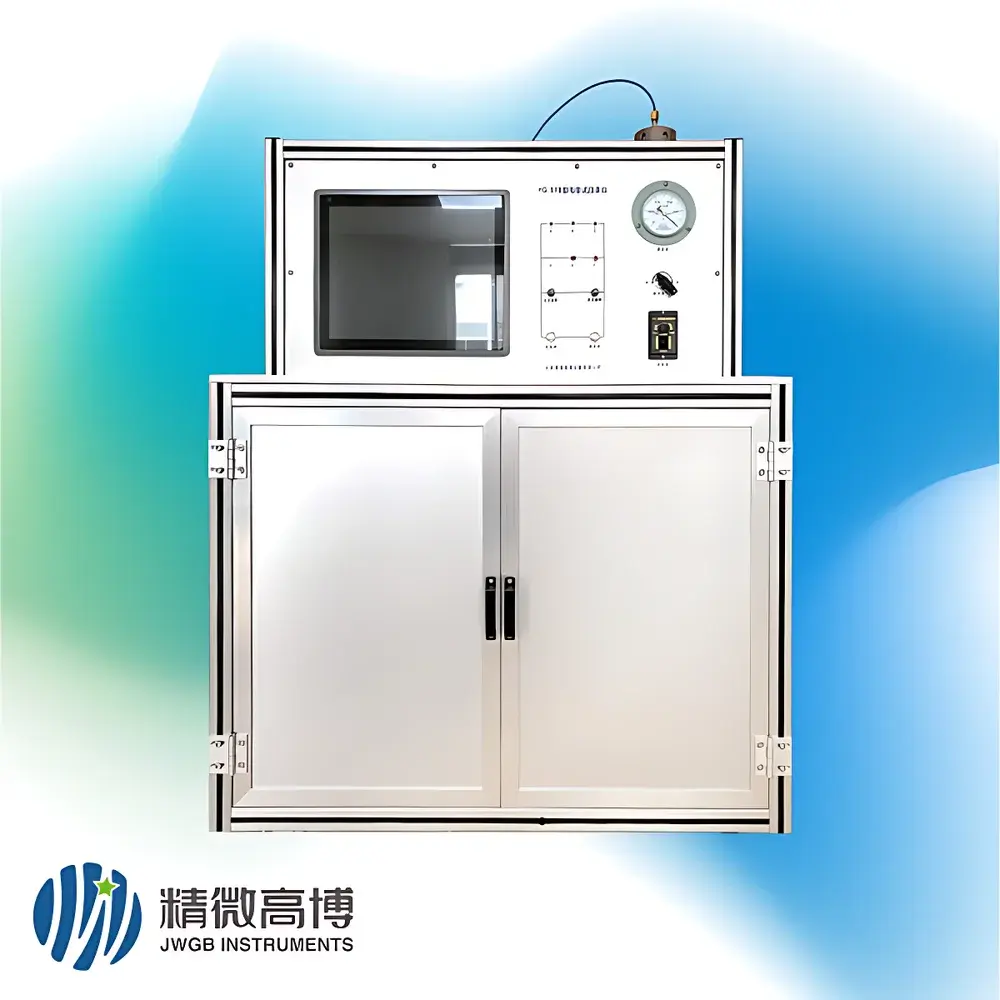
JWGB YG-23A Mercury Intrusion Porosimeter (Pore Size Distribution & Porosity Analysis)
| Brand | JWGB |
|---|---|
| Origin | Beijing, China |
| Manufacturer | Yes |
| Product Type | Domestic |
| Model | YG-23A Mercury Intrusion Porosimeter (Pore Size Distribution & Porosity Analysis) |
| Price | Upon Request |
| Pore Size Range | 30 nm – 126 µm |
| Pressure Range | 0.01 – 50 MPa |
| Pore Volume Range | 0.3 – 3.5 mL |
| Measurement Accuracy | ≤ 0.5% |
| Sample Chamber Volume | Up to 15 cm³ |
| Vacuum Level | ≤ 0.05 Pa |
| Blank Volume at 50 MPa | ~0.25 mL |
| Safety | Integrated mercury vapor containment system |
| Compliance | ISO 15901-1:2005, GB/T 21650.1-2008 |
| Analysis Outputs | Cumulative pore volume, cumulative specific surface area, average pore diameter, pore size distribution curve, pore throat ratio, intrusion/extrusion hysteresis curves |
Overview
The JWGB YG-23A Mercury Intrusion Porosimeter is a precision-engineered instrument for quantitative characterization of mesopores (2–50 nm) and macropores (50 nm–126 µm) in rigid, non-collapsible solid materials. It operates on the principle of mercury intrusion porosimetry (MIP), a well-established technique grounded in Washburn’s equation, which relates the applied pressure to the accessible pore diameter via the surface tension and contact angle of mercury on the solid surface. Unlike gas adsorption methods limited to micropores and narrow mesopores, MIP provides direct volumetric assessment of larger pores—critical for evaluating structural integrity, permeability, and transport behavior in heterogeneous porous media. The YG-23A is designed for laboratory environments requiring high reproducibility, traceable calibration, and compliance with international standards including ISO 15901-1:2005 and GB/T 21650.1-2008. Its dual-pressure measurement architecture ensures stable, low-drift pressure control across the full 0.01–50 MPa range (up to 7,250 psi), enabling reliable resolution from fine mesopores (~30 nm) through coarse macropores (≥126 µm).
Key Features
- Single independent analysis station with a maximum sample chamber volume of 15 cm³—accommodates both powdered and monolithic solid specimens without pre-compaction.
- Dual-path pressure sensing system: high-resolution digital pressure transducers coupled with redundant analog monitoring for real-time validation and drift correction.
- Integrated vacuum subsystem featuring a two-stage rotary vane pump achieving ≤0.05 Pa base pressure—essential for complete mercury evacuation and accurate baseline blank subtraction.
- Controlled intrusion/extrusion kinetics via variable-speed hydraulic pump drive, supporting both stepwise and continuous pressure ramp protocols per ASTM D4404 and ISO 15901.
- Comprehensive safety engineering: sealed mercury reservoir, negative-pressure glove box interface, activated carbon filtration, and continuous vapor monitoring—fully aligned with OSHA Hg exposure limits (0.05 mg/m³ TWA) and EU Directive 2017/164/EU.
- Modular firmware architecture supporting audit-ready operation logs, user-level access control, and timestamped parameter recording for GLP/GMP-aligned workflows.
Sample Compatibility & Compliance
The YG-23A accepts a broad spectrum of rigid, mercury-wettable solids—including geological cores (shale, sandstone), ceramic green bodies, catalyst supports (alumina, silica, zeolites), cementitious matrices, polymer foams, battery electrode composites, and pharmaceutical excipients. Samples must exhibit mechanical stability under hydrostatic compression and negligible plastic deformation below 50 MPa. Non-rigid or compressible materials (e.g., gels, soft polymers) require prior validation. All measurements adhere to ISO 15901-1:2005 Annex A for data reduction, incorporating contact angle correction (140°), surface tension (485 mN/m), and density-based volume conversion. Instrument calibration is traceable to NIST-certified reference standards; blank correction routines are executed automatically before each run using the documented 0.25 mL offset at 50 MPa.
Software & Data Management
Control and analysis are performed via JWGB’s proprietary PorosWin v4.x software suite, compliant with FDA 21 CFR Part 11 requirements for electronic records and signatures. The platform delivers automated calculation of cumulative pore volume, differential pore volume distribution, total porosity, median pore diameter, and hysteresis index. Export formats include CSV, XML, and PDF reports with embedded metadata (operator ID, calibration date, environmental conditions). Raw pressure-capacitance-vacuum time-series data are stored in binary archives with SHA-256 checksums. Audit trails record all parameter modifications, method changes, and report generations—retained for ≥36 months per internal QA policy. Remote diagnostics and firmware updates are supported over secure TLS 1.2 connections.
Applications
- Geoscience & Energy: Pore network quantification in unconventional reservoir rocks; capillary pressure curve derivation for relative permeability modeling.
- Catalysis: Support pore structure optimization for diffusion-limited reactions; post-synthesis thermal stability assessment.
- Construction Materials: Correlation of pore size distribution with chloride ingress resistance, freeze-thaw durability, and alkali-silica reactivity.
- Advanced Manufacturing: Quality control of additive-manufactured metal/ceramic lattices; sintering densification monitoring.
- Energy Storage: Electrode porosity mapping in Li-ion and solid-state batteries; separator tortuosity estimation.
- Pharmaceuticals: Excipient compactibility profiling; controlled-release matrix characterization per USP .
FAQ
What pore size range does the YG-23A cover, and how is it validated?
The instrument measures pores from 30 nm to 126 µm, verified using certified glass frit standards (NIST SRM 224a) and cross-referenced against nitrogen physisorption data for overlapping mesopore regions.
Is the system compatible with regulatory-compliant data integrity requirements?
Yes—PorosWin software implements role-based access control, electronic signatures, immutable audit trails, and 21 CFR Part 11–compliant electronic records.
How is mercury exposure mitigated during routine operation?
The system integrates a hermetically sealed mercury handling module, continuous vapor-phase activated carbon filtration, and interlocked chamber access doors that halt operation upon door opening.
Can the YG-23A perform extrusion-only analysis for ink-bottle pore identification?
Yes—user-defined extrusion-only sequences are supported, enabling hysteresis loop analysis and pore geometry inference per ISO 15901-1 Section 8.3.
What maintenance intervals are recommended for long-term accuracy?
Vacuum pump oil replacement every 500 hours; pressure transducer recalibration annually or after 10,000 cycles; mercury purity verification quarterly using cold-vapor atomic absorption spectroscopy (CVAAS).



