
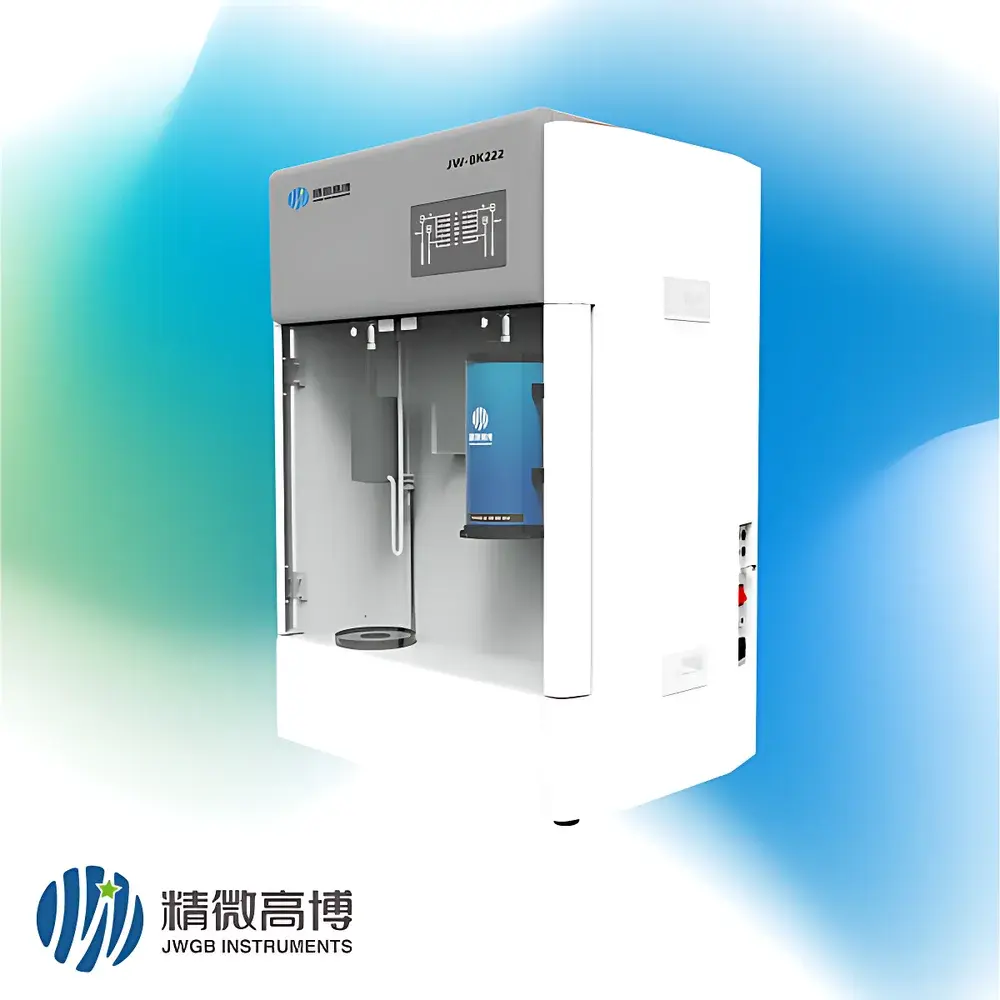
JWGB JW-BK222 Carbon Black & Silica Fumed Specific Surface Area Analyzer
| Brand | JWGB |
|---|---|
| Origin | Beijing, China |
| Manufacturer Type | Direct Manufacturer |
| Product Category | Domestic Instrument |
| Model | JW-BK222 Carbon Black & Silica Fumed Specific Surface Area Analyzer |
| Instrument Type | Specific Surface Area and Pore Size Analyzer |
| Measurement Principle | Static Volumetric Gas Adsorption Method |
| Number of Analysis Stations | 2 independent parallel stations with in-situ degassing capability |
| Specific Surface Area Range | Down to 0.0005 m²/g |
| Relative Pressure Range (p/p₀) | 1×10⁻⁶ to 0.998 |
| Theoretical Basis | Gas Adsorption Isotherm Analysis via Static Volumetric Technique |
Overview
The JWGB JW-BK222 Carbon Black & Silica Fumed Specific Surface Area Analyzer is a dedicated static volumetric gas adsorption instrument engineered for high-precision external surface area characterization of non-porous or weakly microporous carbon black and fumed silica materials. Unlike general-purpose surface area analyzers, the JW-BK222 is optimized for low-surface-area, high-density industrial powders where accurate measurement of external (non-microporous) surface area is critical—particularly in rubber compounding, pigment dispersion, and catalyst support quality control. It operates on the fundamental principle of nitrogen (or other inert gas) adsorption at cryogenic temperature (77 K), applying the Brunauer–Emmett–Teller (BET) theory for specific surface area calculation and the t-plot or αs-method for external surface area differentiation. Its dual-station architecture enables simultaneous analysis and in-situ degassing under identical thermal and vacuum conditions, minimizing inter-sample variability and enhancing throughput without compromising reproducibility.
Key Features
- Dual independent analysis stations with fully parallel operation—each station equipped with dedicated pressure transducers, dosing valves, and thermal management—ensuring true concurrent measurement and eliminating cross-talk.
- Ultra-low surface area detection limit of 0.0005 m²/g, validated using certified reference materials (e.g., NIST SRM 1936a graphite), with repeatability (RSD) ≤ ±1.0% on standard samples.
- Extended p/p₀ range from 1×10⁻⁶ to 0.998, achieved via dual-range pressure sensing (1000 torr + 10 torr transducers), enabling high-resolution isotherm acquisition across monolayer formation, multilayer adsorption, and capillary condensation regimes.
- Integrated in-situ degassing system: two dedicated heating zones (ambient to 400 °C, ±1 °C stability) with programmable ramp/hold profiles; vacuum level <7×10⁻¹ Pa via dual-stage rotary vane pump, optionally upgradable with secondary sorption pump for sub-10⁻² Pa base pressure.
- All-critical hardware components—including stainless-steel manifold, high-stability capacitance manometers, and ultra-low-permeability gas lines—are sourced from globally recognized industrial suppliers to ensure long-term calibration integrity and system robustness.
Sample Compatibility & Compliance
The JW-BK222 is specifically validated for carbon black (ASTM D3765, ISO 18852) and fumed silica (ISO 9277, ASTM D3849) surface area determination, supporting both N₂ and Ar as adsorbates (with Kr optional for ultra-low-area verification). It complies with core international standards governing gas adsorption analysis, including ISO 9277:2010 (determination of specific surface area by gas adsorption), ASTM D6567-22 (standard test method for determining specific surface area of carbon black), and IUPAC 2015 recommendations for physisorption data reporting. While not FDA-registered, its hardware architecture and software audit trail capabilities align with GLP-compliant laboratory practices; raw isotherm data, degassing logs, and calibration records are timestamped and user-attributed to support internal QA/QC documentation and regulatory readiness.
Software & Data Management
The instrument is controlled via JWGB’s proprietary SurfaceMaster™ v4.x software, a Windows-based platform designed for technical users in R&D and QC environments. It supports automated isotherm acquisition, multi-point BET linear regression with automatic monolayer range selection, t-plot analysis for external surface estimation, and BJH/DFT pore size distribution modeling (for applicable mesoporous extensions). All data files are stored in open-format CSV and XML structures, enabling direct import into LIMS or statistical analysis tools (e.g., JMP, Python pandas). Software includes full audit trail functionality—recording operator ID, method version, parameter changes, and instrument status—with exportable PDF reports compliant with internal SOPs. No cloud dependency: all processing occurs locally, preserving data sovereignty and network security.
Applications
- Rubber & tire industry: Quantitative correlation of carbon black external surface area with reinforcement efficiency, Payne effect, and compound viscosity.
- Silicone & coating formulations: Monitoring fumed silica surface hydrophobicity/hydrophilicity via nitrogen uptake after controlled silanization.
- Catalyst support qualification: Verifying surface area consistency of alumina- or silica-based carriers prior to noble metal impregnation.
- Quality assurance labs: Routine batch release testing per ASTM D3765 or ISO 18852, with built-in pass/fail thresholds and trend charting over time.
- Academic research: Fundamental studies on surface functionalization kinetics, agglomeration behavior, and thermal stability of nanofillers under controlled degassing protocols.
FAQ
What distinguishes the JW-BK222 from general-purpose surface area analyzers?
It features hardware and software optimizations tailored to carbon black and fumed silica—specifically enhanced low-pressure sensitivity (1×10⁻⁶ p/p₀), dual-range transducers for accurate monolayer region resolution, and pre-configured BET/t-plot workflows that prioritize external surface quantification over total porosity.
Can the instrument analyze microporous materials?
While capable of detecting pores down to 0.35 nm, the JW-BK222 is calibrated and validated primarily for non-microporous or weakly microporous systems. For rigorous micropore analysis (e.g., activated carbons), dedicated high-resolution instruments with immersion cooling and sub-10⁻⁸ torr vacuum are recommended.
Is compliance with 21 CFR Part 11 supported?
The base software does not include electronic signature or role-based access control modules required for full 21 CFR Part 11 compliance; however, audit trail logs, immutable raw data storage, and method versioning provide foundational elements for validation under GxP frameworks when integrated with lab-wide IT governance policies.
What maintenance intervals are recommended?
Annual calibration of pressure transducers and leak-checking of the vacuum manifold are advised; the rotary vane pump oil should be replaced every 3,000 operating hours or per manufacturer specifications. No consumables beyond standard N₂ gas and liquid nitrogen are required.
Does the system support automated sample loading?
No—sample tubes are manually loaded into heated degassing ports and analysis stations. Automation is not implemented, preserving mechanical simplicity, thermal stability, and cost-effectiveness for high-volume routine labs.



