
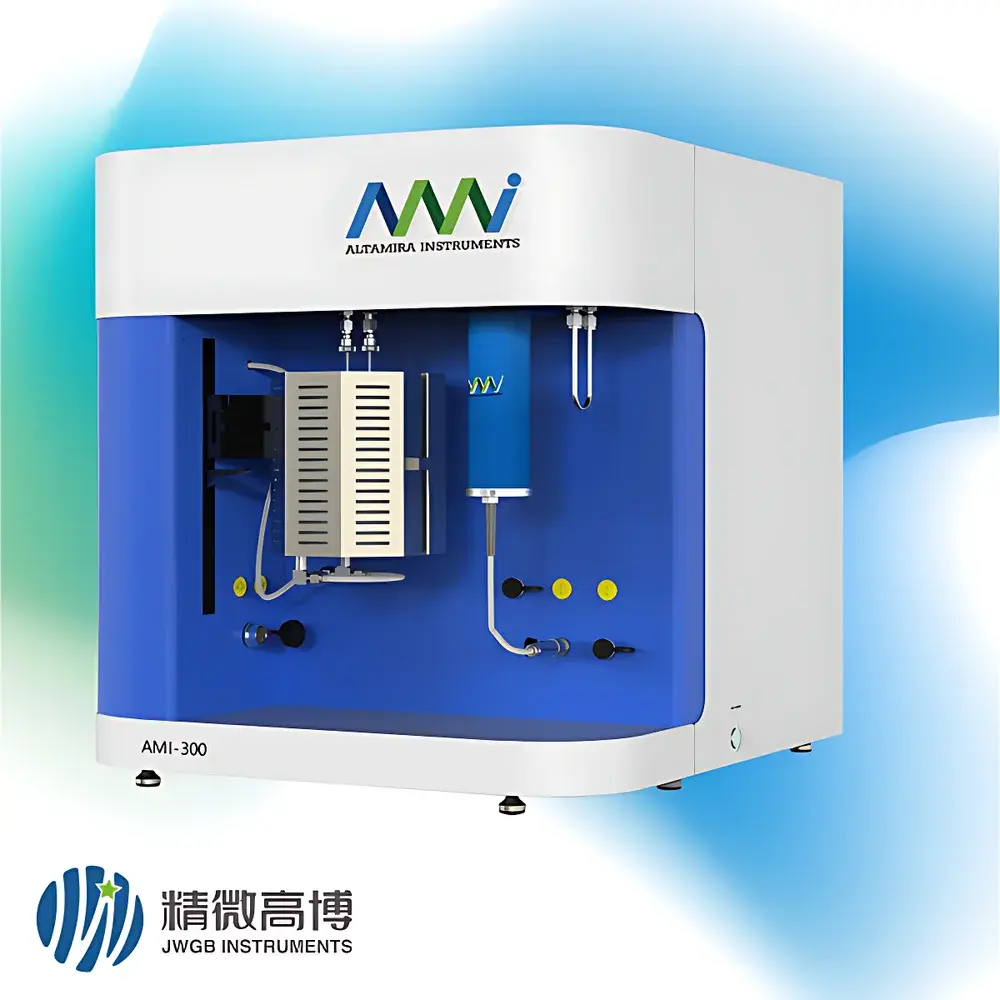
Altamira AMI-300 TPD/TPO/TPR Chemisorption Analyzer
| Brand | Altamira (USA) |
|---|---|
| Origin | USA |
| Model | AMI-300 TPD/TPO/TPR Chemisorption Analyzer |
| Test Principle | Continuous Flow Method |
| Gas Inlet Ports | Expandable to 12 |
| Temperature Range | Ambient to 1200 °C |
| Isothermal Stability | ±0.01 °C |
| Heating Rate | 1–50 °C/min |
| Pressure Range | Atmospheric to 30 bar (optional up to 100 bar) |
| Functions | TPR, TPO, TPD, TPS, Pulse Chemisorption, Pulse Calibration |
Overview
The Altamira AMI-300 TPD/TPO/TPR Chemisorption Analyzer is a fully automated, continuous-flow dynamic thermal desorption and catalytic characterization system engineered for high-precision surface science investigations of heterogeneous catalysts. It operates on the principle of temperature-programmed desorption (TPD), reduction (TPR), oxidation (TPO), and sulfidation (TPS), enabling quantitative assessment of active site density, metal dispersion, adsorption enthalpy distribution, reducibility, oxidative stability, and surface reactivity under controlled gas atmospheres. Designed for research laboratories and industrial R&D centers in catalysis, energy materials, and chemical process development, the AMI-300 delivers reproducible, trace-level gas-phase detection with minimal peak broadening—achieving analysis times approximately one-third that of conventional volumetric systems. Its modular architecture supports integration with external analytical detectors including mass spectrometers (MS), Fourier-transform infrared (FTIR) spectrometers, flame ionization detectors (FID), and gas chromatographs (GC), ensuring compatibility with multi-modal surface characterization workflows.
Key Features
- Expandable Gas Handling System: Configurable with up to four precision mass flow controllers (MFCs), supporting up to 12 independently regulated gas inlets—including 4 carrier gases, 4 treatment gases, and 2 premix channels—enabling complex multi-step gas switching protocols without manual intervention.
- Wide Thermal Operating Range: Programmable heating from ambient to 1200 °C (with optional cryogenic extension down to –130 °C), maintaining ±0.01 °C isothermal stability and linear ramp rates between 1 and 50 °C/min across the full range.
- Minimized Dead Volume Architecture: All internal gas pathways constructed from 1/16″ 316 stainless steel tubing with thermally insulated, actively heated valves and manifolds—eliminating condensation and adsorption artifacts while preserving chromatographic resolution and response time.
- Integrated Saturated Vapor Generation: Onboard temperature-controlled saturator enables precise delivery of vapor-saturated carrier gases (e.g., H2O, NH3, SO2) for probing acid–base or redox-active surface functionalities.
- Dual-Temperature Monitoring & Control: Independent thermocouples monitor both furnace zone and sample bed temperatures in real time, allowing accurate kinetic modeling and correction for thermal lag during rapid heating cycles.
- High-Sensitivity Detection Options: Standard dual-filament TCD with selectable filament material (tungsten or gold/tungsten alloy) and multiple calibrated loop volumes (0.1–10 mL); optional seamless data synchronization with external MS via embedded AMI software interface.
- Automated Thermal Management: Integrated air-cooling module reduces cooldown time between experiments, improving throughput without compromising thermal history control.
Sample Compatibility & Compliance
The AMI-300 accommodates diverse sample geometries and chemistries through interchangeable reactor tubes: standard quartz U-tubes and bubble-type reactors for low-pressure studies; high-pressure 316 stainless steel reactors rated to 100 bar. Sealing components are available in Viton®, Buna-N, and Kalrez® elastomers to ensure chemical compatibility with corrosive or reactive gases (e.g., H2S, Cl2, NH3). All thermal zones—including gas lines, valves, and detector cells—are actively temperature-controlled to prevent condensate formation or surface retention of polar vapors. The system conforms to GLP-compliant operation requirements, supporting audit-ready electronic records, user-access logging, and instrument parameter versioning when paired with validated software configurations aligned with FDA 21 CFR Part 11 principles.
Software & Data Management
Controlled via Windows-based AMI Instrument Software, the platform provides intuitive method setup, real-time monitoring of temperature, flow, pressure, and signal output, and synchronized multi-detector data acquisition. Experimental sequences—including gas switching, ramp/hold profiles, pulse injection timing, and cooling cycles—are programmable with sub-second resolution. Raw data files store metadata (instrument ID, operator, timestamp, calibration IDs) and support export in ASCII, CSV, and proprietary binary formats compatible with third-party kinetic modeling tools (e.g., MATLAB, Origin, Thermo Scientific Avantage). Advanced users may access low-level hardware configuration menus for custom PID tuning, analog I/O mapping, and detector gain optimization—without requiring firmware modification.
Applications
The AMI-300 is routinely deployed in academic and industrial laboratories for mechanistic studies of catalyst deactivation, structure–activity relationships in transition metal oxides and supported noble metals, and formulation screening of emission control catalysts (e.g., three-way catalysts, SCR formulations). Key application domains include: hydrodesulfurization (HDS), hydrodenitrogenation (HDN), and hydrodeoxygenation (HDO) catalyst development; CO2 hydrogenation and Fischer–Tropsch synthesis; ammonia synthesis and decomposition; solid oxide fuel cell (SOFC) electrode characterization; battery electrode surface passivation analysis; and surface acidity/basicity profiling of zeolites, MOFs, and mesoporous oxides. Its ability to quantify metal dispersion and turnover frequency (TOF) makes it indispensable for QC/QA in catalyst manufacturing and regulatory submissions under ASTM D7215 (TPR of supported catalysts) and ISO 18321 (chemisorption-based dispersion measurement).
FAQ
Can the AMI-300 be used for high-pressure TPR studies?
Yes—when equipped with the optional 100 bar high-pressure reactor and compatible sealing components, the system supports TPR, TPO, and TPD under elevated pressures up to 100 bar, enabling simulation of industrially relevant reaction conditions.
Is the TCD detector suitable for detecting low-concentration species like CO or NO?
The dual-filament TCD offers detection limits in the low ppm range for diatomic and small polyatomic gases; for sub-ppm sensitivity or speciation of isobaric compounds (e.g., CO vs. N2), coupling with a quadrupole mass spectrometer is recommended.
Does the software support automated calibration routines for pulse chemisorption?
Yes—the software includes built-in pulse calibration wizards that guide users through loop volume verification, baseline drift correction, and stoichiometric factor assignment using reference standards such as H2 or CO on Pt/SiO2.
What safety features are integrated into the AMI-300?
Multi-point thermal monitoring, overtemperature cutoff (hardware-independent), TCD flow fault detection, emergency power disconnect switch, and optional gas leak detection interlock circuits ensure compliance with OSHA and local laboratory safety codes.
Can the system perform simultaneous TPD–MS experiments with synchronized data acquisition?
Yes—via the AMI–MS bridge interface, TCD and MS signals are time-aligned and saved within a single project file, enabling direct correlation of thermal events with evolved species mass spectra.



