
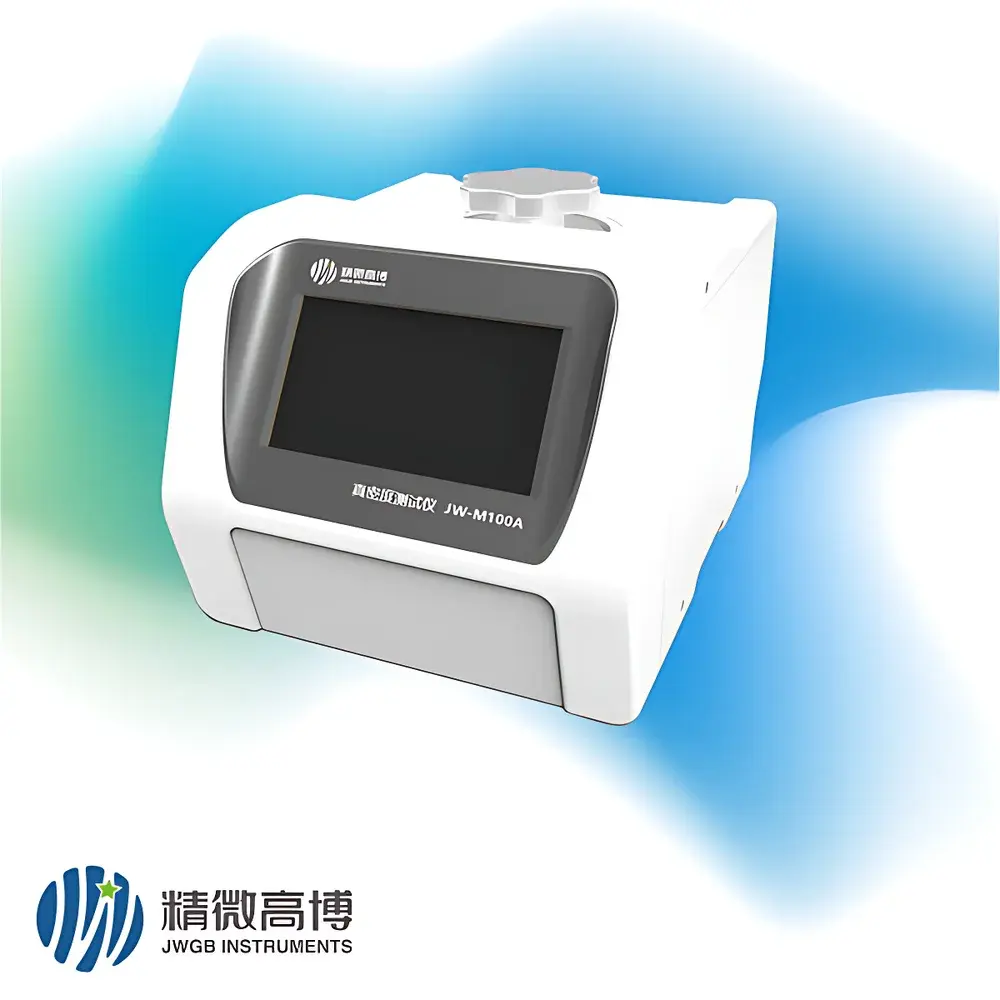
JWGB JW-M100A Fracturing Proppant-Specific True Density Analyzer
| Brand | JWGB |
|---|---|
| Origin | Beijing, China |
| Manufacturer Type | Direct Manufacturer |
| Product Category | Domestic |
| Model | JW-M100A Fracturing Proppant-Specific True Density Analyzer |
| Instrument Type | True Density Analyzer |
| Form Factor | Benchtop Laboratory Instrument |
| Sample Type | Solid Materials |
| Measurement Principle | Gas Displacement (Helium Pycnometry) |
| Density Range | 0 g/mL to no known upper limit |
| Density Accuracy | ≤ 0.03% RSD |
| Resolution | 0.00001 g/mL |
| Temperature Control Range | 0–50 °C |
| Analysis Stations | 1 |
| Sample Chamber Volumes | 10–120 mL (6 standard aluminum cells included) |
| Vacuum System | Integrated oil-free diaphragm pump |
| Pressure Sensor | Imported high-stability sensor, 0.04% FS accuracy, long-term stability ≤ 0.025% FS |
| Pressure Control | Fully automated, peak pressure ≤ atmospheric |
| Data Interface | Built-in full-touch LCD control panel with USB export capability |
| Compliance | CE certified |
Overview
The JWGB JW-M100A Fracturing Proppant-Specific True Density Analyzer is a benchtop gas pycnometer engineered for high-precision determination of true density, skeletal volume, and closed/open porosity in granular and irregular solid materials—particularly engineered proppants used in hydraulic fracturing operations. It operates on the principle of gas displacement (helium pycnometry), leveraging Boyle’s law and precise pressure differentials within a calibrated reference chamber and sample chamber. Helium is selected as the default test gas due to its small atomic diameter (2.6 nm), enabling full penetration into micropores < 2 nm and ensuring measurement of *true* (skeletal) density—not apparent or bulk density. The instrument integrates a thermally stabilized dual-chamber architecture with active temperature homogenization across both reference and sample volumes, minimizing thermal drift and enhancing repeatability under ambient lab conditions (0–50 °C). Its design conforms to ASTM D5550 and ISO 12154 standards for solid density measurement by gas pycnometry, and supports traceable calibration using NIST-traceable standard reference materials supplied with each unit.
Key Features
- Integrated helium-compatible gas handling system with zero-leak electromagnetic valves (imported), eliminating reverse leakage and ensuring pressure integrity during equilibration cycles
- Modular aluminum sample cell assembly with six standardized volumes (10, 20, 30, 50, 100, and 120 mL), all CNC-machined for dimensional consistency and surface passivation to prevent adsorption artifacts
- Self-contained oil-free diaphragm vacuum pump (≤ 50 Pa ultimate vacuum), optimized for rapid degassing without hydrocarbon contamination
- High-fidelity pressure transduction using imported piezoresistive sensors (0.04% full-scale accuracy, < 0.025% FS long-term drift), digitally compensated for temperature and linearity
- Onboard full-touch LCD interface with embedded real-time data acquisition, eliminating dependency on external PCs while supporting USB mass-storage export of raw pressure-time logs and final reports
- Active thermal management system maintaining ±0.1 °C uniformity between reference and sample chambers—critical for sub-0.03% RSD reproducibility across repeated measurements
- Automated multi-cycle testing protocol with user-defined repetition count (no upper limit), enabling statistical validation per ISO 5725-2 precision requirements
Sample Compatibility & Compliance
The JW-M100A accepts powders, granules, monolithic ceramics, sintered metals, polymer composites, and porous foams—including proppants with angular morphology, surface coatings, or residual resin binders. Its 5–20 g recommended sample mass accommodates typical proppant batch sizes while minimizing interstitial void error. Closed-porosity analysis follows ASTM D6223 for refractory ceramics; open-porosity calculation derives from combined helium and mercury intrusion (optional add-on) or complementary gravimetric saturation methods. The system meets CE marking requirements for electromagnetic compatibility (EN 61326-1) and safety (EN 61010-1). Calibration verification is supported through CNIM-certified reference materials (e.g., fused quartz SRM 1921b), and full traceability documentation complies with ISO/IEC 17025 laboratory accreditation criteria. Optional software modules provide 21 CFR Part 11–compliant electronic signatures and audit trails for regulated environments.
Software & Data Management
Firmware includes embedded analytical algorithms for automatic baseline correction, thermal drift compensation, and non-linear pressure decay modeling. Raw pressure vs. time curves are stored with metadata (timestamp, ambient T/P, operator ID, cell ID). Export formats include CSV (for Excel or MATLAB post-processing) and PDF reports with embedded uncertainty budgets per GUM (JCGM 100:2018). The system supports custom report templates compliant with internal QA/QC workflows. While standalone operation is standard, optional Ethernet connectivity enables integration into LIMS via Modbus TCP or OPC UA protocols. All firmware updates are delivered via signed USB firmware packages to ensure integrity.
Applications
This analyzer is routinely deployed in upstream oilfield service labs for quality control of ceramic, resin-coated sand (RCS), and bauxite proppants—quantifying density shifts induced by sintering, surface treatment, or thermal aging. It also serves battery material developers measuring electrode coating density homogeneity; catalyst manufacturers assessing metal dispersion in alumina supports; and nanomaterial producers validating crystallite densification after calcination. Additional use cases include pore structure characterization of MOFs for gas storage, density mapping of additive-manufactured metal parts, and QC screening of pharmaceutical excipients where true density correlates with compaction behavior.
FAQ
What gases can be used besides helium?
Nitrogen and dry air are supported for less demanding applications, though helium remains mandatory for accurate true density of materials with microporosity (< 2 nm).
Is vacuum degassing required before each test?
Yes—integrated vacuum purging removes adsorbed moisture and ambient gases from sample surfaces; dwell time is configurable (default: 60 s at ≤ 50 Pa).
How is temperature stability maintained during long test sequences?
A proprietary aluminum thermal bus connects reference and sample chambers, coupled with PID-controlled low-power heating elements that maintain ΔT < 0.1 °C across 4-hour continuous operation.
Can the instrument differentiate between closed and open porosity?
Yes—by combining helium pycnometry (total skeletal volume) with either mercury intrusion porosimetry (MIP) or liquid saturation + Archimedes’ method, the system calculates both closed- and open-pore fractions per ASTM D6223 and D4404.
Does the system support IQ/OQ/PQ documentation for regulated labs?
Standard delivery includes Factory Acceptance Test (FAT) reports; optional IQ/OQ/PQ packages—aligned with USP , ISO 13485, and FDA guidance—are available upon request.



