
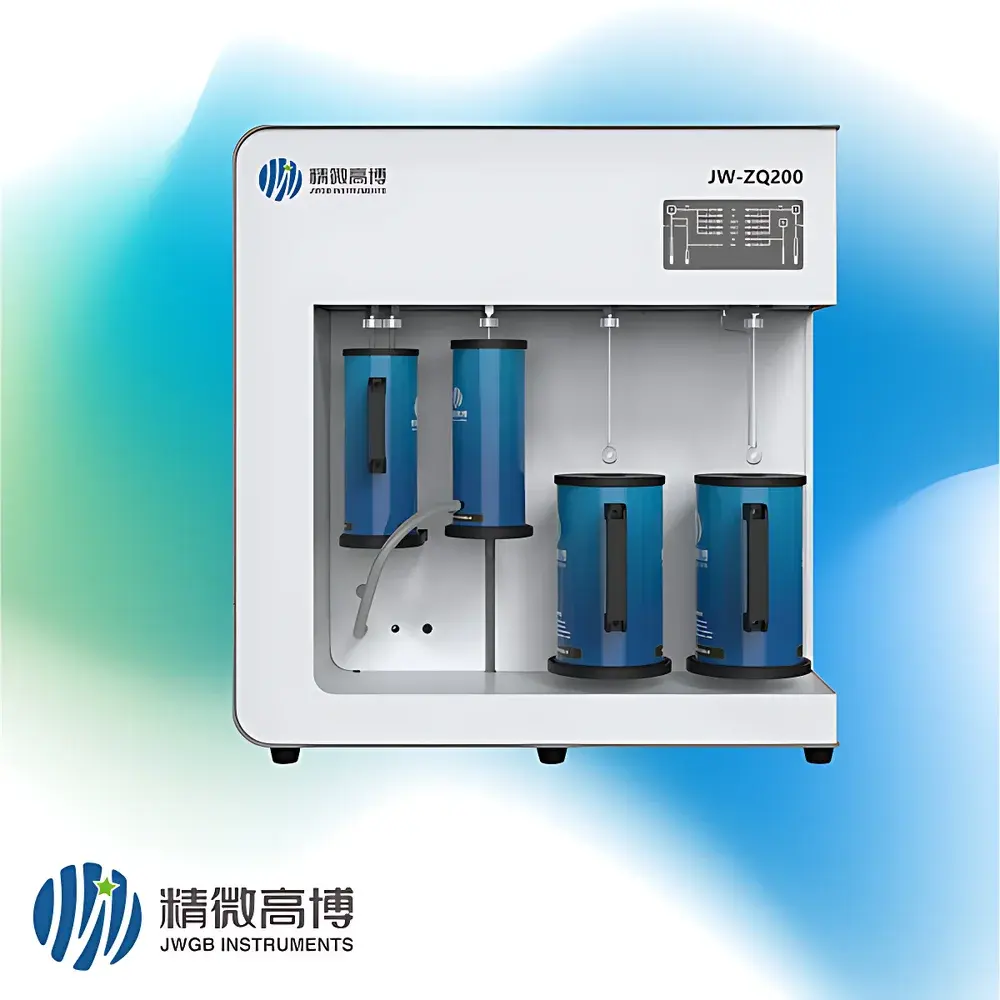
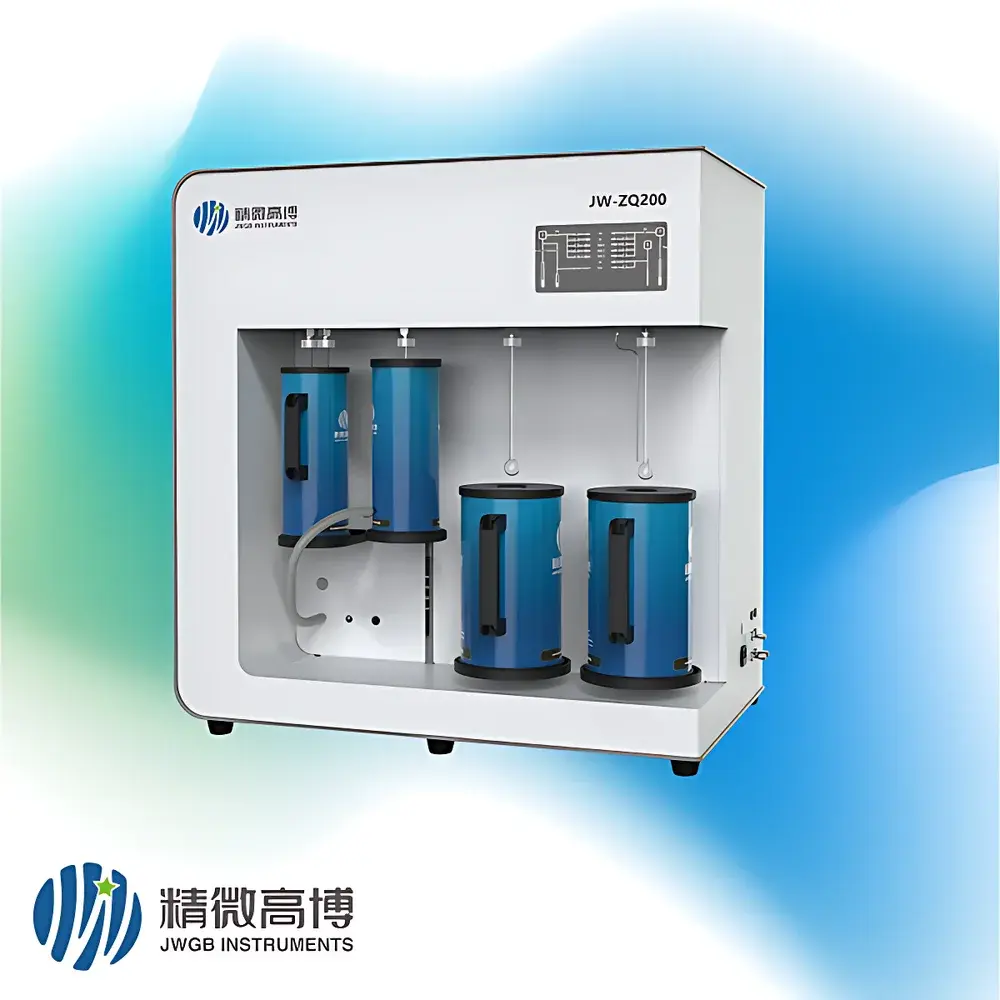
JWGB JW-ZQ200C Static Vapor Adsorption Analyzer
| Brand | JWGB |
|---|---|
| Origin | Beijing, China |
| Manufacturer Type | Direct Manufacturer |
| Instrument Type | Static Vapor Adsorption Analyzer |
| Model | JW-ZQ200C |
| Weighing Range | 0.0001 g – 100 g |
| Weighing Resolution | 0.0001 g |
| Temperature Control Range | Ambient to 400 °C |
| Relative Humidity Range | 30 %RH – 60 %RH |
| RH Accuracy | ±0.11 %RH |
| Vacuum Base Pressure | ≤1 × 10⁻⁸ Pa |
| Pore Size Analysis Range | 0.35 nm – 500 nm |
| Specific Surface Area Range | ≥0.005 m²/g (no upper limit) |
| Total Pore Volume Range | ≥0.0001 cm³/g (no upper limit) |
| Integrated Pressure Sensors | 1000 torr / 10 torr / 0.1 torr (vapor station) |
| Dual Cold Trap System | Independent cryo-traps for degassing and vapor analysis stations |
| Pumping System | External dual-stage rotary vane pump (anti-backflow auto-control) + internal German-sourced turbomolecular pump (2nd stage) |
| Data Acquisition | Ethernet-connected networked DAQ card |
| Dimensions (L×W×H) | 900 mm × 570 mm × 920 mm |
| Net Weight | 95 kg |
| Operating Environment | 15–40 °C, 30–60 %RH |
| Power Supply | AC 220 V ±20 V, 50/60 Hz |
Overview
The JWGB JW-ZQ200C Static Vapor Adsorption Analyzer is a high-precision, fully automated gravimetric instrument engineered for quantitative characterization of surface and interface properties via controlled vapor adsorption/desorption isotherms. It operates on the static volumetric (manometric) principle, where equilibrium vapor pressure over a sample is precisely regulated and measured while real-time mass change is recorded using an ultra-microbalance with 0.1 mg resolution. Designed for rigorous academic and industrial R&D environments, the system enables thermodynamically grounded determination of specific surface area (BET, Langmuir), external surface area, pore volume distribution, and critical pore size parameters across microporous (50 nm) regimes — all under programmable temperature and relative humidity conditions up to 400 °C and 60 %RH.
Key Features
- Triple-range pressure sensing architecture: Dedicated 1000 torr, 10 torr, and 0.1 torr transducers for both vapor generation and micropore analysis stations — ensuring optimal signal-to-noise ratio across full adsorption branches from near-zero to saturation pressure.
- Dual independent cryogenic trapping: Separate cold traps for the sample degassing station and vapor analysis station eliminate cross-contamination, suppress residual moisture and volatile impurities, and preserve vacuum integrity during long-duration isotherm acquisition.
- Hybrid vacuum system: External anti-backflow dual-stage rotary vane pump paired with an internal German-sourced turbomolecular pump achieves ultimate base pressure ≤1 × 10⁻⁸ Pa — essential for accurate low-pressure micropore filling assessment and reproducible P₀ determination.
- Network-integrated control architecture: Real-time data acquisition via Ethernet-linked modular DAQ card ensures electromagnetic noise immunity, deterministic timing, and seamless integration into centralized lab informatics infrastructure.
- Programmable thermal management: Independent heating zones support precise isothermal conditioning from ambient to 400 °C, enabling activation protocols compliant with ASTM D3663 and ISO 9277 for carbonaceous and inorganic sorbents.
Sample Compatibility & Compliance
The JW-ZQ200C accommodates solid powders, granules, monoliths, and thin-film substrates with mass up to 100 g. Its design conforms to core requirements for GLP-compliant surface characterization workflows, including audit-trail-capable parameter logging, user-access-controlled method storage, and timestamped raw-data archiving. The instrument supports method validation per ISO 15901-2 (physisorption), ISO 22007-2 (thermal conductivity correlation), and USP (porous material qualification). All pressure transducers are NIST-traceable; RH calibration is certified to ISO/IEC 17025-accredited standards. Vacuum performance meets IUPAC-recommended thresholds for micropore analysis (≤10⁻⁷ Pa), and thermal stability complies with IEC 61000-6-2 for industrial electromagnetic compatibility.
Software & Data Management
The proprietary JW-Adsorb software provides ISO/IEC 17025-aligned data processing pipelines for BET surface area (single- and multi-point), t-plot external surface area, DFT/NLDFT kernel-based pore size distribution, and Horvath–Kawazoe micropore analysis. Raw isotherm files (.jwa) include embedded metadata: operator ID, calibration timestamps, sensor serial numbers, and environmental logs. Export formats include ASTM E1447-compliant CSV, PDF reports with digital signatures, and XML for LIMS ingestion. Software enforces 21 CFR Part 11 compliance through role-based access control, electronic signature workflows, and immutable audit trails covering all method edits, data reprocessing, and report generation events.
Applications
- Characterization of MOFs, COFs, activated carbons, zeolites, silica gels, and metal oxides for gas storage, separation, and catalysis.
- Stability assessment of pharmaceutical excipients and amorphous solid dispersions under controlled humidity stress (ICH Q1A/Q5C).
- Pore network evolution monitoring in battery electrode materials (e.g., Si anodes, sulfur cathodes) after cycling or thermal aging.
- Surface hydrophobicity/hydrophilicity quantification of functionalized nanoparticles and nanocomposites.
- Validation of coating uniformity and interfacial adhesion in thin-film barrier materials (e.g., ALD layers, polymer films).
FAQ
What vapor species can be analyzed with the JW-ZQ200C?
The system is optimized for water vapor, ethanol, toluene, cyclohexane, and other common organic vapors with saturated vapor pressures between 0.1–1000 torr at operating temperatures. Custom vapor modules are available upon request.
Is P₀ measurement performed in situ or externally?
P₀ is measured continuously using the dedicated 1000 torr transducer in the reference station, with automatic saturation correction applied during each isotherm step — eliminating manual intervention and minimizing systematic drift.
How does the dual cold trap configuration improve data reproducibility?
Independent cryo-trapping prevents backstreaming of condensables from the degassing zone into the microbalance chamber, maintaining long-term balance stability and reducing baseline drift to <0.05 µg/h over 72-hour acquisitions.
Can the system operate unattended overnight?
Yes — full automation includes scheduled power-on, self-diagnostics, vacuum ramp verification, and adaptive equilibration algorithms that dynamically extend dwell times only when pressure/mass convergence criteria are unmet.
Does the software support third-party data import for comparative modeling?
Raw isotherm data can be imported in ASTM E1447-compliant format for cross-platform DFT kernel comparison; batch processing scripts (Python API) are provided for integration with MATLAB, Origin, or custom statistical models.



