
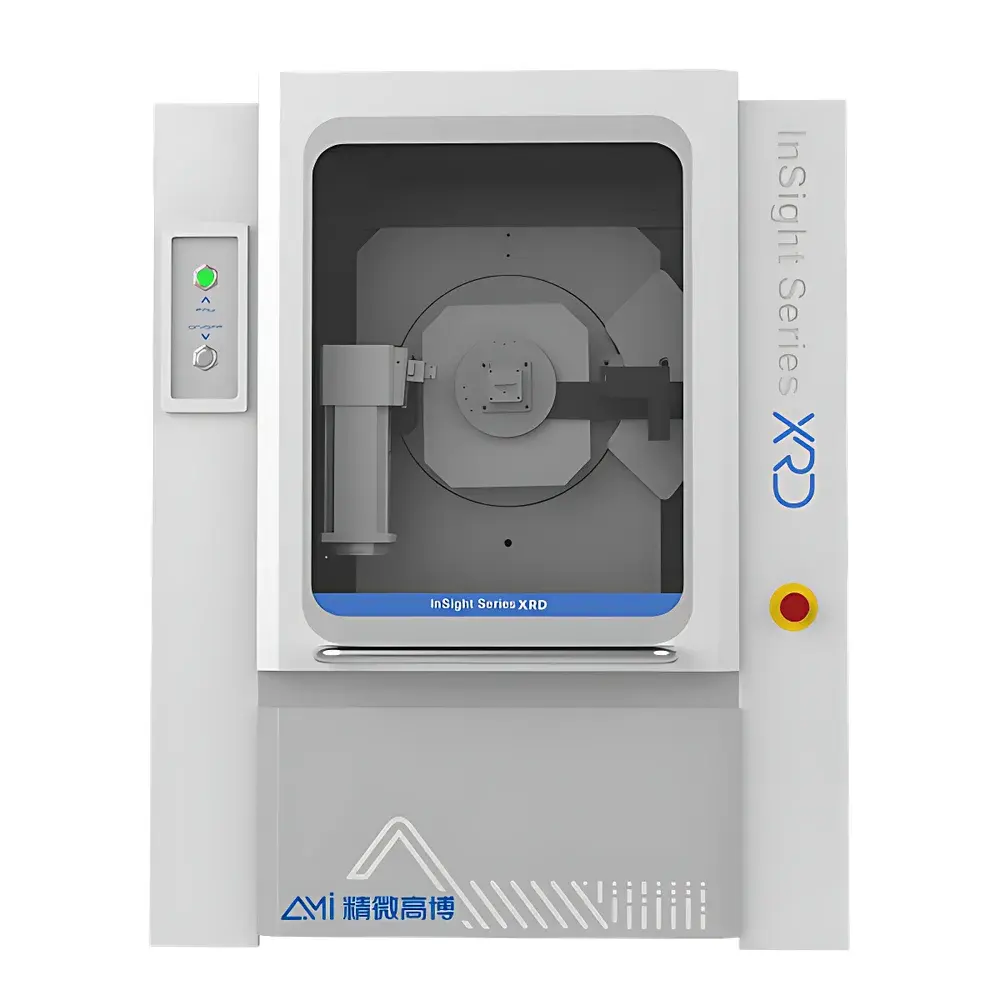
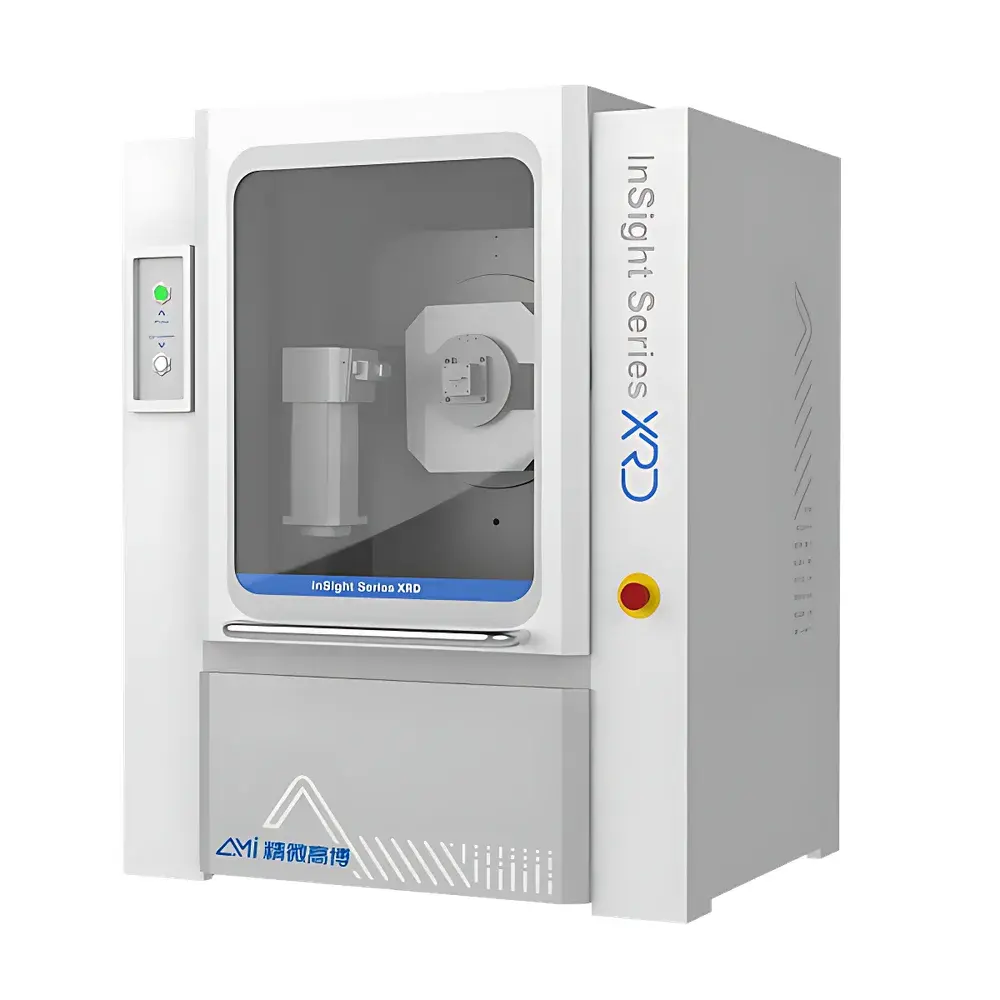
JWGB InSight Series In-situ Transmission X-ray Diffractometer for Pouch Cells
| Brand | JWGB |
|---|---|
| Origin | Beijing, China |
| Manufacturer Type | Direct Manufacturer |
| Instrument Type | Powder X-ray Diffractometer |
| Configuration | Benchtop |
| X-ray Source | Sealed Mo-target Tube |
| Maximum Power | 1600 W |
| Angular Accuracy | ±0.01° |
| Angular Resolution | 0.1° |
| Goniometer Geometry | Vertical θ–2θ |
| Goniometer Radius | 144 mm |
| Angular Range | 0°–150° |
| Detector | Photon-counting 2D Array Detector |
| Sample Stage | Temperature-Controlled Pouch-Cell Holder (−30 °C to 300 °C) |
| Dimensions | 900 mm × 680 mm × 550 mm |
| Weight | 100 kg |
Overview
The JWGB InSight Series In-situ Transmission X-ray Diffractometer is a purpose-engineered benchtop system designed specifically for real-time structural characterization of pouch-type lithium-ion batteries under electrochemical operation. Unlike conventional reflection-mode in-situ XRD systems—typically limited to coin-cell configurations—the InSight platform implements a true transmission geometry: monochromatic Mo-Kα X-rays (λ = 0.71073 Å) enter the pouch cell orthogonally through one laminated foil face and exit through the opposing face, where they are captured by a high-efficiency, photon-counting 2D array detector. This configuration ensures full-depth sampling across the entire electrode stack—including simultaneous diffraction contributions from both cathode and anode active layers—without signal attenuation or geometric shadowing inherent to reflection setups. The system operates on a vertical θ–2θ goniometer with 144 mm radius and achieves angular accuracy of ±0.01° over a 0°–150° 2θ range, enabling precise lattice parameter tracking (e.g., NCM c-axis expansion, LiFePO₄ phase fraction evolution) during galvanostatic cycling. Its integration-ready architecture supports synchronized data acquisition with commercial potentiostats/galvanostats via TTL/trigger I/O, ensuring temporal alignment between electrochemical state-of-charge and diffraction pattern acquisition.
Key Features
- Transmission-mode XRD optimized for commercially relevant pouch-cell format—enabling >1,000-cycle structural stability studies not feasible with sealed coin cells
- High-power (1600 W) sealed Mo-target X-ray tube delivering stable, high-flux radiation suitable for time-resolved measurements (typical single-pattern acquisition: 300 s)
- Photon-counting 2D array detector with zero readout noise, high dynamic range, and intrinsic energy discrimination—critical for resolving overlapping Bragg peaks in multi-phase electrode systems
- Motorized, temperature-regulated pouch-cell stage supporting continuous operation from −30 °C to 300 °C; compatible with thermal runaway simulation and low-temperature kinetic analysis
- Benchtop footprint (900 × 680 × 550 mm) and robust mechanical design facilitate deployment in shared laboratory spaces and QC environments without dedicated shielding rooms
- Modular electrical interface (TTL trigger, analog voltage input/output) for seamless synchronization with third-party electrochemical workstations (e.g., BioLogic, Gamry, Ivium)
Sample Compatibility & Compliance
The InSight Series accommodates standard-format aluminum-laminated pouch cells (up to 100 mm × 80 mm active area) with customizable current collector tabs and electrolyte fill ports. Electrode thicknesses up to 150 µm are fully compatible with transmission geometry without resolution degradation—leveraging the inherent insensitivity of Bragg angle dispersion to sample thickness in normal-incidence transmission. All mechanical and thermal subsystems comply with IEC 61000-6-3 (EMC emission limits) and IEC 61010-1 (safety requirements for electrical equipment). Data acquisition workflows support audit-trail generation and electronic signature capability, aligning with GLP and GMP documentation standards. While not FDA-cleared as a medical device, the system meets ISO 17025-relevant traceability requirements for calibration of angular scale and temperature sensor response.
Software & Data Management
Control and analysis are executed via JWGB’s proprietary XRDStudio software suite, built on a modular Qt-based framework. Real-time pattern monitoring includes live 2D image integration, dynamic background subtraction, and auto-threshold peak detection. Batch processing pipelines support Rietveld refinement (using GSAS-II or TOPAS-compatible output), quantitative phase analysis (QPA) via internal standard or reference intensity ratio (RIR) methods, and lattice parameter mapping across charge/discharge cycles. Raw and processed datasets are stored in HDF5 format with embedded metadata (voltage, current, temperature, timestamp), ensuring FAIR (Findable, Accessible, Interoperable, Reusable) compliance. Export modules generate ASTM E1361-compliant .xye files and ISO 13314-structured reports for regulatory submissions.
Applications
- In-situ monitoring of phase transitions in layered oxides (e.g., NCM, NCA) and polyanion cathodes (LiFePO₄, LiMnPO₄) during long-term cycling
- Quantification of coexisting lithiated/delithiated phases (e.g., FePO₄/LiFePO₄ ratio) and their evolution kinetics under varying C-rates
- Thermal degradation pathway analysis—tracking onset temperatures of structural collapse, gas evolution signatures, and metastable intermediate formation
- Electrolyte decomposition product identification via crystalline byproduct detection at elevated temperatures (≥60 °C)
- Interface reaction layer growth assessment at anode/current collector interfaces using low-angle scattering enhancements
- Validation of computational models (e.g., DFT-predicted lattice strains) against experimentally derived unit-cell parameters (a, c, V)
FAQ
Can the system be used with non-aqueous or solid-state pouch cells?
Yes—the transmission geometry imposes no fundamental restriction on electrolyte chemistry; compatibility has been verified with carbonate-based liquid, ionic liquid, and sulfide-based solid electrolytes, provided optical path length remains within detector dynamic range.
Is lead shielding integrated into the instrument enclosure?
The benchtop housing incorporates 2 mm Pb-equivalent lining compliant with IEC 61000-6-4 and local radiation safety regulations for Class I X-ray equipment; no external shielding room is required for standard operation.
Does the software support automated Rietveld refinement during in-situ experiments?
XRDStudio enables scheduled batch refinement using pre-loaded structural models; however, full-cycle Rietveld fitting is performed post-acquisition to ensure computational stability and result reproducibility.
What is the minimum detectable phase fraction in quantitative analysis?
Under optimal counting statistics (≥10⁶ total counts per pattern), detection limits for secondary crystalline phases are typically ≤1.5 wt% using internal standard methodology per ISO 13314 Annex B.
Are custom pouch-cell fixtures available for non-standard dimensions?
JWGB offers OEM fixture design services; mechanical drawings and thermal interface specifications must be provided prior to fabrication to maintain stage calibration integrity.






