
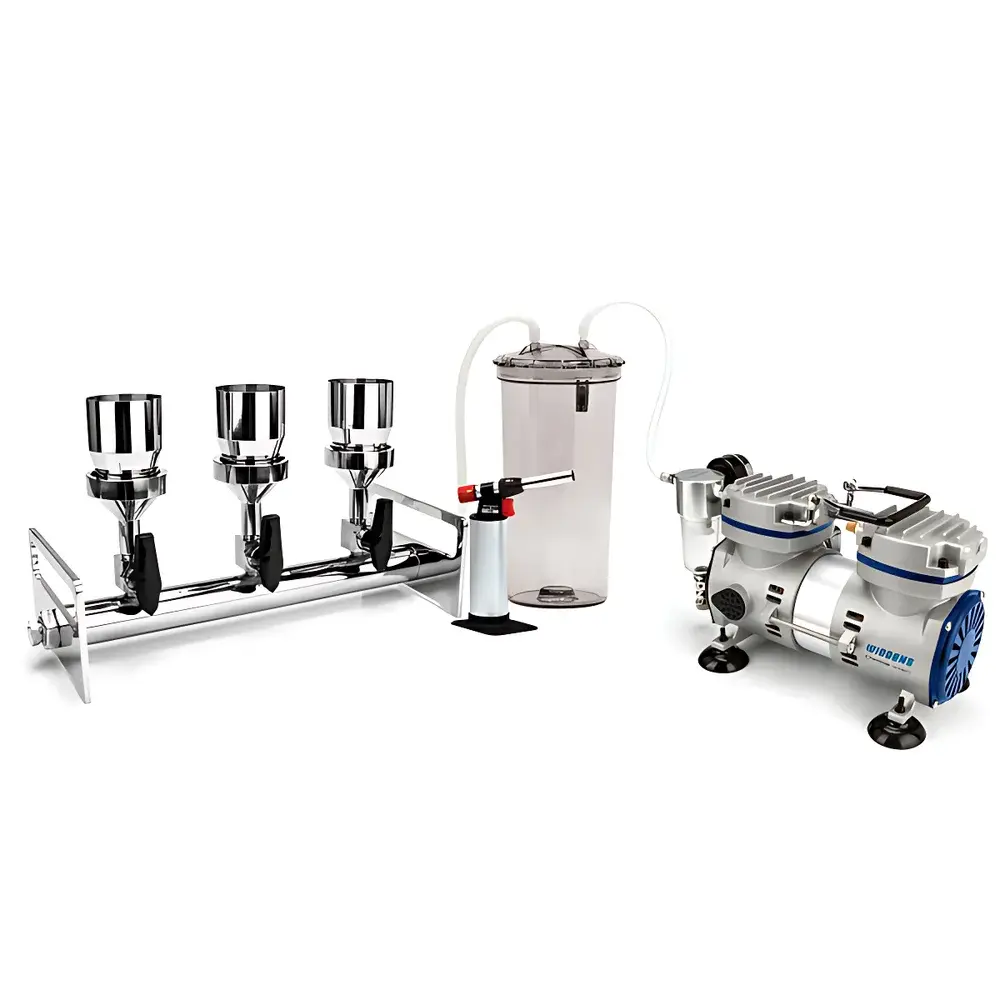
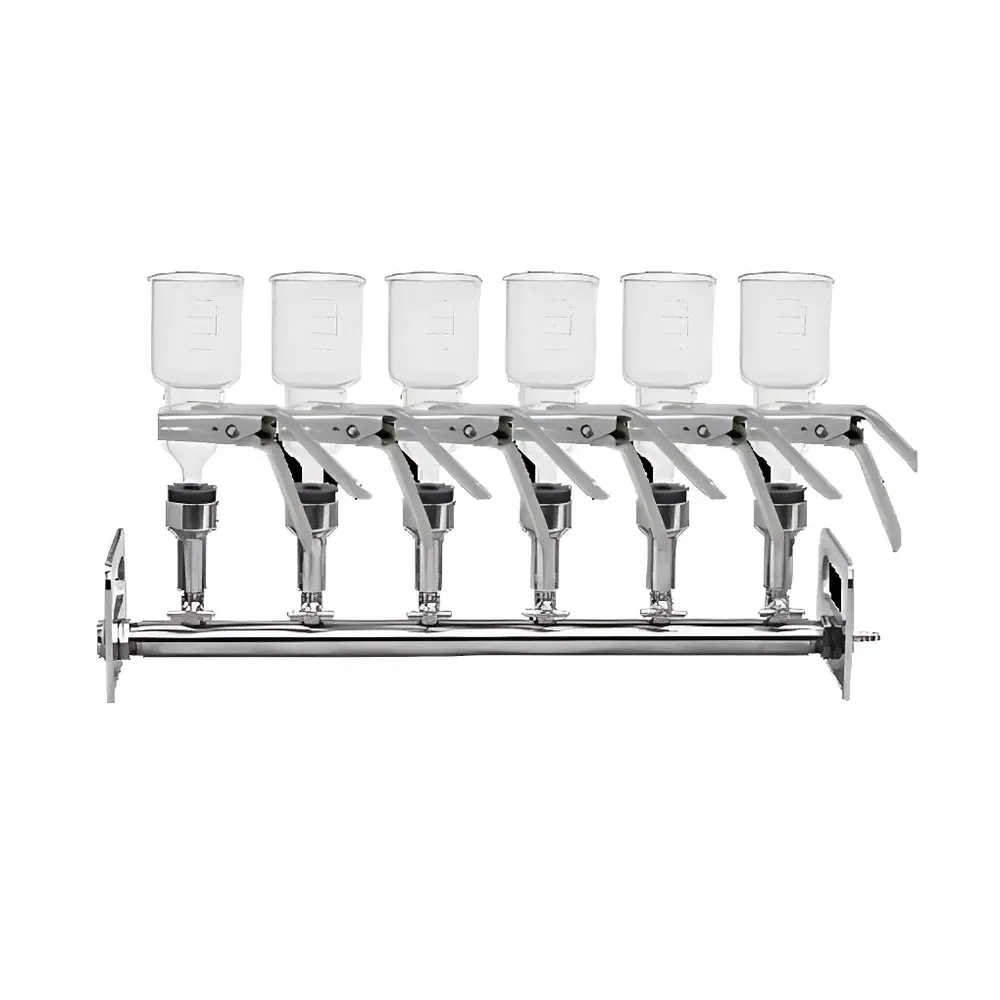
WIGGENS BioVac 330 Multi-Position Vacuum Filtration Manifold
| Brand | WIGGENS |
|---|---|
| Origin | Germany |
| Model | BioVac 330 |
| Construction Material | ASTM A276 Type 316 Stainless Steel |
| Filtration Positions | 3 |
| Filter Diameter | 47–50 mm |
| Effective Filtration Area per Position | 9.6 cm² |
| Hose Connection | 8 mm ID |
| Dimensions (L×W×H) | 45 × 15 × 15 cm |
| Sterilization Compatibility | Autoclavable (121 °C, 20 min), Dry Heat (180 °C), Flame-Sterilizable |
| Compatible Vessel Options | 100 mL, 300 mL, and 500 mL stainless steel filter flasks |
Overview
The WIGGENS BioVac 330 Multi-Position Vacuum Filtration Manifold is an engineered solution for high-integrity, scalable vacuum-assisted filtration in life science laboratories. Designed for applications requiring reproducible sample processing under sterile or aseptic conditions—including cell harvesting, microbial recovery, buffer exchange, particulate removal, and membrane-based assays—the BioVac 330 operates on the principle of controlled differential pressure across microporous membranes (e.g., cellulose acetate, PVDF, PTFE, or nylon). Its three independent filtration ports enable parallel processing of discrete samples without cross-contamination risk, while maintaining consistent vacuum distribution and flow dynamics across all positions. Constructed entirely from ASTM A276 Type 316 stainless steel—a grade selected for its superior resistance to chloride-induced pitting, organic solvents, and aggressive sterilization protocols—the manifold meets stringent material compatibility requirements for GMP-aligned bioprocessing and GLP-compliant analytical workflows.
Key Features
- Three independently controllable vacuum valves—enabling selective activation of individual filtration positions without interrupting ongoing processes at adjacent ports
- Rotary bayonet-style locking mechanism—ensures rapid, tool-free assembly and leak-tight sealing between manifold body and filter flasks or funnels
- Full-body construction from electropolished 316 stainless steel—providing corrosion resistance against acids, bases, alcohols, and halogenated solvents commonly used in nucleic acid purification and protein isolation
- Autoclavable up to 121 °C for 20 minutes, compatible with dry-heat sterilization (180 °C) and direct flame treatment—supporting repeated use in sterile technique environments
- Standardized 8 mm internal-diameter hose interface—compatible with common laboratory vacuum pumps, including oil-free diaphragm and scroll-type systems meeting ISO 8573-1 Class 0 air purity standards
- Modular design—accepts interchangeable vessel configurations: stainless steel filter flasks (100/300/500 mL), magnetic funnels (150/300/500 mL), borosilicate glass funnels (250 mL), and mesh-bottomed glass funnels for coarse particulate retention
Sample Compatibility & Compliance
The BioVac 330 supports filtration of aqueous buffers, cell culture supernatants, fermentation broths, clarified lysates, and environmental water samples across pH 1–14 and temperatures ranging from 4 °C to 80 °C during operation. Its surface finish complies with ASME BPE-2022 specifications for hygienic process equipment, ensuring low extractables and minimal leachables—critical for downstream applications such as HPLC sample prep, ELISA plate washing, and vaccine formulation QC. The manifold is routinely deployed in workflows aligned with ISO 13485, USP , and ASTM D2974 (for suspended solids analysis). When paired with certified sterile-filter membranes (e.g., 0.22 µm PVDF), it satisfies sterility testing requirements per USP and EP 2.6.1.
Software & Data Management
As a passive, manually operated manifold, the BioVac 330 does not incorporate embedded electronics or firmware. However, its mechanical architecture is fully compatible with integrated lab automation ecosystems: vacuum pump controllers (e.g., KNF N86 KT.18 or Vacuubrand PC 3001 Vario) may be configured with analog/digital I/O interfaces to log pressure setpoints, runtime, and valve actuation events. When used within validated cleanroom or QC laboratories, the device’s traceability is maintained via standard operating procedure (SOP) documentation, equipment logbooks, and calibration records for associated vacuum gauges and pumps—fully supporting FDA 21 CFR Part 11 audit trails when linked to LIMS or electronic lab notebook (ELN) platforms.
Applications
- High-throughput clarification of mammalian cell cultures prior to chromatography or ultrafiltration
- Simultaneous preparation of multiple environmental water samples for microbiological enumeration (e.g., membrane filtration per ISO 9308-1)
- Parallel solvent exchange in protein refolding workflows using tangential flow filtration (TFF) pre-concentration steps
- Removal of precipitated contaminants during plasmid DNA purification (alkaline lysis followed by neutralization and filtration)
- Aseptic filtration of media supplements and antibiotics into sterile bioreactor feed bags
- Routine quality control of injectable pharmaceuticals—filter integrity testing (bubble point, diffusion test) and particulate analysis per USP
FAQ
Is the BioVac 330 compatible with aggressive cleaning agents such as sodium hydroxide or peracetic acid?
Yes—Type 316 stainless steel exhibits excellent resistance to caustic solutions up to 30% w/w NaOH at ambient temperature and oxidizing agents including 5% peracetic acid, making it suitable for CIP (clean-in-place) validation studies.
Can the manifold be used under positive pressure for backflushing or membrane cleaning?
No—the BioVac 330 is designed exclusively for vacuum-driven filtration. Positive-pressure operation is not structurally rated and may compromise seal integrity.
What is the maximum recommended vacuum level for optimal membrane performance?
For most polymeric membranes (0.22–0.45 µm), a vacuum range of −0.8 to −0.95 bar (−80 to −95 kPa) is recommended to balance flow rate and membrane integrity; higher differentials may cause premature pore collapse or channeling.
Are replacement O-rings and valve components available as spare parts?
Yes—WIGGENS supplies certified Viton® and EPDM elastomer kits (Order No. W-OR-KIT-BV330) compliant with USP Class VI and FDA 21 CFR 177.2600 for repeated sterilization cycles.
Does the manifold meet EU Machinery Directive 2006/42/EC requirements?
As a non-powered, manually operated component, the BioVac 330 falls outside the scope of the Machinery Directive but conforms to EN 10204:2004 Type 3.1 material certification requirements for stainless steel fabrication.




