
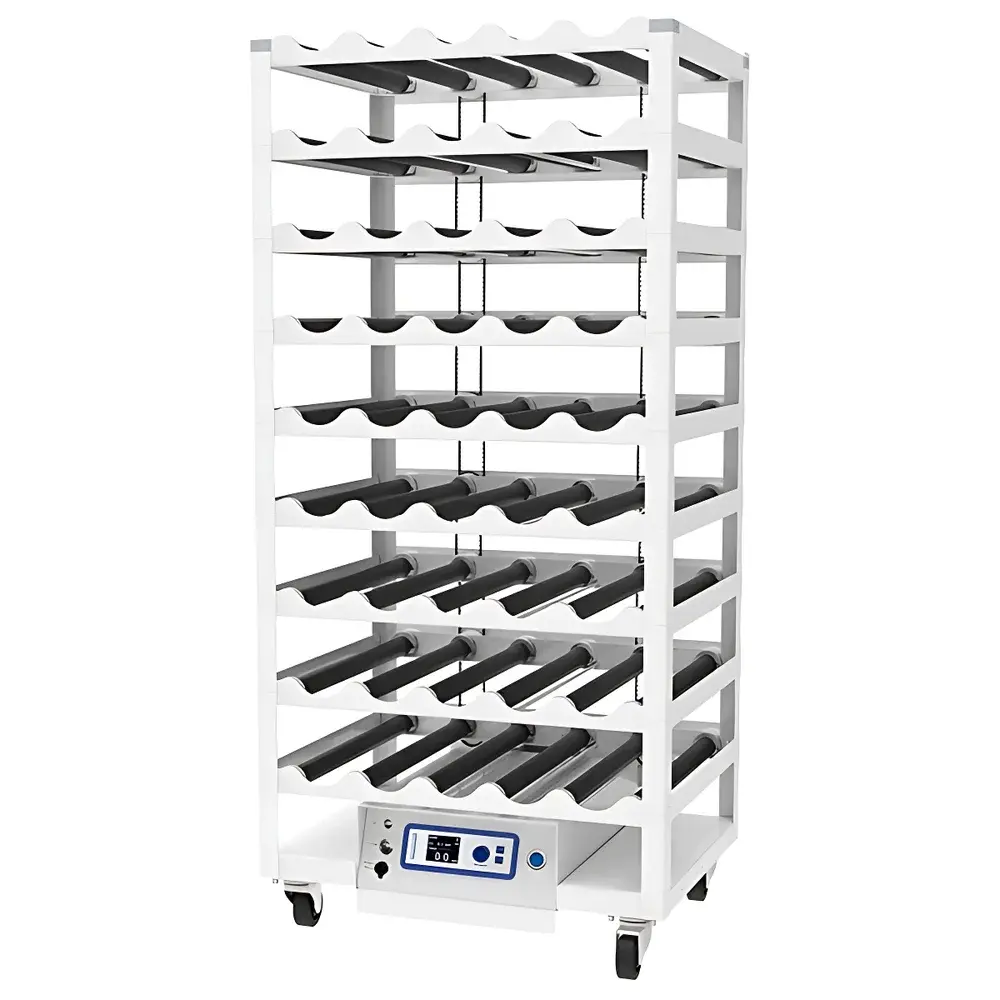
WIGGENS Celrol Pro Cell Culture Roller Drum System
| Brand | WIGGENS |
|---|---|
| Origin | Germany |
| Model | Celrol Pro |
| Capacity | 5–55 roller bottle positions per unit |
| Roller Speed Range (for 110 mm diameter bottles) | 0.08–2.5 rpm |
| Speed Accuracy | ±0.01 rpm |
| Bottle Diameter Compatibility | 108–121 mm |
| Max. Bottle Length | ≤550 mm |
| Drive System | Belt-driven, brushless DC motor |
| Rotation Direction | Selectable clockwise or counterclockwise |
| Display | High-contrast LCD |
| Power Supply | 100–240 VAC, 50/60 Hz |
| Operating Temperature Range | 10–40 °C |
| Humidity Limit | ≤80% RH at 31 °C |
| Communication Interface | RS232 |
| Optional Accessories | Backup battery module, thermal printer |
Overview
The WIGGENS Celrol Pro Cell Culture Roller Drum System is an engineered solution for scalable, reproducible adherent cell propagation under controlled rotational conditions. Designed in accordance with fundamental bioreactor principles for surface-dependent growth, the Celrol Pro employs precise, low-shear rotational motion to maximize monolayer expansion across the inner surface of cylindrical culture vessels—commonly referred to as roller bottles. Unlike static flasks or stirred-tank bioreactors, roller drum systems maintain laminar fluid dynamics and uniform nutrient/gas exchange without inducing damaging hydrodynamic stress, making them particularly suitable for sensitive primary cells, hybridomas, and virus production workflows. The system’s modular architecture supports integration into larger environmental enclosures—including WIGGENS’ ultra-large-volume incubators—enabling synchronized control of temperature, humidity, and CO₂ alongside rotational parameters. Its core function is not merely mechanical rotation, but the delivery of a stable, programmable angular velocity profile that ensures consistent cell attachment, metabolic activity, and harvest yield across multi-bottle batches.
Key Features
- Precision-controlled rotational speed from 0.08 to 2.5 rpm, adjustable in increments of 0.01 rpm—ensuring optimal shear management for delicate cell lines.
- Brushless DC motor drive with belt transmission delivers exceptional torque stability, zero maintenance requirements, and minimal mechanical vibration (<0.1 mm/s RMS), critical for long-term culture integrity.
- High-contrast backlit LCD interface provides real-time display of setpoint, actual speed, elapsed runtime, and operational status—accessible without external software.
- Configurable layer design accommodates either 5- or 8-position trays per level; up to 11 layers can be stacked vertically, enabling a maximum capacity of 88 roller bottles (550 mm length) per fully integrated unit.
- Bi-directional rotation selection (clockwise/counterclockwise) allows experimental optimization of flow patterns and boundary layer development on the bottle interior surface.
- Integrated rotation monitoring with audible and visual alarm triggers if motion ceases unexpectedly—supporting GLP-compliant process documentation and deviation tracking.
- RS232 serial interface enables remote parameter configuration, data logging, and synchronization with central laboratory management systems.
Sample Compatibility & Compliance
The Celrol Pro accepts standard ISO-compliant roller bottles with outer diameters between 108 mm and 121 mm and lengths up to 550 mm—including widely used formats such as Corning® 850 cm² and Nunc™ 1750 cm² vessels. Its mechanical design conforms to IEC 61000-6-2 (immunity) and IEC 61000-6-4 (emissions) standards for laboratory equipment. While not certified as a medical device, the system meets general requirements for use in ISO 13485-aligned manufacturing environments when operated within validated protocols. It supports adherence to USP , ASTM F2629, and relevant sections of FDA 21 CFR Part 11 when paired with compliant data acquisition software and audit-trail-enabled controllers (e.g., via optional RS232-connected SCADA systems).
Software & Data Management
The Celrol Pro operates autonomously via its embedded microcontroller and LCD interface, requiring no host PC for basic operation. For advanced integration, the RS232 port supports ASCII-based command protocols compatible with LabVIEW™, Python (pySerial), or custom LIMS interfaces. When connected to a time-stamped logging system, all speed changes, start/stop events, and alarm activations are recorded with millisecond resolution—facilitating retrospective analysis and regulatory review. Optional thermal printer output provides hard-copy verification of operational logs, satisfying traceability requirements in GMP pilot-scale cell banking applications.
Applications
- Large-scale production of monoclonal antibodies and recombinant proteins in suspension-adapted or surface-adherent mammalian cell lines (e.g., CHO-K1, HEK293, Vero).
- Viral vector manufacturing (AAV, lentivirus) where high MOI consistency and low shear stress are essential for capsid integrity.
- Primary human fibroblast and mesenchymal stem cell expansion prior to cryopreservation or clinical-grade differentiation protocols.
- Regulatory batch documentation support for Phase I–III bioprocess development, including comparability studies across scale-up transitions.
- Academic and industrial research into shear-sensitive phenotype expression, extracellular matrix deposition, and contact inhibition dynamics.
FAQ
Can the Celrol Pro be installed inside a CO₂ incubator?
Yes—the 5-position per-layer configuration is specifically designed to fit within WIGGENS’ ULT-series large-volume incubators (e.g., ULT-700), permitting concurrent control of temperature, humidity, and gas composition.
Is speed calibration traceable to national standards?
Speed accuracy (±0.01 rpm) is factory-verified using NIST-traceable optical tachometry; calibration certificates are available upon request for IQ/OQ validation packages.
Does the system support 24/7 unattended operation?
Yes—its brushless motor architecture, thermal overload protection, and non-volatile memory for last-set parameters ensure continuous operation over extended periods without performance drift.
What safety certifications does the unit carry?
It complies with CE marking requirements under the EU Machinery Directive 2006/42/EC and Low Voltage Directive 2014/35/EU, and bears the RoHS 2011/65/EU conformity mark.
Can multiple Celrol Pro units be synchronized?
While no native master-slave protocol exists, RS232 command sets allow external PLC or script-based coordination of start/stop and speed profiles across networked units.




