
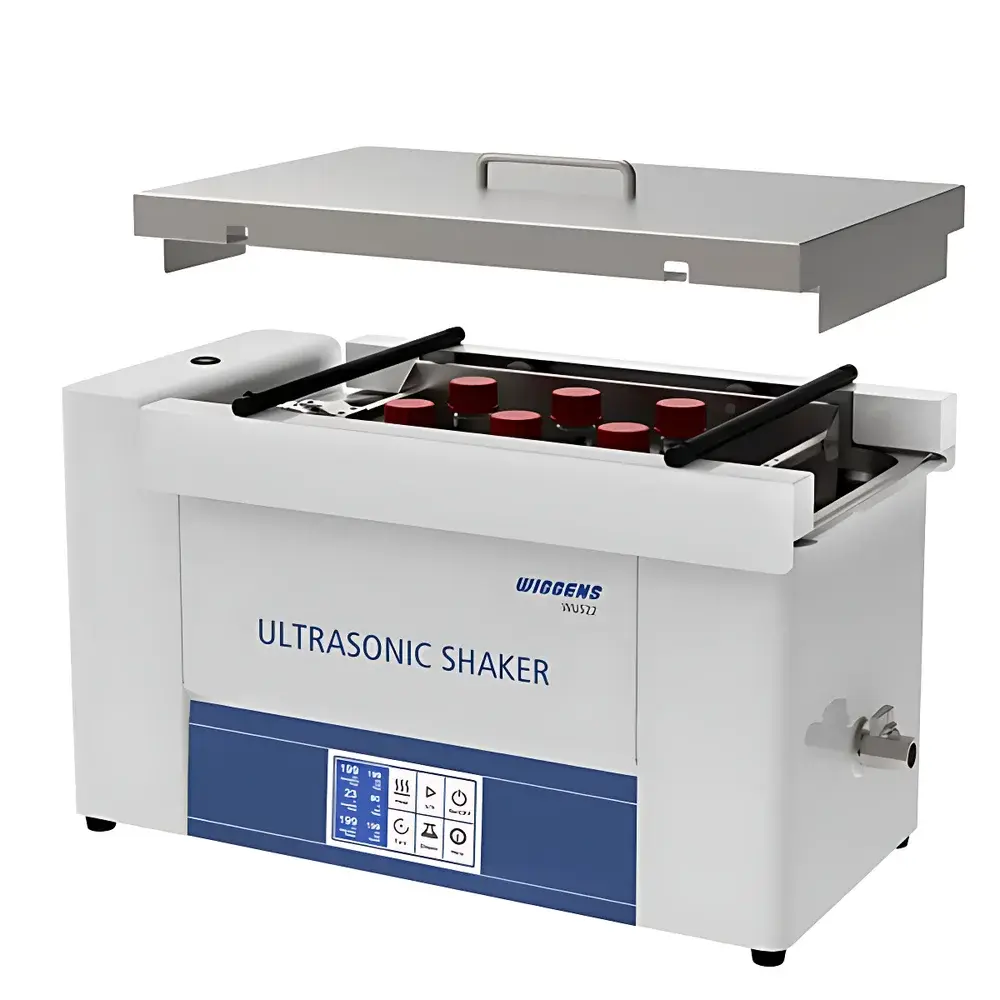
WIGGENS WUS22 Ultrasonic Bath with Reciprocating Shaking Function
| Brand | WIGGENS |
|---|---|
| Origin | Germany |
| Model | WUS22 |
| Temperature Range | 20–80 °C |
| Heating Power | 550 W |
| Ultrasonic Frequency | 37 kHz |
| Oscillation Mode | Reciprocating |
| Oscillation Amplitude | 20 mm |
| Oscillation Speed | 20–200 rpm |
| Speed Control Accuracy | ±1 rpm |
| Timer Range | 1–199 min |
| Bath Tray Dimensions (W×D×H) | 315×205×55 mm |
| External Dimensions (L×W×H) | 800×340×390 mm |
| Drain Valve | Integrated side-mounted |
| Display | TFT touchscreen with real-time simultaneous display of set temperature, oscillation speed, and timer |
Overview
The WIGGENS WUS22 Ultrasonic Bath with Reciprocating Shaking Function is an integrated laboratory instrument engineered for precision sample preparation in life science, pharmaceutical, environmental, and food testing laboratories. It combines high-frequency ultrasonic energy (37 kHz) with mechanically controlled reciprocating oscillation to simultaneously enhance dissolution kinetics, particle dispersion, and homogenization of heterogeneous suspensions. Unlike conventional water baths or standalone shakers, the WUS22 operates on a dual-actuation principle: ultrasonic cavitation disrupts interfacial forces and agglomerates at the microscale, while programmable reciprocating motion (20–200 rpm, ±1 rpm accuracy) ensures macroscopic mixing uniformity across vessel arrays. Its thermostatically regulated stainless-steel bath (20–80 °C, 550 W heating capacity) maintains thermal stability within ±0.3 °C under load—critical for temperature-sensitive extractions, enzyme reactivation, or solubility profiling per USP , ISO 17025-compliant workflows, and GLP-aligned sample prep protocols.
Key Features
- Integrated dual-mode operation: simultaneous ultrasonication (37 kHz) and reciprocating shaking (20–200 rpm) for synergistic sample homogenization
- TFT touchscreen interface with real-time, synchronized display of set temperature, oscillation speed, and countdown timer—enabling full parameter visibility without mode switching
- Proportional-speed control architecture ensures linear, repeatable response across the full oscillation range; no stepwise jumps or hysteresis
- Electropolished 316-grade stainless-steel bath chamber with integrated side-mounted drain valve for rapid, contamination-free fluid exchange and routine cleaning
- Auto-memory function retains last-used parameters—including temperature setpoint, rpm, and timer duration—even after power interruption, reducing setup time between runs
- Modular tray design (315 × 205 × 55 mm) accommodates standardized labware: up to six 250 mL or 300 mL Erlenmeyer flasks, two 500 mL or 1 L vessels, or one 2 L container—optimized for parallel processing under identical thermal and mechanical conditions
Sample Compatibility & Compliance
The WUS22 supports a broad spectrum of sample matrices including aqueous suspensions, viscous biological lysates, powdered pharmaceutical intermediates, soil extracts, and emulsified food homogenates. Its non-contact ultrasonic transduction minimizes cross-contamination risk, while the sealed bath chamber prevents solvent evaporation and maintains consistent acoustic coupling during extended treatments. The instrument complies with IEC 61010-1:2010 for laboratory electrical safety and meets CE marking requirements for electromagnetic compatibility (EMC Directive 2014/30/EU). Its stable temperature control and traceable parameter logging support audit readiness for FDA 21 CFR Part 11–aligned environments when paired with validated LIMS integration.
Software & Data Management
While the WUS22 operates as a stand-alone benchtop unit with embedded firmware, its parameter retention logic and deterministic control loop enable seamless integration into automated lab workflows. All user-defined settings—including temperature ramp profiles, oscillation duty cycles, and ultrasonic pulse durations—are stored in non-volatile memory with timestamped write events. When connected via optional RS-232 or USB-to-serial adapter (sold separately), the device supports ASCII command protocol for remote initiation, status polling, and event logging—facilitating compliance with electronic record requirements under 21 CFR Part 11 when deployed with validated third-party data acquisition software.
Applications
- Routine dissolution testing of solid dosage forms per USP and Ph. Eur. 2.9.3
- Cell lysis and nucleic acid extraction from tissue samples under controlled thermal conditions
- Accelerated leaching studies for environmental monitoring (e.g., heavy metal release from sediments)
- Homogenization of nanoparticle dispersions prior to DLS or TEM analysis
- Preparation of calibration standards for HPLC and ICP-MS requiring matrix-matched uniformity
- Rehydration and dispersion of lyophilized reference materials in QC laboratories
FAQ
Does the WUS22 support continuous ultrasonic operation without oscillation?
Yes—the ultrasonic generator and reciprocating drive operate independently; either function can be activated or deactivated individually via the touchscreen interface.
Is the bath temperature uniformity verified across the entire working volume?
Yes—temperature uniformity is maintained within ±0.5 °C at 37 °C and ±0.8 °C at 80 °C (measured at five points per ASTM E1112-18 standard test method).
Can the device be calibrated in-house using NIST-traceable references?
Temperature calibration is supported via offset adjustment using a certified RTD probe; oscillation speed verification requires an optical tachometer per ISO 27888:2012 guidelines.
What maintenance intervals are recommended for long-term reliability?
Ultrasonic transducer performance should be verified quarterly using a hydrophone-based power meter; stainless-steel bath surfaces require weekly passivation with citric acid solution to maintain corrosion resistance.
Is the drain valve compatible with standard laboratory waste collection systems?
Yes—the 1/2″ BSP-threaded valve accepts standard polypropylene or PTFE-lined tubing and integrates directly with sink-side vacuum-assisted drainage manifolds.




