
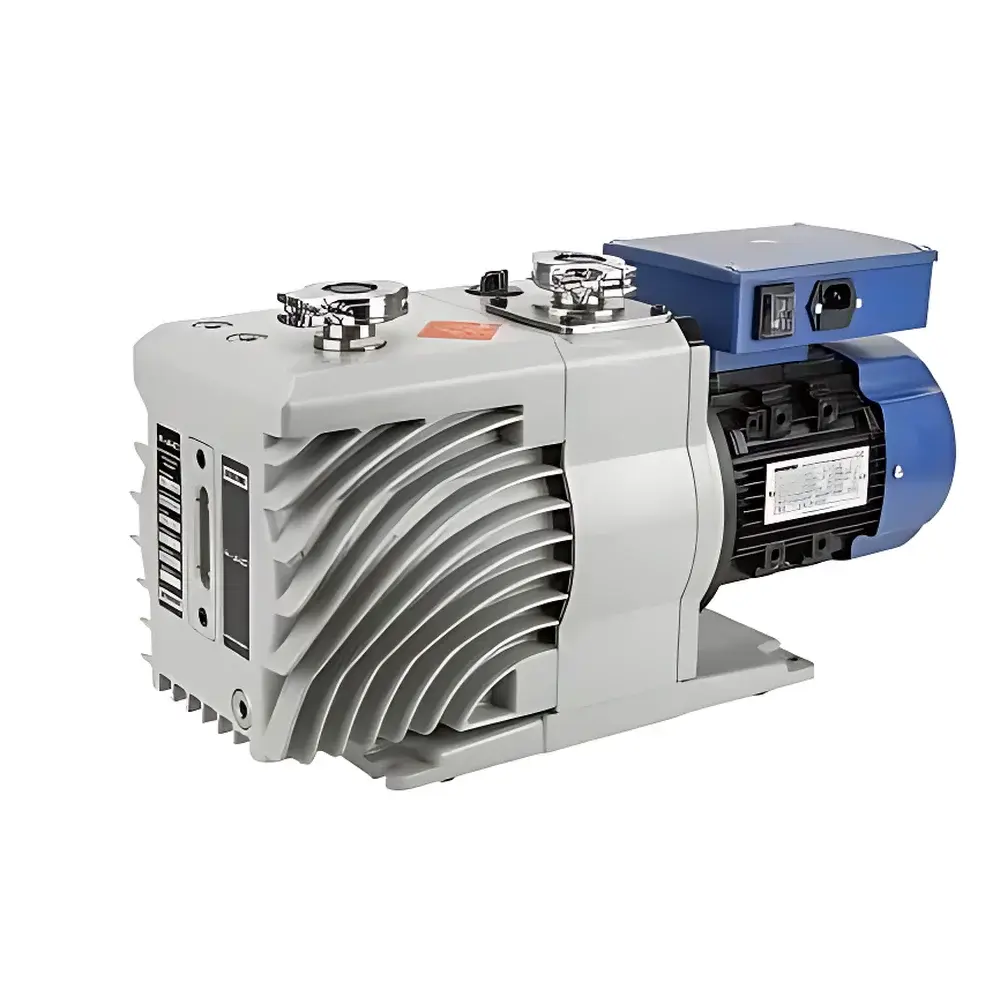
WIGGENS R-36D Dual-Stage Oil-Sealed Rotary Vane Vacuum Pump
| Brand | WIGGENS |
|---|---|
| Origin | Germany |
| Pump Type | Dual-Stage Rotary Vane |
| Lubrication | Oil-Sealed |
| Ultimate Vacuum | 4 × 10⁻⁴ mbar |
| Pumping Speed | 540 L/min |
| Motor Power | 1100 W |
| Motor Speed | 1400 rpm |
| Noise Level (Gas Ballast Off) | < 56 dB(A) |
| Oil Capacity | 2.1 L |
| Protection Rating | IP44 |
| Weight | 39 kg |
| Inlet Port | DN25 KF |
| Order Code | 900035-22 |
Overview
The WIGGENS R-36D is a dual-stage, oil-sealed rotary vane vacuum pump engineered for reliable and continuous operation in demanding laboratory and pilot-scale industrial applications. Based on the proven Couette-flow principle of rotary vane displacement, it achieves high volumetric efficiency through precisely machined vanes rotating eccentrically within a cylindrical stator chamber. The two-stage configuration enables progressive compression—first stage evacuates the process chamber, while the second stage further compresses the gas to atmospheric pressure—resulting in superior ultimate vacuum performance (4 × 10⁻⁴ mbar) and enhanced tolerance to water vapor and mild condensables. Designed and manufactured to German engineering standards, the R-36D serves both as a standalone roughing pump and as a forepump for high-vacuum systems such as turbomolecular pumps, diffusion pumps, and cryogenic traps. Its robust architecture supports uninterrupted duty cycles under variable load conditions typical in vacuum distillation, freeze drying, solvent recovery, and thin-film deposition processes.
Key Features
- Compact dual-stage design with integrated gas ballast valve for controlled admission of dry air—enabling efficient removal of condensable vapors (e.g., water, solvents) without oil emulsification
- Hermetically sealed induction motor (IP44-rated enclosure) with thermal overload protection, ensuring safe operation under voltage fluctuations and extended runtime
- Optimized oil circulation system with anti-backflow check mechanism—prevents oil migration into vacuum lines upon shutdown
- Low-noise operation (< 56 dB(A) with gas ballast closed) achieved via balanced rotor dynamics, vibration-damping mounting, and acoustic shielding
- Corrosion-resistant internal components—including chrome-plated vanes and stainless steel exhaust valves—enhancing longevity when handling mildly aggressive vapors
- Large-diameter circular oil sight glass with calibrated scale for rapid, at-a-glance verification of oil level and clarity
- DN25 KF quick-connect inlet port compliant with ISO-KF standard, facilitating tool-free integration with common vacuum manifolds and tubing
- Minimal oil mist generation due to multi-stage oil separation and baffle geometry—reducing ambient contamination and extending filter service life
Sample Compatibility & Compliance
The R-36D is compatible with non-reactive, non-polymerizing, and low-to-moderate vapor pressure samples commonly encountered in analytical, pharmaceutical, and materials science laboratories. It is not intended for pumping highly corrosive gases (e.g., Cl₂, HF, NH₃), explosive mixtures, or particulate-laden streams without upstream filtration. When used with cold traps or chemical scrubbers, the pump meets operational requirements aligned with ISO 21831-1 (vacuum pump performance testing) and ASTM D3924 (laboratory vacuum system safety practices). Its sealed motor and mechanical construction comply with IEC 60034-5 (IP44 ingress protection) and EU Machinery Directive 2006/42/EC. For GLP/GMP environments, routine oil analysis (per ISO 4406:2017 particle count) and documented maintenance logs support audit readiness.
Software & Data Management
The R-36D operates as a stand-alone analog device without embedded firmware or digital interfaces. However, its stable vacuum output and predictable power draw (1100 W ±5%) make it fully compatible with third-party vacuum monitoring systems—such as capacitance manometers (e.g., MKS Baratron), PLC-based controllers (e.g., Siemens S7 series), and data acquisition platforms (e.g., LabVIEW, Python-PyVISA). Integration with vacuum sequencing logic allows automated start/stop protocols, gas ballast activation based on pressure thresholds, and real-time logging of motor current and temperature (via optional external sensors). All operational parameters—including ultimate vacuum, pumping speed, and noise emission—are traceably certified per EN 1012-2 and reported in the factory test certificate shipped with each unit.
Applications
- Vacuum distillation of heat-sensitive organic compounds and essential oils
- Routine freeze drying (lyophilization) of biological samples and pharmaceutical intermediates
- High-throughput vacuum filtration in analytical sample preparation workflows
- Leak detection using helium mass spectrometry (as forepump for leak detectors)
- Thin-film coating processes requiring stable base pressure prior to sputtering or evaporation
- Vacuum impregnation of porous ceramics and composites
- Electron microscopy specimen preparation (critical point drying, vacuum embedding)
- Encapsulation and vacuum packaging of electronic components and optical elements
FAQ
What is the recommended oil change interval for the R-36D under continuous operation?
Under normal lab use (≤8 h/day, non-condensing loads), oil should be replaced every 500 operating hours or semiannually—whichever occurs first. For high-water-vapor applications (e.g., freeze dryer foreline), oil analysis is advised after 200 hours.
Can the R-36D be used with a cold trap? If so, what temperature range is suitable?
Yes—cold traps operating between –20 °C and –80 °C are compatible and strongly recommended when pumping aqueous or solvent-rich vapors to prevent oil degradation and extend service life.
Is the DN25 KF inlet compatible with ISO-KF 25 vacuum fittings from other manufacturers?
Yes—the inlet conforms strictly to ISO 2861-1:2017 dimensional specifications and seals reliably with standard copper or Viton O-rings used across major vacuum component suppliers.
Does the R-36D meet FDA 21 CFR Part 11 requirements for electronic records?
As an analog-only device without digital data storage or user-accessible software, the R-36D does not fall under Part 11 scope. However, when integrated into validated vacuum systems with compliant controllers, it contributes to overall system traceability.
What maintenance tasks require certified technician intervention?
Vane replacement, stator bore reconditioning, and motor winding inspection must be performed by WIGGENS-authorized service centers to preserve warranty and performance certification.



