
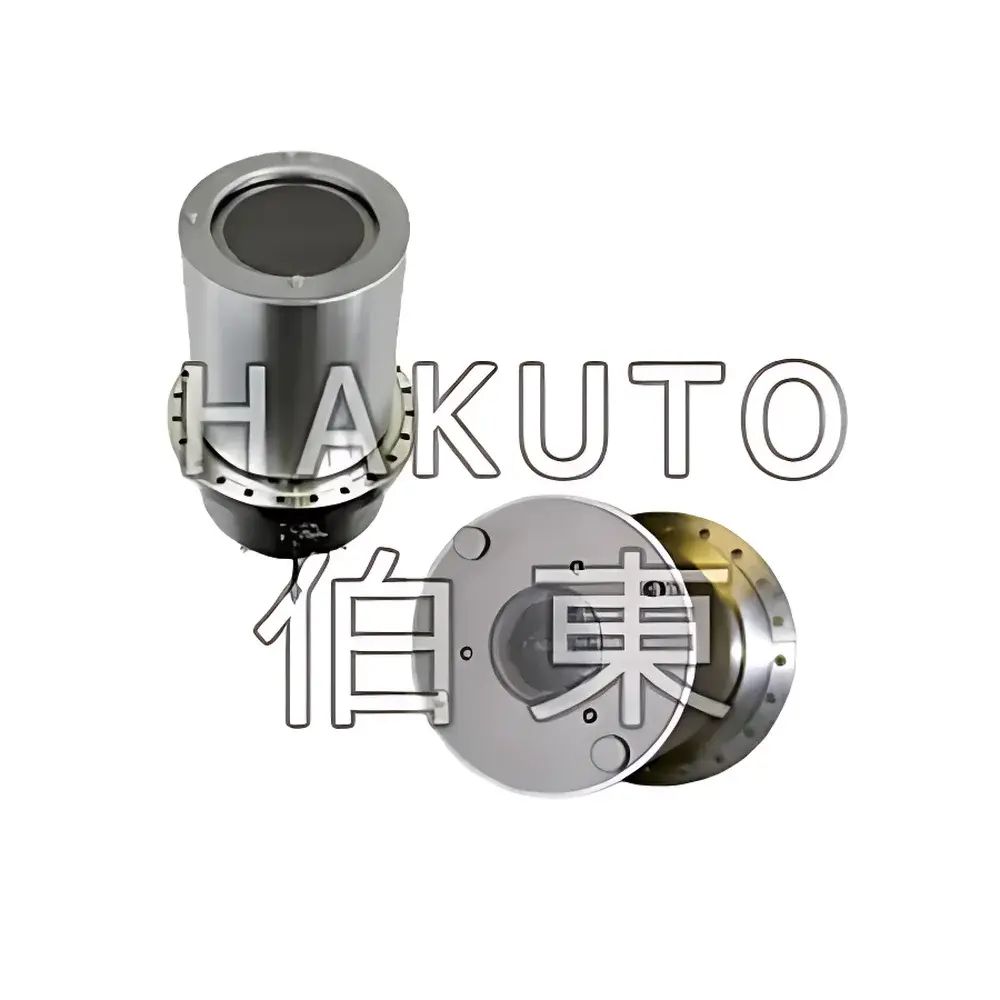
KRi RFICP Series RF Ion Source by Kaufman & Robinson, Inc.
| Brand | Kaufman & Robinson (KRI) |
|---|---|
| Origin | USA |
| Model | RFICP Series |
| Discharge Type | RF Inductive Coupling |
| Beam Current Range | 100–1500 mA |
| Beam Energy Range | 100–1200 V |
| Grid Aperture Diameter | 4–30 cm |
| Operating Gases | Ar, Kr, Xe, O₂, N₂, H₂ |
| Chamber Pressure | < 0.5 mTorr |
| System Components | Ion Source Body, RF Power Supply, Neutralizer (LFN-2000), Automated Control Unit |
| Compliance | Designed for integration into UHV and HV vacuum systems per ASTM F1716 and ISO 20000-1 standards |
Overview
The KRi RFICP Series RF Ion Source is a high-reliability, filament-free ion generation system engineered by Kaufman & Robinson, Inc. (KRI), a U.S.-based pioneer in ion beam technology since 1978. Unlike thermionic cathode-based ion sources, the RFICP design employs inductively coupled plasma (ICP) excitation to generate stable, low-divergence ion beams without consumable filaments—eliminating thermal degradation, contamination risk, and operational downtime associated with hot-cathode erosion. The source operates under controlled radio-frequency (13.56 MHz typical) power coupling into a quartz or ceramic discharge chamber, sustaining dense plasma at pressures below 0.5 mTorr. This enables precise control of ion energy (100–1200 eV) and beam current (100–1500 mA) via electrostatic grid extraction and acceleration optics. Its robust architecture supports long-duration, repeatable processes in ultra-high vacuum (UHV) and high-vacuum (HV) coating and etching platforms—including 8-inch and 12-inch industrial ion beam etch (IBE) tools—where beam uniformity, directional fidelity, and process stability are critical.
Key Features
- Filament-free RF inductive plasma generation ensures extended source lifetime, reduced maintenance cycles, and minimized metallic contamination in sensitive thin-film processes.
- Modular configuration across five scalable models (RFICP-40 to RFICP-380), distinguished by grid aperture diameter (4–30 cm Φ) and maximum extractable beam current (100–1500 mA).
- Independent control of beam energy (100–1200 V) and beam current enables decoupled optimization of sputter yield, surface activation depth, and stoichiometric incorporation in reactive deposition.
- Integrated neutralizer (LFN-2000 series) provides electron emission to prevent spacecraft-like charging effects on insulating substrates during ion-assisted deposition or etching.
- Full system integration package includes RF matching network, water-cooled source body, programmable controller with analog/digital I/O, and vacuum-compatible feedthroughs compliant with ConFlat® and ISO-KF standards.
- Designed for compatibility with standard 300–500 kHz RF generators and capable of operating with multiple process gases—including inert (Ar, Kr, Xe), oxidizing (O₂), and reducing (H₂, N₂) species—without hardware modification.
Sample Compatibility & Compliance
The RFICP Series supports processing of conductive, semiconductive, and dielectric substrates—including Si, GaAs, fused silica, CaF₂, polymers, and oxide ceramics—without substrate biasing requirements. Its low-energy, high-current capability makes it suitable for delicate surface preparation (e.g., pre-deposition cleaning of optical coatings) as well as aggressive material removal (e.g., anisotropic etching of SiC or diamond). All models meet mechanical and electrical safety requirements per UL 61010-1 and CE EN 61000-6-3. System-level validation aligns with ISO/IEC 17025 calibration traceability protocols when integrated into GLP/GMP-compliant thin-film manufacturing lines. For pharmaceutical-grade optical thin films, the source’s contaminant-free operation satisfies USP particulate matter thresholds when deployed in Class 100 cleanroom-integrated evaporators.
Software & Data Management
KRi provides a Windows-based control suite (KRI-CCS v4.x) supporting real-time monitoring of RF forward/reflected power, beam current/voltage, neutralizer emission current, and gas flow rates via calibrated mass flow controllers (MFCs). The software logs timestamped operational parameters with ≥1 Hz resolution, enabling full audit trails required under FDA 21 CFR Part 11 for regulated environments. Export formats include CSV and HDF5; API access allows integration with LabVIEW, Python (PySerial/PyVISA), and MES platforms such as Siemens Opcenter or Rockwell FactoryTalk. Optional Ethernet/IP and Modbus TCP interfaces facilitate centralized supervisory control in multi-chamber cluster tools.
Applications
- Ion Beam Assisted Deposition (IBAD): Enhances film density, adhesion, and environmental stability during thermal or e-beam evaporation of anti-reflective, high-LIDT laser coatings.
- In-situ Precleaning (PC): Removes native oxides and hydrocarbon monolayers prior to sputtering or evaporation—critical for low-defect multilayer mirrors and EUV mask blanks.
- Surface Modification & Activation (SM): Increases surface energy of polymers and composites for improved paint adhesion or biocompatible layer bonding.
- Ion Beam Etching (IBE): Delivers sub-5 nm feature resolution in hard materials (e.g., Si₃N₄, Al₂O₃) with near-zero redeposition and high aspect-ratio control.
- Ion Beam Sputter Deposition (IBSD): Enables stoichiometric transfer of complex targets (e.g., YBCO, TiAlN) for superconducting or wear-resistant multilayers.
FAQ
What distinguishes RFICP from DC or Kaufman-type ion sources?
RFICP eliminates thermionic cathodes entirely, relying on inductive RF coupling to sustain plasma—thereby avoiding filament burnout, tungsten contamination, and limited duty-cycle constraints inherent in DC-discharge sources.
Can RFICP operate continuously for >24 hours without intervention?
Yes—under stable vacuum conditions (100-hour mean time between failures (MTBF) in production IBAD systems.
Is customization available for non-standard grid geometries or gas inlets?
KRI offers engineering support for custom aperture profiles (e.g., elliptical, slotted), differential pumping ports, and dual-gas inlet manifolds—subject to NDA and mechanical interface review.
Does the system comply with electromagnetic compatibility (EMC) directives for cleanroom installation?
All RFICP control cabinets meet EN 55011 Class B emissions limits and include ferrite-suppressed cabling; optional RF-shielded enclosures are available for Class 10/ISO 4 environments.
How is beam uniformity characterized and verified?
Beam profile mapping is performed using Faraday cup arrays or rotating wire scanners per ASTM F1871; typical uniformity across ±15° divergence is ±3% for RFICP-380 at 800 mA/800 V under optimized extraction geometry.



