
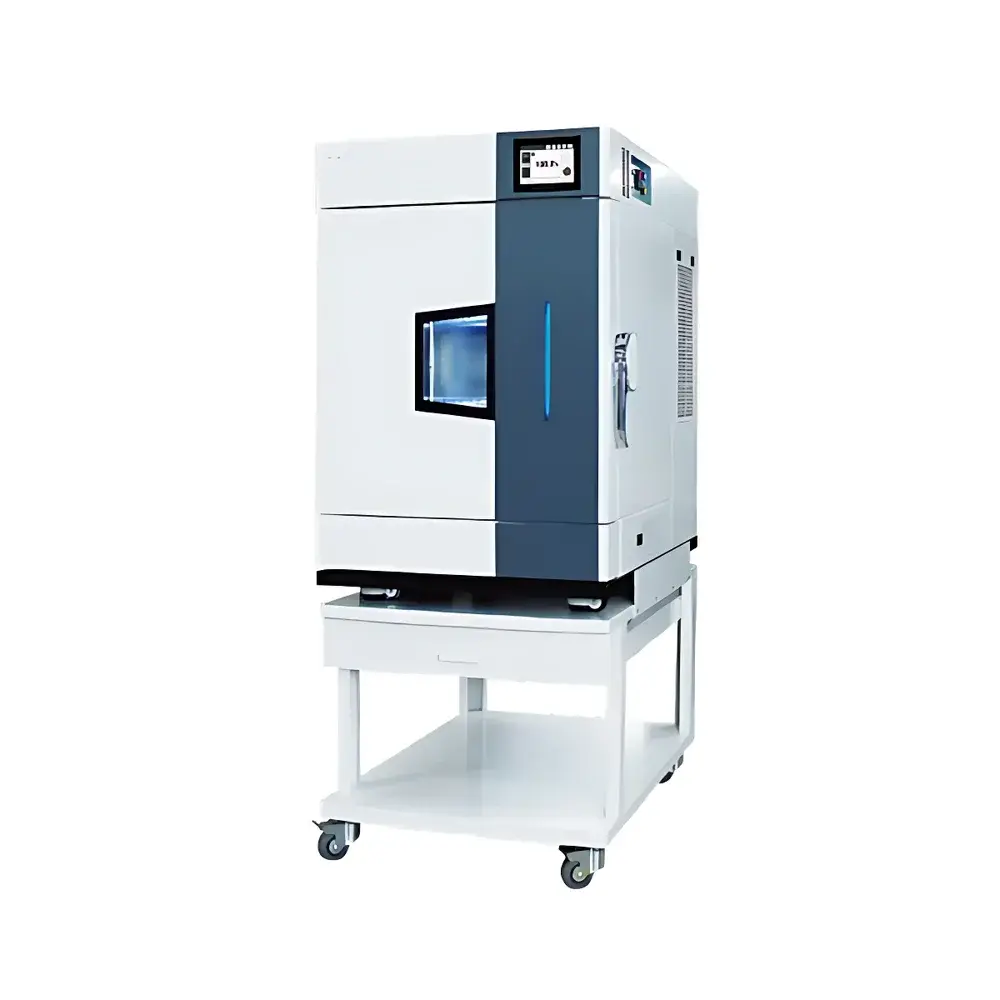
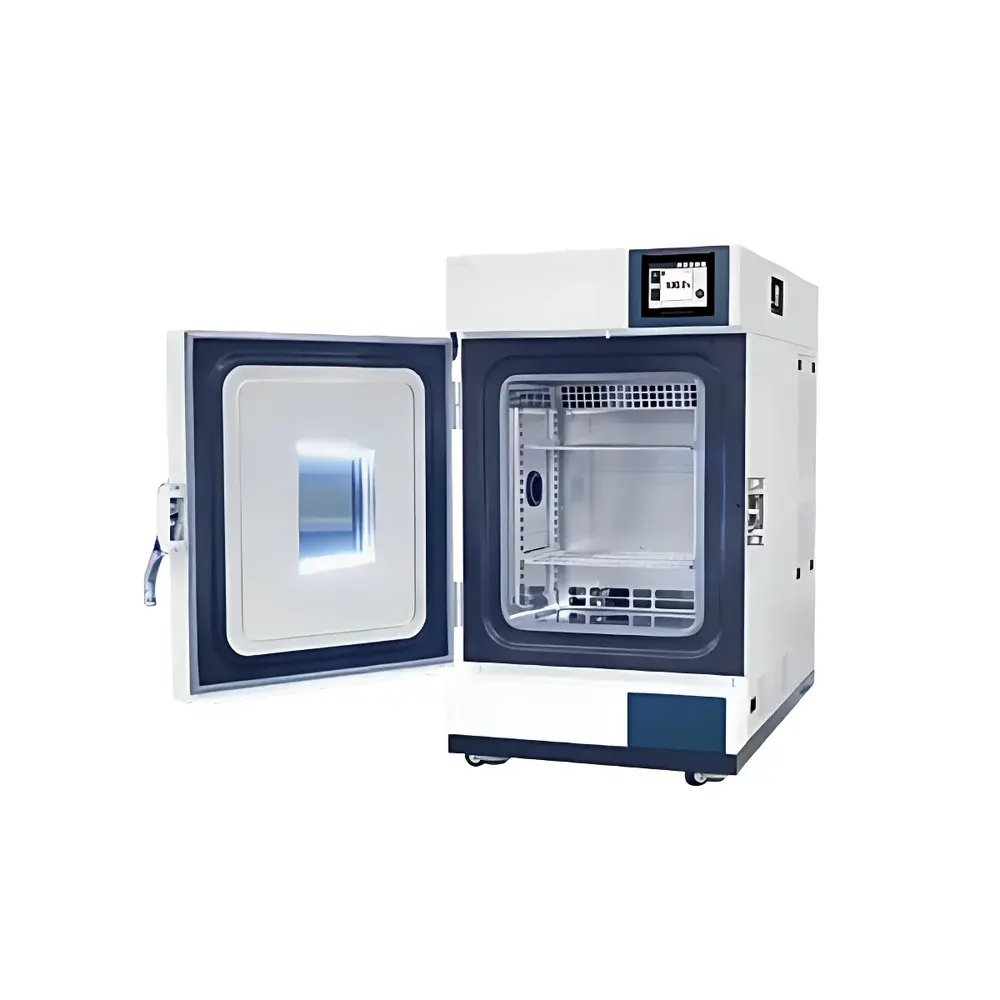
ChemTron TC3-KE & TC3-ME Series Benchtop Environmental Chambers
| Brand | ChemTron |
|---|---|
| Origin | Germany |
| Model | TC3-KE-025, TC3-ME-025 |
| Temperature Range | −40 °C to +150 °C (TC3-KE), −20 °C to +150 °C (TC3-ME) |
| Chamber Volume | 25 L |
| Temperature Uniformity (at 50 °C) | ±0.3 °C |
| Temperature Stability (at 50 °C) | ±0.5 °C |
| Heating Time (0 °C → 90 °C) | 60 min (TC3-KE), 50 min (TC3-ME) |
| Cooling Time (90 °C → 0 °C) | 70 min (TC3-KE), 50 min (TC3-ME) |
| Programmable Logic | 100 programs × 100 segments × 999 repeats |
| Control Interface | 5.6″ color touchscreen |
| Compliance | DIN 12880, IEC 60068-3-5, FDA-registered device |
| Communication | RS-232 standard, RS-485 optional (up to 32 units daisy-chained) |
Overview
The ChemTron TC3-KE and TC3-ME series benchtop environmental chambers are precision-engineered thermal test systems designed for controlled temperature exposure of pharmaceuticals, polymers, electronics, and stability-critical samples in regulated laboratory environments. Based on forced-air convection with dual independent heating and refrigeration circuits, these chambers deliver high reproducibility across wide operating ranges: −40 °C to +150 °C (TC3-KE) and −20 °C to +150 °C (TC3-ME). Their compact footprint—optimized for benchtop integration—maintains rigorous thermal performance without compromising spatial efficiency. All models comply with DIN 12880 (laboratory climate chambers) and IEC 60068-3-5 (environmental testing methods), and the device is registered with the U.S. Food and Drug Administration (FDA) under 21 CFR Part 807, supporting use in GLP- and GMP-aligned workflows.
Key Features
- Modular chamber architecture with standardized 25 L internal volume (TC3-KE-025 / TC3-ME-025), enabling consistent validation across instrument fleets.
- Dual-seal door system with integrated anti-fog heating element and LED status indicators—providing visual operational feedback from distance and ensuring condensation-free observation.
- Redundant safety architecture: independent electronic overtemperature cutoff (with dedicated sensor), mechanical overtemperature limiter (surface temperature <60 °C), door-open alarm with automatic thermal shutdown, and compressor protection against overcurrent, high/low refrigerant pressure, and thermal overload.
- 5.6″ full-color capacitive touchscreen controller featuring graphical real-time monitoring, intuitive icon-based navigation, and multilingual UI support (English, German, French, Spanish).
- High-efficiency insulation using low-conductivity polyurethane foam (≥100 mm thickness) and seamless welded stainless steel interior—achieving ≤0.3 °C temperature fluctuation at 50 °C (unloaded, 20 °C ambient).
- Configurable cable entry ports (standard Ø50 mm, optional Ø80 mm) with removable grommets for secure integration with external sensors, data loggers, or process control systems.
- Removable condenser grilles and front-accessible service panels—facilitating routine maintenance without disassembly or facility downtime.
Sample Compatibility & Compliance
These chambers accommodate standard laboratory sample carriers including wire shelving (2 standard + 5 optional positions, 25 kg max per shelf), ISO-compliant stability trays, and custom fixtures via adjustable shelf spacing (20 mm increments). The sealed, corrosion-resistant 304 stainless steel chamber interior resists degradation from solvents, humidity cycling, and repeated thermal stress. All units meet IEC 60068-2-1 (cold), IEC 60068-2-2 (dry heat), and IEC 60068-2-14 (thermal shock) test profiles. As an FDA-registered device, the TC3 series supports audit-ready documentation—including calibration traceability to NIST standards—and integrates with electronic lab notebooks (ELNs) and LIMS via RS-232/RS-485. Optional 21 CFR Part 11–compliant software packages provide user access control, electronic signatures, and immutable audit trails for critical quality attributes.
Software & Data Management
The embedded controller supports up to 100 programmable test sequences, each containing up to 100 time-temperature segments (max 2,000 total segments per unit). Each segment defines ramp rate, dwell time (0–99 h 59 min), and setpoint—with repeat loops (up to 999 cycles per program) for accelerated aging or cyclic stress testing. Data logging records temperature, runtime, alarm events, and system status at user-defined intervals (1 s to 60 min resolution). Export formats include CSV and PDF reports compatible with JMP, Minitab, and Python-based statistical analysis pipelines. RS-485 daisy-chaining enables centralized supervision of up to 32 chambers via a single host PC, with synchronized timestamping and cross-unit correlation analysis. Firmware updates are performed via USB or network interface, preserving all user configurations and historical logs.
Applications
- ICH Q1A(R2) stability testing of active pharmaceutical ingredients (APIs) and finished dosage forms under long-term (25 °C/60% RH) and accelerated (40 °C/75% RH) conditions.
- Material qualification per ASTM D3418 (Tg determination), ASTM D618 (conditioning prior to mechanical testing), and ISO 11357 (DSC sample pre-conditioning).
- Electronics reliability screening: thermal cycling (MIL-STD-810H Method 502.7), solder joint fatigue simulation, and component burn-in validation.
- Biological reagent storage validation—verifying thermal uniformity across shelf zones during extended low-temperature holds (−20 °C to −40 °C).
- Method development for lyophilization cycle optimization, including shelf temperature mapping and vial heat transfer coefficient (Kv) studies.
FAQ
What is the temperature uniformity specification, and how is it validated?
Temperature uniformity is specified as ±0.3 °C at 50 °C (unloaded, per DIN 12880 Annex B). Validation uses a 9-point sensor array (center + 8 corners) mapped across the working volume, with results documented in the factory calibration certificate traceable to DAkkS-accredited laboratories.
Can the chamber operate continuously at −40 °C?
Yes—the TC3-KE series is rated for continuous operation from −40 °C to +150 °C. Compressor staging and defrost logic ensure stable sub-zero performance without manual intervention.
Is remote monitoring supported without additional hardware?
RS-232 is standard; RS-485 requires optional module installation. Neither interface requires external gateways—direct serial-to-PC or Modbus TCP conversion via industrial protocol converters is fully supported.
How does the dual-seal door improve experimental integrity?
The primary silicone gasket and secondary magnetic seal reduce air exchange during door opening by >90%, minimizing temperature recovery lag and humidity perturbation—critical for ICH-compliant stability studies.
What documentation is provided for regulatory submissions?
Each unit ships with IQ/OQ protocols, a full calibration report (including uncertainty budgets), FDA registration letter, CE Declaration of Conformity, and compliance statements for DIN, IEC, and ISO standards referenced in EU Annex 11 and USP .



