
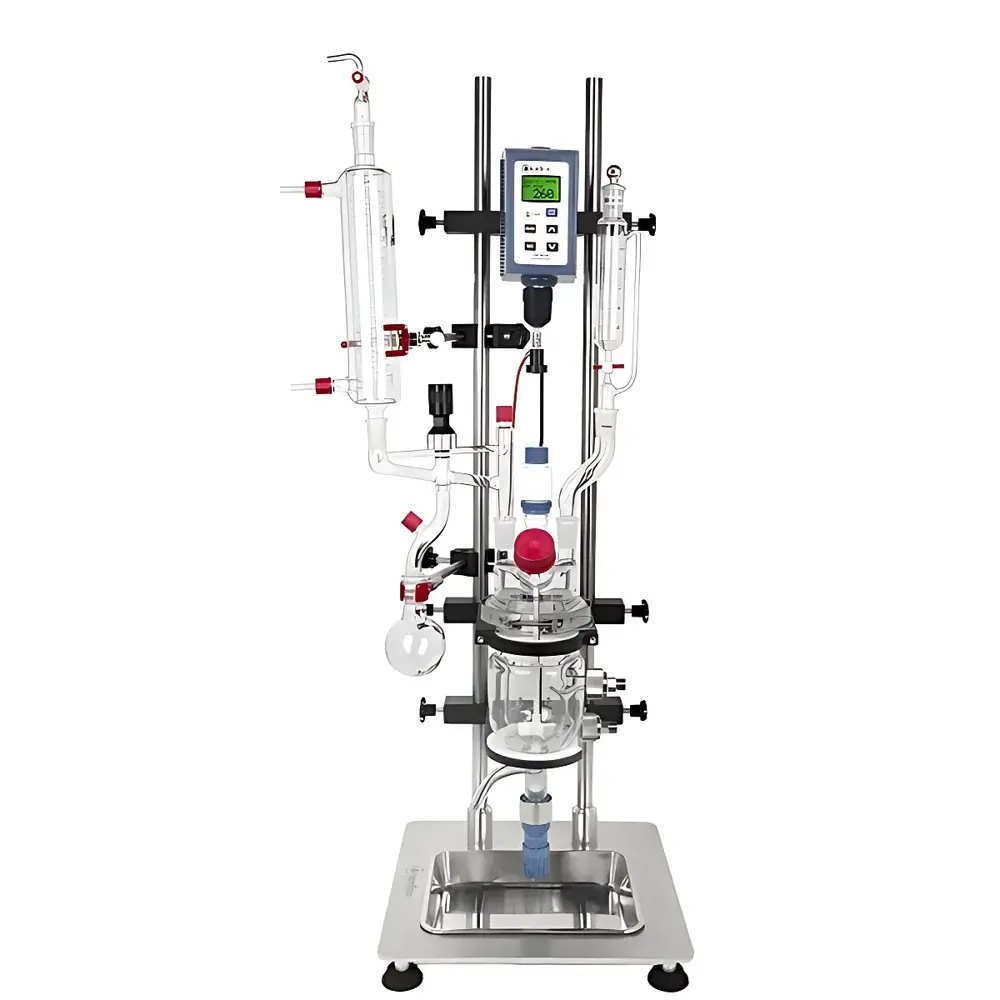
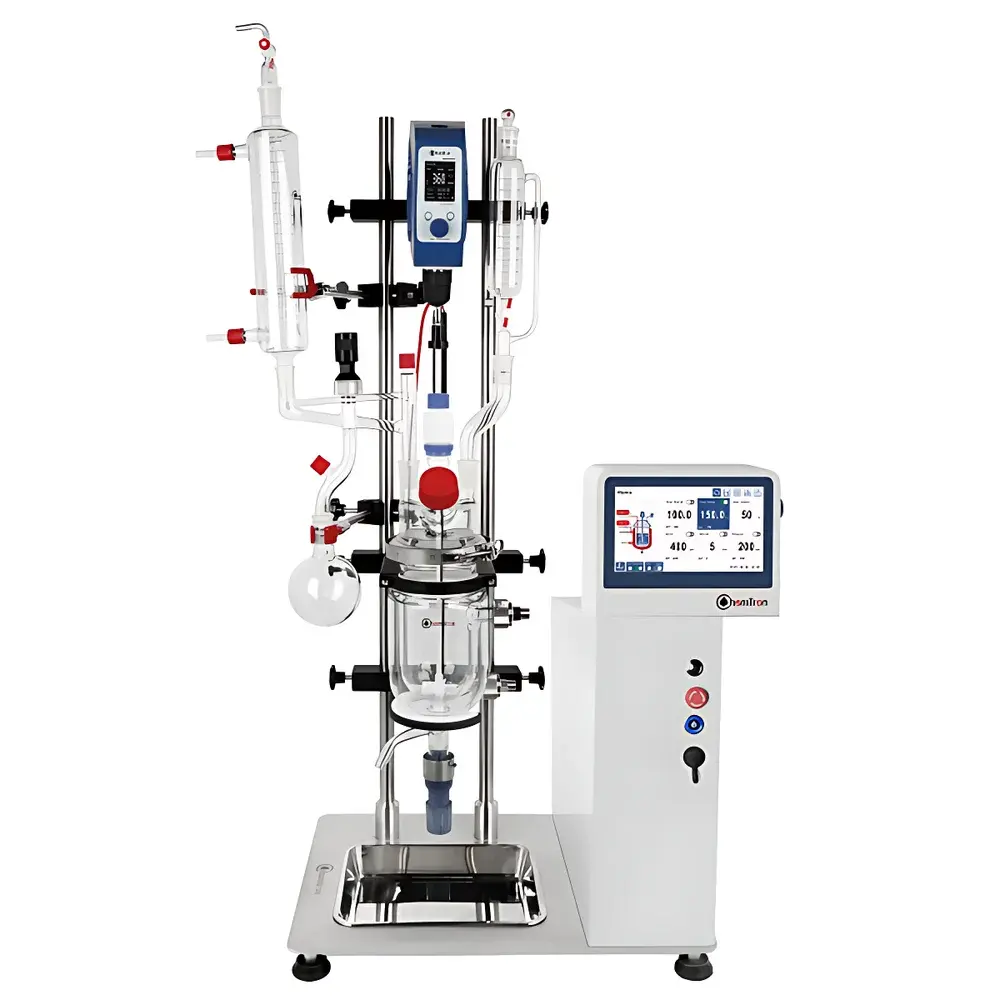
ChemTron All-in-one Benchtop Glass Jacketed Reactor System
| Brand | ChemTron |
|---|---|
| Origin | Germany |
| Model | All-in-one |
| Capacity | 5 L |
| Material | Borosilicate glass (Duran®/Pyrex® grade) |
| Operating Pressure | Up to 0.5 bar (gauge) in jacket |
| Temperature Range | −60 °C to +200 °C (with external heating/cooling circulator) |
| Stirring Speed | Continuous operation up to 500 rpm |
| Flange Standard | DN150 |
| Jacket Inlet/Outlet | DN15 |
| Bottom Valve Orifice | 0–10 mm (optional 0–20 mm) |
| Compliance | Designed per DIN ISO 3585, ASTM E438 Type I, Class A borosilicate glass specifications |
Overview
The ChemTron All-in-one Benchtop Glass Jacketed Reactor System is an integrated, modular laboratory-scale reaction platform engineered for precise control of temperature, pressure, and mixing dynamics in synthetic chemistry, process development, and kinetic studies. Built around a high-purity borosilicate glass (DIN ISO 3585 / ASTM E438 Type I, Class A) vessel with double-wall jacket construction, the system enables simultaneous application of external heating or cooling via thermofluid circulation while maintaining optical clarity for real-time visual monitoring of reaction progress, phase separation, crystallization, or precipitate formation. Its compact benchtop footprint—optimized for fume hood integration—supports safe operation under reduced pressure (down to 5 mbar absolute) or mild overpressure (up to 0.5 bar gauge in the jacket), making it suitable for reflux, distillation, hydrogenation, Grignard reactions, polymerization, and low-temperature lithiation protocols. The reactor operates as a closed, chemically inert environment where all wetted surfaces consist exclusively of borosilicate glass, PTFE, or PFA—ensuring compatibility with aggressive reagents including strong acids, alkalis, anhydrous organometallics, and halogenated solvents.
Key Features
- Modular all-in-one architecture comprising reactor vessel, precision stirring unit, and rigid aluminum alloy support frame with quick-release clamping system—enabling tool-free assembly/disassembly in under 90 seconds.
- Dual stirring configuration options: digitally controlled DC motor (OHS.2) for standard applications; high-torque brushless motor (OHS.4) rated for viscous media and heterogeneous slurries.
- Five-port standardized ground-glass interface (one central 24/40, three lateral 24/40, one 45° GL45 threaded port) for flexible integration of condensers, addition funnels, thermowells, gas inlets, or sampling lines.
- Zero-dead-volume bottom discharge valve with PTFE-sealed conical plug (adjustable orifice 0–10 mm; optional 0–20 mm) enabling quantitative product recovery and inline sampling without system venting.
- Jacketed vessel rated for 0.5 bar internal jacket pressure, compatible with standard recirculating chillers and heating circulators (e.g., Julabo, Huber, Lauda) using silicone oil or ethanol/water mixtures.
- Robust mechanical design validated for continuous operation at 500 rpm; transient operation up to 800 rpm permitted with appropriate impeller selection and dynamic balancing.
Sample Compatibility & Compliance
The ChemTron All-in-one reactor is constructed entirely from materials compliant with ISO 9001-certified manufacturing processes and conforms to key international standards governing laboratory glassware and chemical resistance. The borosilicate glass body meets DIN ISO 3585 specifications for thermal shock resistance (ΔT ≥ 120 °C), hydrolytic class HGB 1, and linear expansion coefficient α ≈ 3.3 × 10⁻⁶ K⁻¹. All elastomeric seals are FDA-compliant PTFE or perfluoroalkoxy (PFA); no silicone or EPDM components contact process media. The system supports GLP/GMP-aligned workflows through traceable component serialization (per JRS-xxxx order codes) and is routinely deployed in regulated environments requiring audit-ready documentation per ISO/IEC 17025 and USP . While not intrinsically rated for ATEX Zone 1, optional explosion-proof motor variants (ATEX II 2G Ex db IIB T4 Gb) are available upon request.
Software & Data Management
As a hardware-integrated platform—not a standalone instrument—the All-in-one reactor does not include embedded firmware or proprietary software. Instead, it interfaces seamlessly with third-party process controllers and data acquisition systems via analog 0–10 V or 4–20 mA outputs (stirring speed, temperature sensor inputs) and digital I/O triggers. Users commonly integrate it with LabVIEW, DeltaV, or Siemens Desigo CC systems for automated ramp-hold sequences, cascade PID control of jacket temperature versus internal probe readings, and time-synchronized logging of torque, temperature, pressure, and addition rates. All mechanical components carry CE marking and comply with Machinery Directive 2006/42/EC essential health and safety requirements.
Applications
- Synthetic organic chemistry: Controlled exothermic additions, cryogenic deprotonations (−60 °C), and air-sensitive transformations under nitrogen/argon blanket.
- Pharmaceutical process R&D: Solvent screening, polymorph investigation, and crystallization kinetics under programmable thermal gradients.
- Materials science: Sol-gel synthesis, nanoparticle nucleation, and controlled hydrolysis reactions monitored visually through transparent walls.
- Education and training: Hands-on demonstration of mass/energy balances, reaction calorimetry principles, and safety-critical depressurization procedures.
- Quality control labs: Reproducible small-batch formulation testing (e.g., adhesives, coatings, emulsions) with full traceability of process parameters.
FAQ
What temperature control accuracy can be achieved with this system?
Accuracy depends on the external circulator used; typical industrial-grade units achieve ±0.1 °C stability over 24 h when paired with a calibrated Pt100 probe mounted in the reactor headspace.
Is the system compatible with magnetic stirring?
No—this is a mechanically stirred system only; magnetic coupling is not supported due to jacket geometry and required torque transmission.
Can the reactor be cleaned in an autoclave?
Glass components are autoclavable at 121 °C / 2 bar for 20 min; PTFE/PFA parts must be removed prior to sterilization.
What certifications accompany shipment?
Each unit ships with a Declaration of Conformity (DoC), material certificates for glass and PTFE, and a factory calibration report for flange concentricity and jacket integrity testing.
How is vacuum integrity verified during commissioning?
A helium leak test (≤5 × 10⁻⁹ mbar·L/s sensitivity) is performed pre-shipment; users may repeat verification using a digital vacuum gauge and controlled nitrogen bleed test per ISO 20483.



