
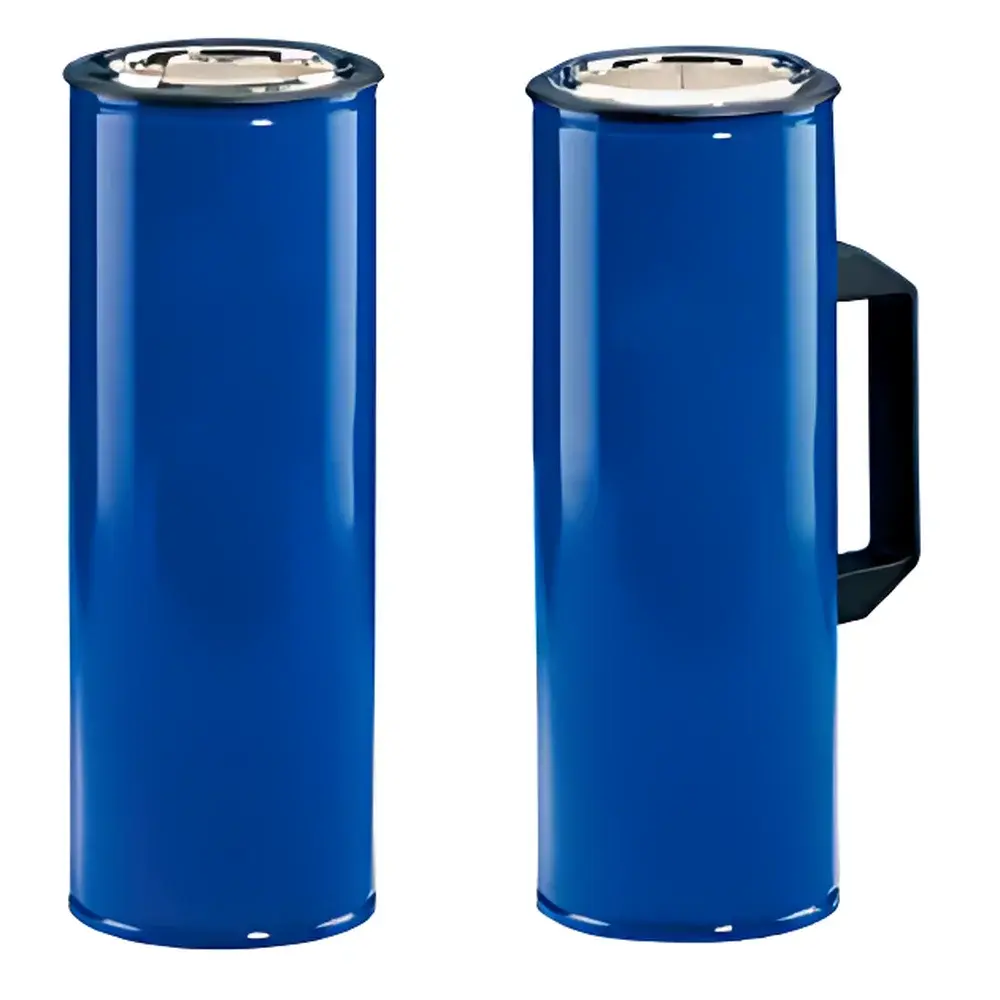
ChemTron C-Series and G-C-Series Cylindrical Dewar Flasks (Cold Traps) for Low-Temperature Adsorption Analysis
| Brand | ChemTron |
|---|---|
| Origin | Germany |
| Product Type | Imported Laboratory Dewar Flask |
| Model Series | C Series / G-C Series |
| Inner Vessel Material | Borosilicate Glass 3.3 |
| Inner Surface Finish | Full Silvering |
| Optional Features | Observation Window (customizable), Evaporation-Resistant Insulating Lid |
| Temperature Compatibility | Liquid Nitrogen (−196 °C) |
| Typical LN₂ Hold Time | 40–193 h |
| Typical LN₂ Evaporation Rate | 0.25–0.7 L/day |
Overview
The ChemTron C-Series and G-C-Series cylindrical dewar flasks are precision-engineered cryogenic containers designed specifically for integration with physical and chemical adsorption analyzers, surface area and porosity analyzers (BET/BJH), and gas sorption instrumentation. These dewars serve as the primary low-temperature thermal sink—typically maintained at liquid nitrogen temperature (−196 °C)—to enable accurate measurement of gas adsorption isotherms across a wide range of pressures and temperatures. Their geometry and thermal architecture comply with standard ISO 9001 manufacturing practices and support reproducible, traceable low-temperature operation in accordance with ASTM D3663 and ISO 9277 methodologies for specific surface area determination. Constructed with high-integrity borosilicate glass 3.3 inner vessels and double-walled stainless steel or painted metal outer shells, they deliver exceptional thermal stability and mechanical robustness in demanding laboratory environments.
Key Features
- Double-wall vacuum-insulated design with full silvering of the inner vessel surface to minimize radiative heat transfer and extend liquid nitrogen hold time
- Borosilicate glass 3.3 inner vessel—chemically inert, thermally shock-resistant, and optically transparent for visual monitoring of cryogen level
- Two standardized shell configurations: C-Series (compact, handle-free design) and G-C-Series (ergonomic integrated handle for safe handling during cryogen refilling)
- Customizable observation window option—aligned apertures in both outer shell and inner vessel permit real-time liquid level verification without compromising vacuum integrity
- Modular compatibility with standard adsorption analyzers (e.g., Micromeritics, Quantachrome, BEL Japan) via standardized neck diameters and mounting interfaces
- Optional evaporation-resistant insulating lid (FT-series compatible) reduces boil-off rate by up to 40% and enhances operational safety during extended analysis cycles
Sample Compatibility & Compliance
These dewars accommodate standard sample tubes (6–12 mm OD) used in volumetric and gravimetric sorption systems. The inner vessel geometry supports uniform thermal equilibration of sample holders immersed in liquid nitrogen, ensuring consistent temperature distribution across the active measurement zone. All models meet CE marking requirements for laboratory equipment and conform to EN 61000-6-3 (EMC) and EN 61000-6-2 (immunity) standards. When deployed within GLP- or GMP-regulated laboratories, their passive thermal performance supports audit-ready documentation of temperature stability per FDA 21 CFR Part 11-compliant data acquisition systems. No electrical components or active controls are integrated—ensuring intrinsic safety and eliminating electromagnetic interference with sensitive transducers.
Software & Data Management
While the dewar itself is a passive thermal component, its dimensional and thermal specifications are fully documented in instrument qualification protocols (IQ/OQ/PQ). ChemTron provides technical datasheets with certified dimensions, weight, LN₂ capacity, and evaporation rates—traceable to NIST-calibrated cryogenic flow meters and calibrated platinum resistance thermometers (PT100). These parameters are directly importable into instrument vendor software (e.g., Micromeritics ASAP, Quantachrome Autosorb) for automated thermal compensation modeling. For laboratories operating under electronic record requirements, dewar model numbers, serial identifiers (where applicable), and calibration history can be logged in LIMS platforms alongside instrument-specific SOPs and maintenance logs.
Applications
- Low-temperature nitrogen adsorption/desorption isotherm acquisition for BET surface area calculation
- Argon and CO₂ physisorption analysis at 77 K and 87 K for micropore characterization (DFT, NLDFT modeling)
- Hydrogen storage material evaluation at 77 K and 20 K using high-pressure sorption manifolds
- Calibration and validation of thermal conductivity sensors in cryogenic gas mixtures
- Supporting differential scanning calorimetry (DSC) and thermogravimetric analysis (TGA) when paired with JULABO FT-series immersion coolers for sub-ambient temperature control
FAQ
What is the maximum recommended fill level for optimal thermal performance?
Liquid nitrogen should not exceed 85% of inner vessel volume to prevent violent boiling during insertion of sample tubes or thermal cycling.
Can these dewars be used with liquid argon or other cryogens?
Yes—provided the cryogen’s boiling point is ≥ −186 °C and material compatibility is verified; however, prolonged exposure to liquid oxygen is strictly prohibited due to explosion risk.
Is the observation window option available for all C/G-C models?
Yes—custom observation windows are manufacturable for any listed model upon order confirmation, with lead time extension of 3–4 weeks.
Do the G-C-Series handles affect thermal insulation performance?
No—the handle is mechanically isolated from the vacuum jacket and does not compromise thermal resistance; it is engineered from low-conductivity stainless steel with thermal break design.
Are replacement inner vessels available separately?
Yes—ChemTron supplies certified borosilicate glass 3.3 inner vessels with full silvering, including OEM-matched dimensional tolerances and vacuum seal certification.



