
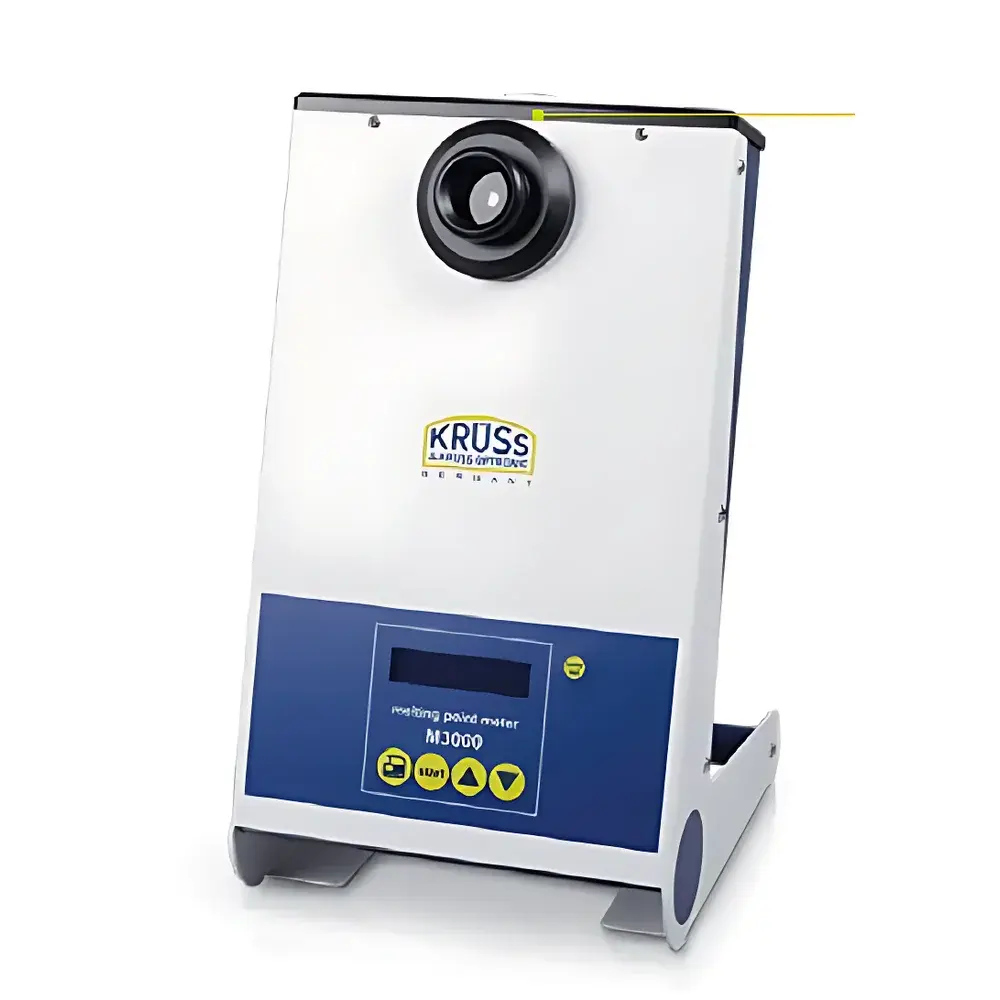
ChemTron M3000 Semi-Automatic Melting Point Apparatus
| Brand | ChemTron |
|---|---|
| Origin | Germany |
| Model | M3000 |
| Temperature Range | 30–360 °C |
| Temperature Resolution | 0.1 °C |
| Accuracy | ±0.3 °C (30–200 °C), ±0.5 °C (200–360 °C) |
| Heating Time | ~4.0 min to 300 °C, ~7.5 min to 360 °C |
| Heating Rate | 1 °C/min |
| Sample Positions | 3 |
| Capillary Diameter | 1.4 mm |
| Interface | RS-232 |
| IP Rating | IP20 |
| Power Supply | 90–264 V AC |
| Dimensions | 210 × 360 × 230 mm |
| Weight | 4.3 kg |
Overview
The ChemTron M3000 Semi-Automatic Melting Point Apparatus is a precision thermal analysis instrument engineered for reliable, repeatable determination of solid-phase transition temperatures in pharmaceuticals, fine chemicals, polymers, and academic research materials. It operates on the classical capillary tube method—where a small crystalline sample is loaded into a standardized glass capillary and heated under controlled conditions while optical detection monitors the onset and completion of melting via real-time visual observation through an integrated lens system. Designed and manufactured in Germany, the M3000 delivers traceable temperature performance aligned with international pharmacopeial requirements, including USP & Ph. Eur. general chapter , and supports GLP-compliant documentation when paired with validated software workflows.
Key Features
- Triple-sample capacity: Simultaneous measurement of up to three independent capillary tubes enables efficient batch testing and intra-run reproducibility assessment.
- High-resolution optical detection: Integrated magnifying lens with side-view illumination ensures unambiguous identification of melt onset (meniscus formation) and clear point (complete liquefaction), minimizing subjectivity in endpoint determination.
- Precision temperature control: PID-regulated heating block with 0.1 °C resolution and verified accuracy (±0.3 °C from 30–200 °C; ±0.5 °C up to 360 °C) meets stringent calibration requirements for QC laboratories.
- Rapid thermal cycling: Built-in forced-air cooling system reduces cooldown time between runs, enhancing throughput without compromising thermal stability or sensor drift.
- Intuitive dual-language interface: Backlit LCD display supports both English and German operational menus, reducing training overhead in multinational R&D and manufacturing environments.
- Ergonomic and hygienic design: Sealed front panel with smooth, non-porous surface allows quick wipe-down cleaning—critical for cross-contamination prevention in regulated pharmaceutical labs.
- Comprehensive standardization support: Supplied with eight certified reference materials (KSPS series), covering primary and secondary USP-grade standards across key therapeutic compound ranges (81–236.5 °C).
Sample Compatibility & Compliance
The M3000 accommodates standard 1.4 mm outer-diameter capillaries (supplied as 100-piece kit), compatible with common sample preparation protocols used in pharmacopeial monographs. Its temperature range (30–360 °C) covers the majority of organic compounds, APIs, excipients, and polymer additives encountered in routine quality control. The instrument conforms to IEC 61010-1 safety standards and carries CE marking for use within the EU. While the base unit does not include automated data logging, its RS-232 interface permits integration with LIMS or validated third-party software for 21 CFR Part 11-compliant audit trails, electronic signatures, and raw data archiving—essential for FDA-regulated environments operating under GMP or GLP frameworks.
Software & Data Management
The M3000 operates as a stand-alone instrument with local display and manual result entry. For enhanced traceability, it supports serial output via RS-232 to external PCs running compliant data acquisition software. Users may configure custom reporting templates that capture date/time stamps, operator ID, sample ID, observed onset/clear points, heating rate, and calibration verification status. When deployed with validated software platforms, full electronic records—including instrument configuration logs and calibration history—can be generated to satisfy ALCOA+ data integrity principles (Attributable, Legible, Contemporaneous, Original, Accurate).
Applications
- Pharmaceutical QC: Identity confirmation and purity assessment of active pharmaceutical ingredients (APIs) per USP and EP 2.2.17.
- Chemical synthesis validation: Monitoring reaction endpoints and intermediate purity during route scouting and process development.
- Academic research: Teaching fundamental thermal behavior concepts and validating computational phase-diagram models.
- Polymers & materials science: Characterizing crystallinity and thermal stability of thermoplastics, waxes, and eutectic blends.
- Regulatory submissions: Generating reference-grade melting data for inclusion in DMF, ANDA, or CMC sections requiring physicochemical characterization.
FAQ
What capillary dimensions are supported by the M3000?
The instrument is optimized for standard 1.4 mm outer-diameter glass capillaries, consistent with USP and Ph. Eur. recommendations.
Is the M3000 compliant with 21 CFR Part 11?
The hardware itself is Part 11-ready via RS-232 connectivity; full compliance requires implementation of validated software with electronic signature, audit trail, and secure user access controls.
How frequently should the system be calibrated?
Annual calibration is recommended, supplemented by daily verification using at least two NIST-traceable reference standards spanning the intended operating range.
Can the M3000 measure decomposition points?
It is designed specifically for melting point determination; decomposition or charring events require complementary techniques such as TGA or DSC.
Does the unit include validation documentation?
Factory-supplied IQ/OQ documentation is available upon request; PQ protocols must be developed internally per site-specific SOPs and regulatory scope.



