
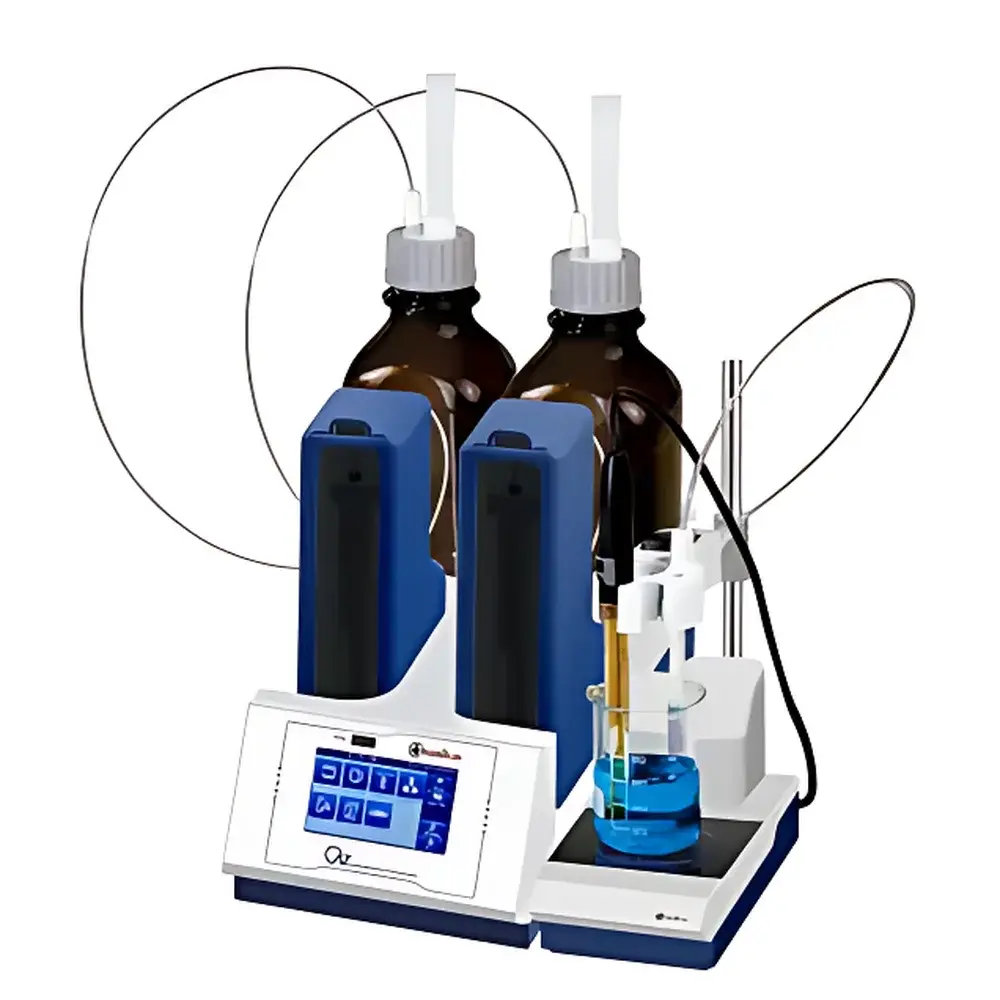
Chemtron CAT2-1 Series Automatic Potentiometric Titrator
| Brand | JULABO-Chemtron |
|---|---|
| Origin | Italy |
| Model | CAT2-1 Series |
| Instrument Type | General-Purpose Potentiometric Titrator |
| pH Range | 0–14 |
| mV Range | ±2000 mV |
| Current Range | ±10 µA |
| pH Accuracy | ±0.02 pH |
| pH Resolution | ±0.01 pH |
| mV Accuracy | ±2 mV |
| mV Resolution | ±0.1 mV |
| Current Accuracy | ±2 µA |
| Current Resolution | ±0.1 µA |
| Temperature Range | 0–100 °C |
| Temperature Accuracy | ±1 °C |
| Temperature Resolution | ±0.1 °C |
| Burette Capacity | 10 mL (dual mountable) |
| Burette Precision | <0.2% (2 µL @ 10 mL) |
| Burette Repeatability | ±0.2% |
| Burette Resolution | 12,000 steps |
| Peristaltic Pump Flow Rate | 1 mL/s (up to 3 modules) |
| Method Storage | 30 preloaded templates (EP, EQ, Free SO₂, Total SO₂, Double SO₂) |
| Data Storage | 50 titration reports + 10 calibration records |
| Interfaces | pH/mV/µA electrode ports, USB-A, USB-B, RS232, Bluetooth |
| Display | 4.3″ capacitive touchscreen |
Overview
The Chemtron CAT2-1 Series Automatic Potentiometric Titrator is an engineered solution for routine and regulated potentiometric titration in quality control, research, and production laboratories. Designed and manufactured in Italy by JULABO-Chemtron, the system operates on classical potentiometric endpoint detection—measuring potential difference (mV) or pH across a redox, acid-base, precipitation, or complexometric reaction to determine stoichiometric equivalence. Its architecture integrates high-stability analog signal conditioning, low-drift electrode input circuitry, and real-time derivative-based endpoint recognition algorithms. Unlike benchtop titrators reliant on manual intervention, the CAT2-1 supports fully automated sample handling when paired with optional 16- or 35-position autosamplers, enabling unattended batch analysis under GLP-compliant workflows. The instrument meets essential metrological requirements for ISO/IEC 17025-accredited testing environments and supports audit-ready data integrity through time-stamped event logging.
Key Features
- 4.3″ high-contrast capacitive touchscreen interface with icon-driven navigation—no keyboard or mouse required
- Dual 10 mL burettes (12,000-step resolution, <0.2% volumetric precision at full scale) with automatic rinsing, filling, and air-bubble detection
- Modular peristaltic pump system (1 mL/s flow rate, up to three independent channels) for reagent delivery, sample aspiration, or automatic leveling
- Multi-electrode compatibility: pH glass, Ag/AgCl, Pt, dual-platinum, and amperometric µA electrodes—all with dedicated input circuitry and auto-identification
- Integrated Pt100 temperature sensor port with automatic temperature compensation per NIST-traceable algorithms
- Onboard method editor supporting EP (endpoint), EQ (equivalence point), linear, dynamic, and continuous pH monitoring modes
- Real-time graphical display of titration curves (E vs. V, dE/dV vs. V, and ∫dE/dV) with adjustable scaling and overlay capability
- Automatic degassing module (optional) for oxygen-sensitive titrations such as iodometric or cerimetric assays
Sample Compatibility & Compliance
The CAT2-1 accommodates aqueous and mildly organic matrices typical of food, beverage, pharmaceutical, environmental, and chemical manufacturing applications. It supports standard electrode configurations for acid–base (e.g., HCl vs. NaOH), redox (e.g., KMnO₄ vs. Fe²⁺), precipitation (e.g., AgNO₃ vs. Cl⁻), and complexometric (e.g., EDTA vs. Ca²⁺) titrations. For wine and juice analysis, dedicated SO₂ methods comply with OIV and AOAC guidelines. All electrochemical measurements adhere to IUPAC-recommended conventions for electrode potential reporting. The system is compatible with ASTM D1126 (hardness), USP (acid–base titrimetry), and ISO 9001–certified documentation practices. Data export via USB adheres to 21 CFR Part 11–compatible file structures (CSV, PDF report snapshots) when used with CAT2 software.
Software & Data Management
The CAT2 software suite (Windows-based, USB- or Bluetooth-connected) provides secure method deployment, remote instrument control, and traceable result review. Each titration generates a structured dataset including raw mV/pH/current vs. volume, first- and second-derivative plots, endpoint coordinates, and statistical summaries (RSD, confidence intervals). Calibration logs record buffer IDs, measured potentials, slope, offset, and date/time stamps. All user actions—including method edits, calibration events, and report exports—are timestamped and stored in non-volatile memory. Up to 50 recent analyses and 10 calibration histories are retained onboard; full datasets may be exported to USB drives in CSV or encrypted binary format. Audit trails meet GLP/GMP documentation standards for regulated labs.
Applications
- Food & Beverage: Total acidity (TA), free and total sulfur dioxide (SO₂) in wine, chloride in dairy products, peroxide value in oils
- Pharmaceuticals: Assay of active ingredients (e.g., aspirin hydrolysis), residual alkali in excipients, Karl Fischer water content (with optional coulometric module)
- Environmental: Alkalinity and hardness in wastewater, cyanide in effluents (silver nitrate titration), fluoride (lanthanum nitrate back-titration)
- Chemical Manufacturing: Acid number (AN) and base number (BN) in lubricants, purity of sodium hydroxide or hydrochloric acid stock solutions
- Education & Research: Teaching fundamental electrochemistry principles, method development for novel endpoints, kinetic titration studies
FAQ
Does the CAT2-1 support Good Laboratory Practice (GLP) compliance?
Yes—the instrument maintains immutable timestamps for all calibrations, titrations, and method modifications. When used with CAT2 software, it generates PDF reports containing full metadata (operator ID, instrument serial, electrode history, environmental conditions) required for GLP audits.
Can I use third-party electrodes with the CAT2-1?
The system accepts any standardized BNC or DIN pH/mV electrodes and amperometric sensors with 0–10 µA output. However, auto-buffer recognition and specialized calibrations (e.g., wine-specific pH) require Chemtron-certified electrodes.
What is the maximum number of titrations possible per day using the 35-position autosampler?
Under typical 2–4 minute/titration conditions (including rinse, fill, titrate, and report generation), the system achieves ~200–250 determinations in an 8-hour shift—subject to sample viscosity, endpoint stability, and method complexity.
Is temperature compensation mandatory during titration?
While not mandatory, temperature compensation is strongly recommended for high-accuracy work. The CAT2-1 uses Pt100 input to correct electrode slope and liquid junction potential per ISO 3696 and IUPAC recommendations.
How is data integrity ensured during power loss or unexpected shutdown?
All critical parameters—including current titration progress, electrode offsets, and calibration coefficients—are written to non-volatile memory every 5 seconds. Upon restart, the instrument resumes from last stable state without data corruption.
Related Products





