
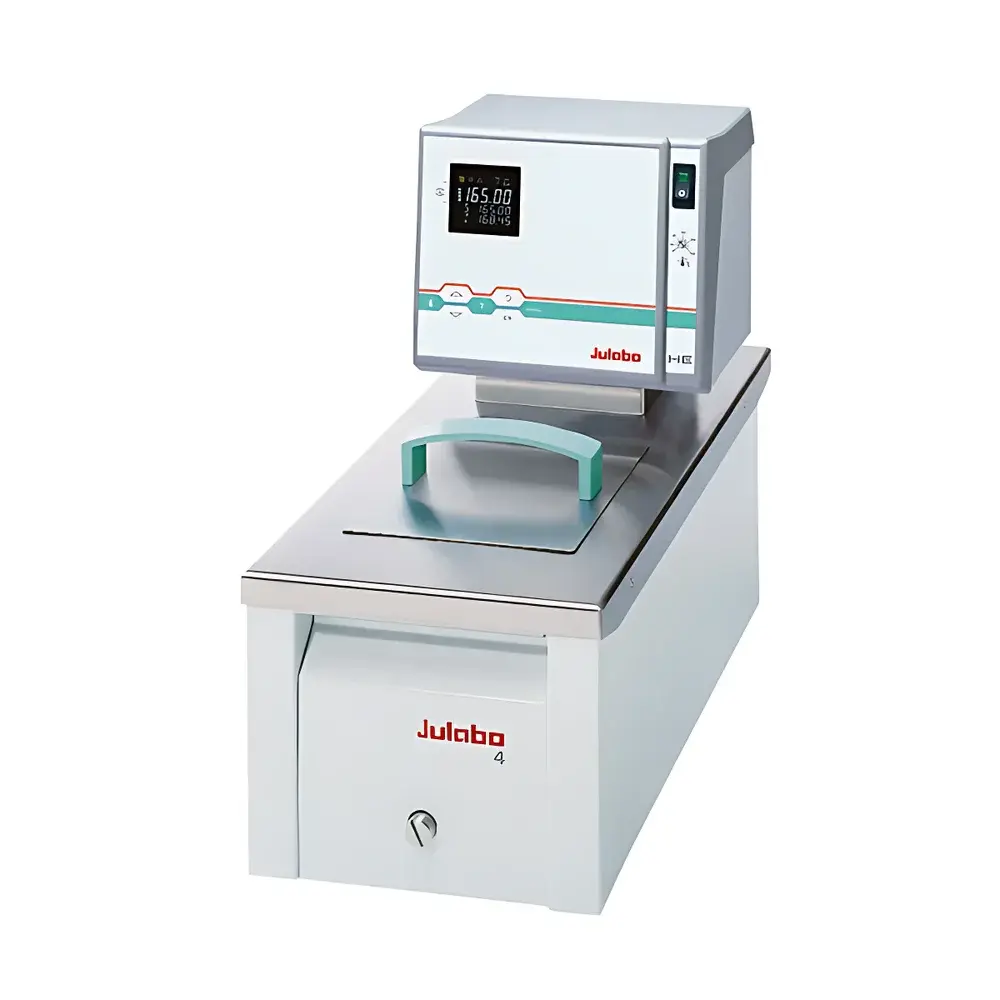
JULABO HE-4 Heating Circulating Bath
| Brand | JULABO |
|---|---|
| Model | HE-4 |
| Type | Heating Circulating Bath |
| Origin | Germany |
| Temperature Range | +5 to +250 °C |
| Temperature Stability | ±0.01 °C |
| Bath Volume | 4.5 L |
| Heating Power | 2 kW |
| Pump Flow Rate | 22–26 L/min |
| Pump Pressure | 0.4–0.7 bar |
| Display | High-brightness VFD |
| Control Technology | ICC (Intelligent Current Control) |
| Temperature Calibration | ATC3 (3-point user calibration) |
| Safety Certification | DIN 12876-1 Class III (FL) |
| Communication Interface | RS232 (optional Profibus) |
| External PT100 Input | Integrated |
| Programmable Steps | 1×10 |
| Cooling Capability | Integrated cooling coil for ambient/near-ambient operation |
| Bath Material | Stainless steel (AISI 304) |
| Dimensions (W×L×H) | 21 × 42 × 40 cm |
| Weight | 11 kg |
| Ambient Operating Temperature | 5–40 °C |
Overview
The JULABO HE-4 Heating Circulating Bath is a precision-engineered, stainless-steel thermal management system designed for demanding laboratory and industrial applications requiring stable, controllable heating across an extended temperature range—from +5 °C up to +250 °C. Unlike basic immersion heaters or static water baths, the HE-4 employs a closed-loop circulation architecture with integrated pump control and intelligent current-based temperature regulation (ICC technology), enabling high reproducibility in both internal bath temperature maintenance and external system temperature control. Its DIN 12876-1 Class III (FL) certification confirms suitability for use with flammable heat transfer media—including silicone oils and glycols—making it compliant with stringent safety requirements for organic solvent-based thermal processes. The unit integrates a built-in cooling coil that facilitates rapid thermal equilibration near ambient conditions without requiring external chillers, enhancing operational flexibility across diverse experimental protocols.
Key Features
- Intelligent Current Control (ICC) algorithm ensures ±0.01 °C temperature stability at setpoint—engineered for long-term repeatability in calibration-critical workflows.
- High-brightness VFD display simultaneously shows set temperature, internal bath temperature, and external PT100-sensed temperature—enabling real-time comparative thermal monitoring.
- ATC3 (Advanced Temperature Calibration) allows users to perform three-point calibration using traceable reference standards, supporting ISO/IEC 17025-compliant instrument qualification.
- SmartPump™ technology dynamically adjusts pump output (22–26 L/min, 0.4–0.7 bar) based on fluid viscosity and flow resistance—ensuring consistent delivery pressure during oil-based high-temperature operation.
- Dual-level temperature protection: programmable high-limit cutoff and independent overtemperature alarm (with adjustable threshold via dedicated rotary knob), halting heating and logging fault conditions.
- Low-level warning system provides audible/visual alert when bath fluid volume drops below operational minimum—permitting continued operation while prompting replenishment.
- Integrated RS232 interface supports remote command execution, data logging, and integration into centralized lab automation platforms; optional Profibus module available for industrial SCADA environments.
- Stainless-steel construction (AISI 304), M16×1 pump ports with dual hose fittings (8 mm & 12 mm), and pre-installed cooling coil ensure mechanical durability and compatibility with standard laboratory fluid-handling infrastructure.
Sample Compatibility & Compliance
The HE-4 accommodates a broad spectrum of thermal applications without modification: direct immersion of small samples, jacketed reactor temperature control, column oven conditioning for HPLC/GC systems, viscometer bath integration, polarimeter stabilization, electrophoresis tank regulation, and spectrophotometer cuvette compartment heating. Its Class III (FL) classification under DIN 12876-1 permits safe operation with combustible heat transfer fluids—critical for GMP-regulated pharmaceutical stability studies and polymer processing R&D. All firmware and hardware design elements conform to IEC 61010-1 safety standards, and temperature control logic supports audit-trail-ready operation when paired with validated software environments adhering to FDA 21 CFR Part 11 requirements.
Software & Data Management
While the HE-4 operates autonomously via its front-panel interface, its RS232 port enables bidirectional communication with host PCs running JULABO’s proprietary LabSoft software or third-party SCADA/HMI platforms. Users may configure, monitor, and log all operational parameters—including real-time temperature traces, pump duty cycle, power consumption (% output), and alarm event timestamps. Data export is supported in CSV format for post-acquisition analysis in MATLAB, Python, or LIMS-integrated statistical process control modules. Firmware updates are performed via serial interface, ensuring sustained compliance with evolving regulatory expectations for instrument lifecycle management.
Applications
- Thermal validation of analytical instruments (e.g., HPLC column ovens, GC injectors, UV-Vis spectrophotometers)
- Material science testing: coefficient of thermal expansion (CTE) measurements, polymer melt rheology pre-conditioning, elastomer aging studies
- Chemical synthesis: precise exotherm control in jacketed batch reactors, crystallization kinetics experiments
- Biotechnology: enzyme activity assays requiring strict thermal uniformity, electrophoresis buffer temperature stabilization
- Calibration laboratories: secondary standard temperature source for thermometer and sensor verification per ISO 17025 clause 6.5
- Quality control labs: accelerated stability testing per ICH Q1 guidelines using controlled thermal stress profiles
FAQ
Can the HE-4 be used with silicone oil at 220 °C without degradation?
Yes—the stainless-steel bath chamber, sealed pump head, and high-temp-rated seals are rated for continuous operation up to +250 °C with compatible heat transfer fluids meeting ASTM D4692 specifications.
Is external cooling required to reach +5 °C?
No—the integrated cooling coil allows passive heat dissipation to ambient air; for sub-ambient operation, an external chiller must be connected via the auxiliary port.
Does the ATC3 calibration function satisfy metrological traceability requirements?
When performed using NIST-traceable PT100 probes and documented per SOP, ATC3 calibration meets GLP/GMP documentation prerequisites for instrument requalification.
What is the maximum allowable external system volume for stable temperature control?
For optimal dynamic response, JULABO recommends external loop volumes ≤ 5 L; larger systems require evaluation of thermal mass and flow resistance to maintain ±0.01 °C stability.
How does the SmartPump™ respond to increasing oil viscosity at elevated temperatures?
The pump controller continuously monitors backpressure and modulates motor current to sustain target flow rate—compensating for viscosity-induced resistance without manual intervention.



