
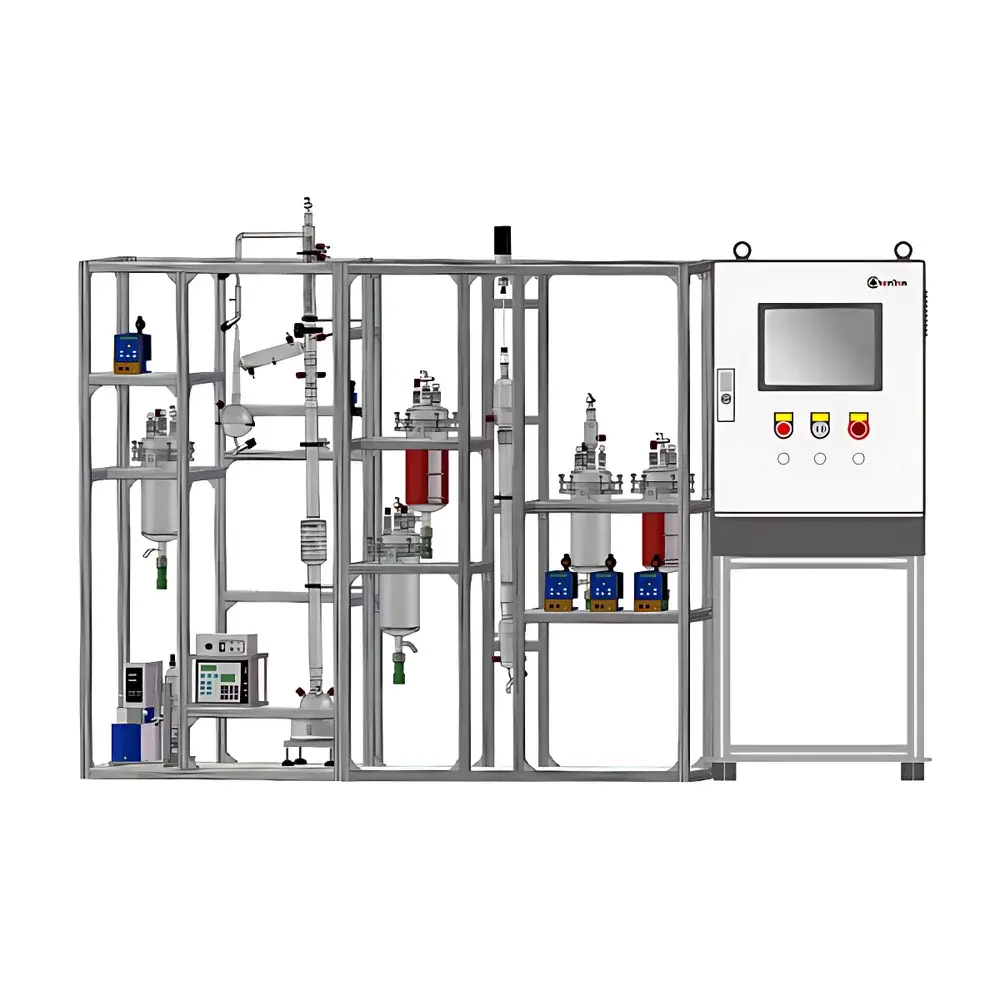
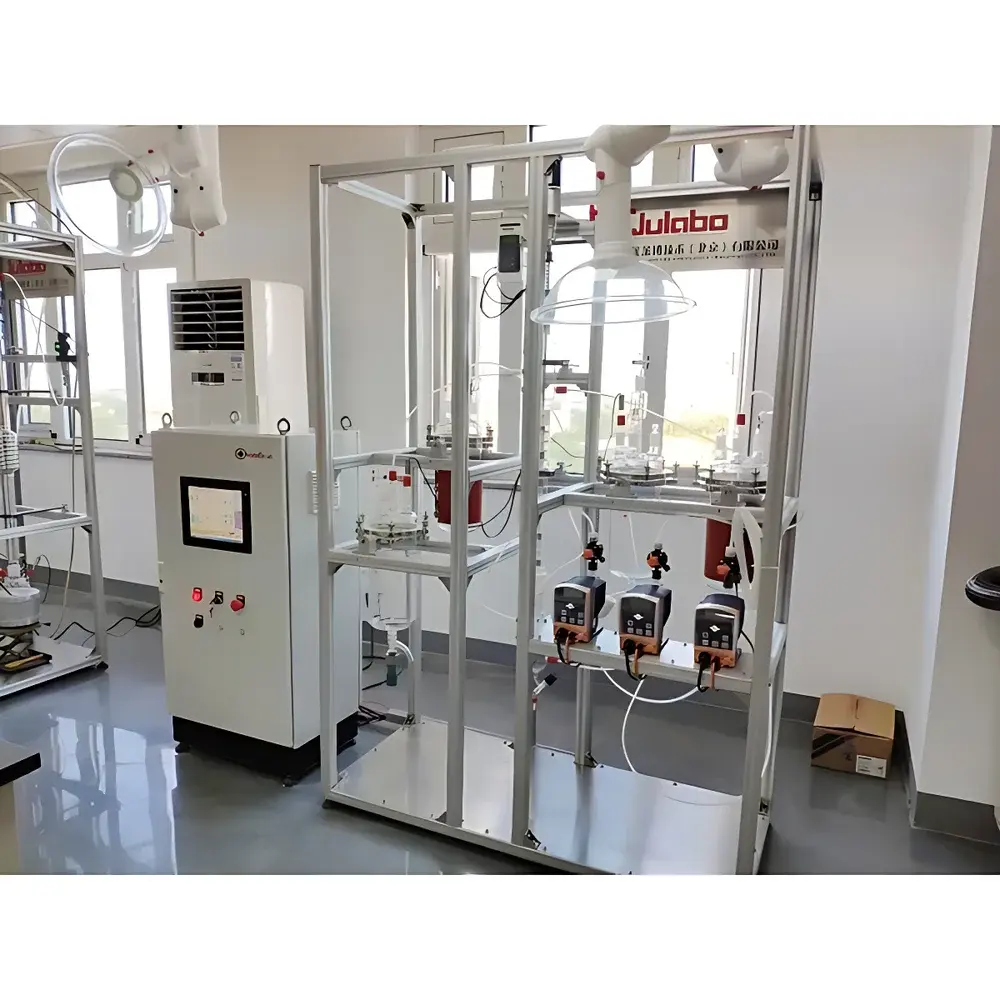
ChemTron Auto-Continuous Liquid-Liquid Extraction System
| Brand | ChemTron |
|---|---|
| Origin | Germany |
| Manufacturer Type | Authorized Distributor |
| Origin Category | Imported |
| Model | Auto-Continuous Liquid-Liquid Extraction System |
| Pricing | Available Upon Request |
Overview
The ChemTron Auto-Continuous Liquid-Liquid Extraction System is an engineered platform for automated, continuous solvent extraction based on the physicochemical principle of differential solute partitioning between two immiscible or partially miscible liquid phases. Grounded in classical mass transfer theory and governed by the Nernst distribution law, the system enables precise control over phase contact time, interfacial area, and mixing intensity—key parameters that directly influence extraction efficiency, selectivity, and reproducibility. Unlike batch-wise separatory funnel operations or semi-automated systems, this unit implements true continuous counter-current or co-current liquid–liquid extraction through a vertically oriented stirred extraction column, where dynamic equilibrium is established and maintained under steady-state flow conditions. Designed for method development and scalable process validation, it bridges the gap between laboratory-scale feasibility studies and pilot-scale process engineering.
Key Features
- Stirred extraction column with multi-blade central agitator shaft, enabling controlled shear and optimized droplet dispersion for enhanced interfacial mass transfer
- Adjustable agitation speed range: 20–800 rpm, calibrated and digitally regulated via integrated stepper motor drive
- Four independently configurable glass reservoirs: light-phase feed, heavy-phase feed, extract phase collection, and raffinate/solvent recovery
- Three magnetically coupled diaphragm metering pumps—chemically resistant to common organic solvents (e.g., chloroform, ethyl acetate, hexane, methanol/water mixtures)—with pulse-free flow delivery and ±1% volumetric accuracy
- Modular borosilicate glass construction (DIN/ISO-compliant joints) for full process visibility, easy cleaning, and compatibility with in-situ pH or conductivity monitoring ports
- Integrated control unit with real-time parameter logging, programmable sequence execution, and USB/RS-485 interface for external SCADA or LIMS integration
Sample Compatibility & Compliance
The system accommodates aqueous–organic, organic–organic, and ionic liquid–aqueous biphasic systems across a wide polarity spectrum. It supports feed stream viscosities up to 50 mPa·s and handles solids content ≤0.5 wt% without clogging, provided pre-filtration is applied. All wetted components comply with USP Class VI and EU Regulation (EC) No 1935/2004 for food-contact materials. The architecture conforms to IEC 61000-6-2/6-3 for electromagnetic compatibility and meets CE Machinery Directive 2006/42/EC requirements. For regulated environments, audit trails, user access levels, and electronic signature support can be enabled in accordance with FDA 21 CFR Part 11 when paired with validated third-party data acquisition software.
Software & Data Management
The embedded controller records time-stamped data for agitation speed, pump flow rates, temperature (via optional Pt100 sensor input), and cumulative volume dispensed per channel at user-defined intervals (1 s to 10 min). Raw data exports in CSV format; metadata (operator ID, method name, timestamp, version) are embedded in file headers. When connected to a Windows-based host PC, the system interfaces with ChemTron’s optional ExtractionStudio™ software—a GxP-ready application supporting IQ/OQ documentation templates, trend analysis, residence time distribution modeling, and KD calculation workflows. All data modifications are logged with immutable timestamps and operator credentials, satisfying GLP and GMP traceability requirements.
Applications
- Process intensification studies in pharmaceutical API purification (e.g., alkaloid isolation, chiral resolution, residual solvent removal)
- Kinetic and equilibrium modeling of metal ion extraction in hydrometallurgy (e.g., Cu, Ni, Co recovery from leach solutions)
- Lipid fractionation and bioactive compound recovery from natural extracts (e.g., carotenoids, polyphenols, terpenes)
- Method scouting for regulatory submissions—including ICH Q5, Q7, and USP —where reproducible partition coefficient (log P) determination is required
- Teaching core unit operations in chemical engineering curricula: mass transfer coefficients, stage efficiency, and McCabe–Thiele analysis for liquid–liquid systems
FAQ
What types of solvents are compatible with the system’s fluid path?
Standard configuration supports halogenated hydrocarbons, esters, aliphatic/aromatic hydrocarbons, alcohols, and water-miscible co-solvents. Custom elastomer selections (e.g., EPDM, FKM, PTFE) are available for aggressive media such as concentrated acids or amines.
Can the system operate unattended overnight?
Yes—equipped with thermal cut-off protection, flow interruption detection, and automatic shutdown upon reservoir depletion or pressure deviation beyond ±15% setpoint.
Is method transfer to larger-scale equipment supported?
The system’s dimensionless operating parameters (e.g., Reynolds number, Weber number, phase velocity ratio) are directly scalable using standard correlations from Kunesh, Treybal, or Hanson, enabling reliable translation to pilot-scale mixer-settlers or centrifugal contactors.
Does the system meet ISO/IEC 17025 requirements for testing laboratories?
While the instrument itself is not certified, its measurement traceability—via factory-calibrated pumps and agitator tachometry—supports compliance when incorporated into a laboratory’s documented calibration and uncertainty budget per ISO/IEC 17025:2017 Clause 6.5.
Related Products



