
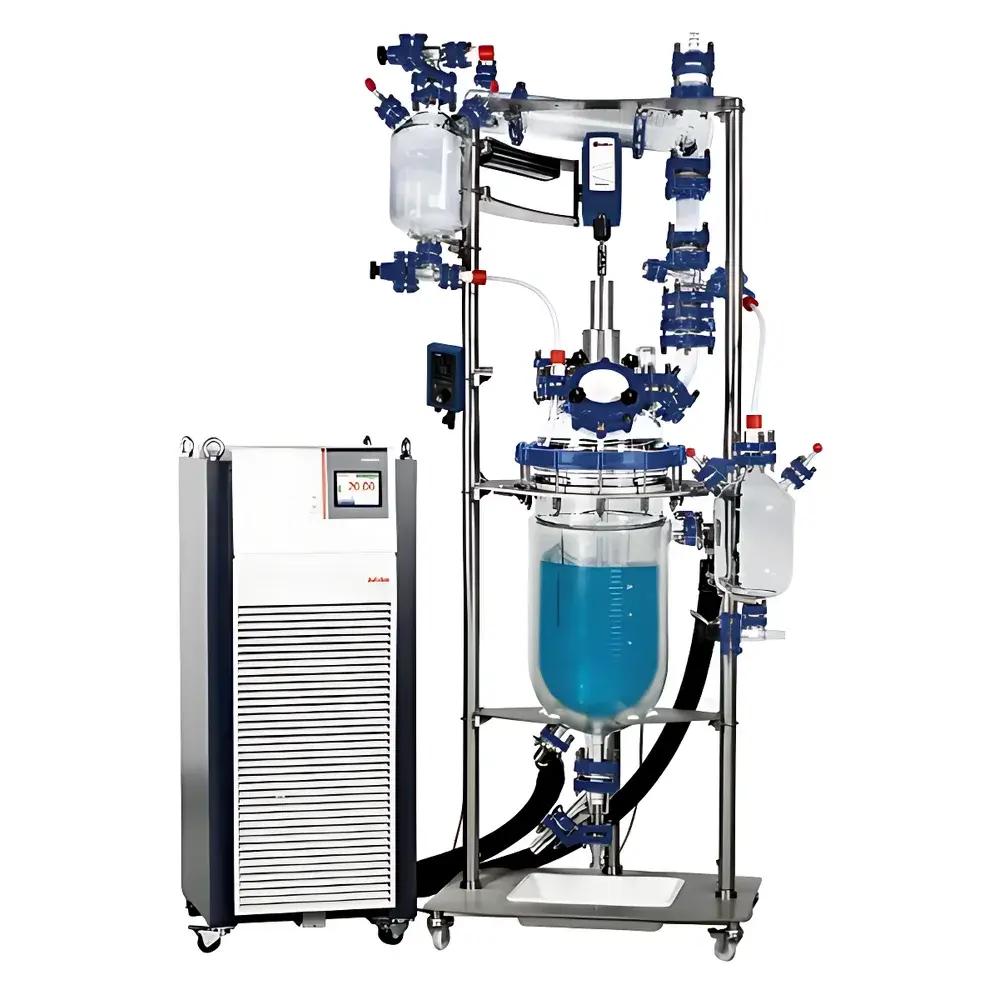
ChemTron PlusChem Glass Reactor System (PPG Series)
| Brand | ChemTron |
|---|---|
| Origin | Germany |
| Model | PPG |
| Reactor Volume | 10–100 L |
| Material | High-Purity Borosilicate Glass (DIN ISO 3585) |
| Operating Pressure Range | –1 to +0.5 bar (gauge) |
| Vacuum Capability | ≤20 mbar (abs) |
| Max Continuous Stirring Speed | 500 rpm |
| Short-Term Max Speed | 800 rpm |
| Jacket Inlet/Outlet Port | DN25 |
| Condenser Surface Area | 0.6 m² (DN50 P-type) |
| Temperature Range | –60 °C to +200 °C |
| Wetted Materials | Borosilicate Glass, PTFE, PFA |
| Flange Standard | DIN 2817 / ISO 2852 |
| Top Plate Configuration | 7-port DN300 lid (1×DN25 CN, 1×DN80, 3×DN40, 1×DN25, 1×DN50) |
| Bottom Valve Bore | 0–25 mm |
| Optional Accessories | Pneumatic bottom valve, integrated Pt100 temperature sensor (600–900 mm immersion length), AR1.8 Automated Reaction Control System |
| Compliance | Designed for GMP-aligned laboratory synthesis environments |
Overview
The ChemTron PlusChem Glass Reactor System (PPG Series) is an engineered modular platform for scalable, reproducible chemical synthesis and process development under controlled temperature, pressure, and vacuum conditions. Built on a unified industrial design philosophy, the system employs flexible buffer flange couplings between functional units—reactor vessel, condenser, distillation valve, collection sump, and feed reservoir—to absorb mechanical stress and eliminate glass fracture risk during thermal cycling or agitation. Its low-profile architecture integrates a horizontal condenser, a single-body reflux/distillation switching valve, a gravity-fed低位 collection trough, and an elevated feed tank—reducing overall height without compromising volumetric capacity or operational safety. The PPG series is explicitly designed for integration into fume hoods and cleanroom-adjacent laboratories, supporting both batch and semi-continuous reaction protocols across pharmaceutical, fine chemical, and academic R&D settings.
Key Features
- Modular borosilicate glass construction (DIN ISO 3585 compliant) ensures exceptional chemical resistance, thermal shock tolerance, and optical clarity for real-time reaction monitoring.
- Standardized DN300 top flange interface across 10–30 L vessels enables rapid configuration of multi-port reactor heads with standardized bore sizes (DN25, DN40, DN50, DN80) for thermocouples, dosing lines, gas inlets, and sampling ports.
- Robust mechanical stirring system with 16 mm stainless steel/PTFE composite shaft and precision-machined bearing housing—rated for continuous operation at 500 rpm and transient duty up to 800 rpm.
- Integrated horizontal P-type condenser (DN50, 0.6 m² active surface area) provides high-efficiency vapor condensation and supports both reflux and fractional distillation modes via a manually or pneumatically actuated three-way valve.
- GMP-compatible design includes optional pneumatic bottom discharge valves, Pt100 temperature probes with 600–900 mm immersion lengths, and full traceability-ready mounting points for digital sensors and control interfaces.
- Two base configurations available: KC1 (core reactor + condenser + feed/collection vessels, no jacket manifold) and KC2 (includes fully assembled jacket inlet/outlet multi-channel valve block with DN25 connections).
Sample Compatibility & Compliance
The PPG system accommodates a broad range of reactive chemistries—including Grignard, lithiation, hydrogenation (with appropriate catalysts and gas handling), esterification, polymerization, and crystallization—without material degradation. All wetted surfaces consist exclusively of Class A borosilicate glass, FDA-compliant PTFE, or inert PFA—ensuring minimal leachables and compatibility with aggressive solvents (e.g., THF, DMF, chlorinated hydrocarbons, concentrated acids/bases). The system operates within a validated pressure envelope of –1 to +0.5 bar (gauge), with ultimate vacuum performance down to 20 mbar (abs), meeting requirements for solvent removal, degassing, and low-boiling-point compound isolation. While not certified as a Class I Div 1 explosion-proof unit, its design aligns with IEC 60079-0 general safety principles for laboratory-scale equipment used in non-hazardous zones. Documentation packages support GLP audit readiness and can be extended to meet FDA 21 CFR Part 11 data integrity requirements when paired with the AR1.8 control system.
Software & Data Management
The PPG platform is natively compatible with the optional AR1.8 Automated Reaction Control System—a modular hardware/software suite that integrates temperature, pressure, stirring speed, feed rate, and pH (via external probe) into a unified PID-controlled environment. AR1.8 provides electronic batch records, time-stamped parameter logging, user-access-level management, and audit-trail generation compliant with ALCOA+ principles. Data export formats include CSV, PDF, and XML, enabling direct import into LIMS or ERP systems. When deployed with KC2 configurations, AR1.8 also manages jacket fluid flow routing, enabling precise ramp/soak thermal profiles across exothermic or endothermic reactions. No proprietary drivers or vendor-locked firmware are required—the system communicates via standard Modbus TCP and OPC UA protocols.
Applications
- Pharmaceutical process development: Route scouting, impurity profiling, and crystallization optimization under controlled supersaturation and seeding conditions.
- Fine chemical synthesis: Multi-step transformations requiring sequential reagent addition, intermediate isolation, and inline distillative workup.
- Academic research: Mechanistic studies involving in situ FTIR or Raman probe integration through dedicated optical ports (DN40).
- Polymer science: Step-growth and chain-growth polymerizations with precise monomer feed control and viscosity monitoring.
- Catalysis screening: Heterogeneous and homogeneous catalytic reactions under inert or reducing atmospheres, supported by integrated gas dispersion spargers and pressure-regulated venting.
FAQ
What is the maximum allowable operating temperature for the PPG reactor body?
The borosilicate glass vessel is rated for continuous use from –60 °C to +200 °C. Sustained exposure above 200 °C or rapid thermal transients exceeding 80 K/min may compromise structural integrity.
Can the PPG system be operated under positive pressure?
Yes—up to +0.5 bar (gauge) with appropriate pressure-relief fittings and validated sealing components. Positive pressure operation requires optional pressure-rated sight glasses and reinforced O-rings.
Is the AR1.8 control system mandatory for GMP compliance?
No—AR1.8 is optional but strongly recommended for regulated environments. Standalone PPG systems meet basic GMP facility requirements; however, electronic recordkeeping, audit trails, and user authentication require AR1.8 or equivalent third-party SCADA integration.
What certifications does the PPG system carry?
The system complies with CE marking requirements (2014/30/EU EMC Directive, 2014/35/EU LVD Directive) and conforms to DIN EN 61000-6-2/6-4 for electromagnetic immunity and emissions. It carries no intrinsic ATEX certification but may be installed in Zone 2 areas with appropriate site-specific risk assessment.
How is maintenance access managed for the stirring mechanism?
The drive motor and gearhead are mounted externally on a service-accessible support frame. Shaft seals utilize double-lip PTFE gaskets with replaceable spring-loaded compression rings—requiring no disassembly of the reactor head for routine seal replacement.



