
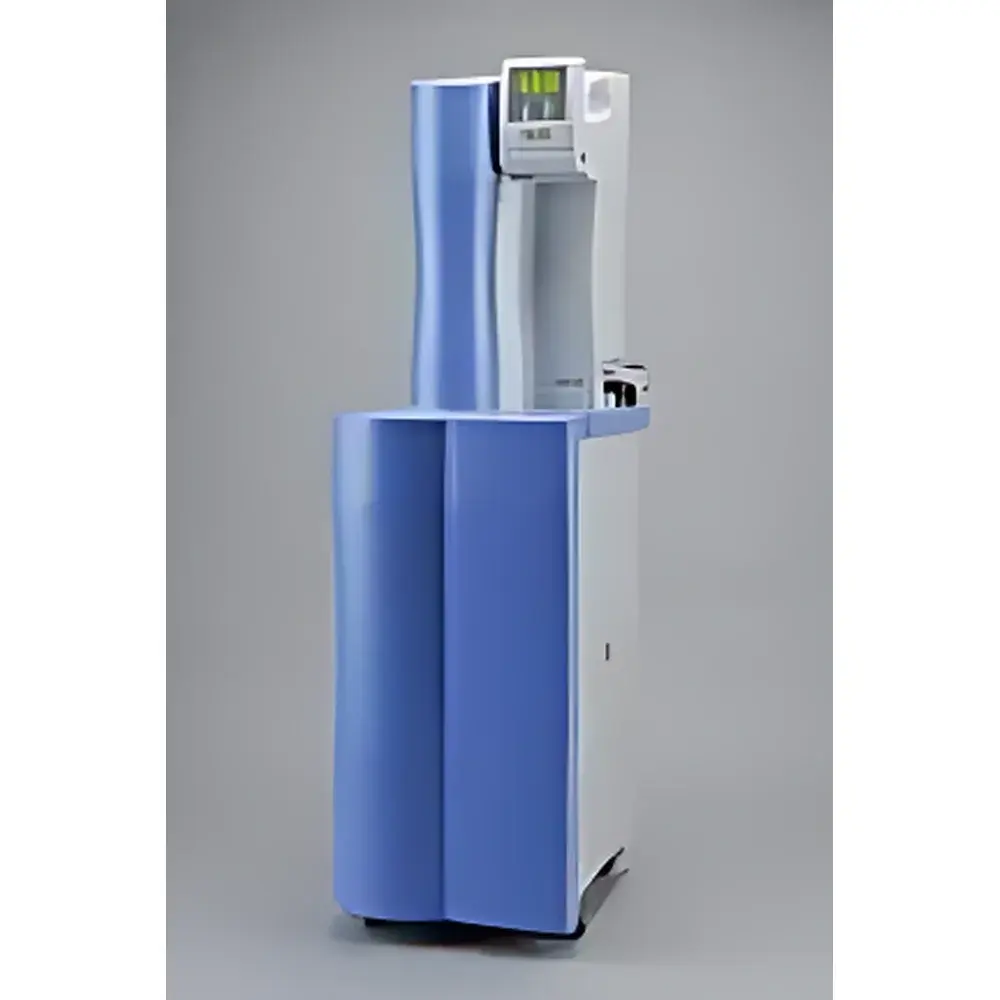
Thermo Fisher LabTower RO Ultra-Pure Water System
| Brand | Thermo Fisher |
|---|---|
| Origin | Imported |
| Manufacturer Type | Original Equipment Manufacturer (OEM) |
| Model | LabTower RO |
| Output Flow Rate | 20 L/hr or 40 L/hr |
| Storage Tank Capacity | 100 L (HDPE, light-blocking) |
| Resistivity Monitoring | Yes (electrode constant 0.16 cm⁻¹) |
| Conductivity/Resistivity Display | Backlit LCD with tilt adjustment |
| Operating Modes | Production, Standby, Cleaning |
| Tank Level Indication | % display |
| Data Logging | RS-232 interface with optional printer support |
| GLP Compliance | Yes (audit-trail capable, password-protected parameter settings) |
| Pretreatment | Integrated antiscalant cartridge, 5 µm sediment filter, activated carbon filter |
| RO Membrane Protection | Antiscalant + carbon prefiltration |
| TOC Reduction | ≥99% |
| Particulate Removal (>0.1 µm) | ≥99% |
| Ionic Impurity Removal | ~98% |
| Application Grade | ASTM Type III Reagent Water (per ASTM D1193-20) |
Overview
The Thermo Fisher LabTower RO Ultra-Pure Water System is a modular, floor-standing reverse osmosis (RO)-based purification platform engineered for reliable, continuous production of ASTM Type III reagent-grade water in research, clinical, and industrial laboratory environments. Unlike point-of-use RO units, the LabTower RO integrates a full pretreatment train—including antiscalant dosing, 5 µm depth filtration, and high-capacity activated carbon adsorption—directly upstream of its high-rejection thin-film composite (TFC) RO membrane. This configuration ensures consistent feedwater quality, minimizes fouling risk, and extends membrane service life. The system delivers purified water at either 20 or 40 liters per hour, stored in a dedicated 100 L opaque, high-density polyethylene (HDPE) tank designed to inhibit microbial growth and photolytic degradation. Its microprocessor-controlled architecture supports real-time monitoring of resistivity (via a precision 0.16 cm⁻¹ electrode), conductivity, tank level (%), and operational status—enabling traceable, reproducible water quality management aligned with Good Laboratory Practice (GLP) requirements.
Key Features
- Floor-standing, mobile design with integrated casters—no benchtop footprint required
- 100 L light-blocking HDPE storage tank with programmable fill-level control and direct draw capability for autoclaves, glassware washers, and downstream ultrapure systems
- Three-stage pretreatment: antiscalant cartridge (prevents CaCO₃/MgSO₄ scaling), 5 µm polypropylene sediment filter, and granular activated carbon (GAC) bed (removes chlorine, chloramines, organics, and particulates)
- Real-time resistivity monitoring using a calibrated, temperature-compensated electrode (cell constant 0.16 cm⁻¹) compliant with ASTM D1125 and ISO 7888
- Backlit, tiltable LCD interface displaying resistivity (MΩ·cm), conductivity (µS/cm), tank fill level (%), and active mode (Production / Standby / Cleaning)
- Password-protected parameter configuration to prevent unauthorized changes—supports GLP audit trails
- RS-232 serial port for data export and optional thermal printer integration; compatible with LIMS and lab-wide water quality tracking protocols
- Automatic membrane cleaning cycle triggered by pressure differential or time-based scheduling
Sample Compatibility & Compliance
The LabTower RO produces water meeting ASTM Type III specifications (resistivity ≥ 0.05 MΩ·cm at 25 °C; TOC ≤ 200 ppb; bacteria ≤ 10 CFU/mL; particles >0.1 µm reduced by ≥99%). It is validated for use as feedwater to steam sterilizers (e.g., autoclaves), laboratory dishwashers, buffer preparation stations, and as inlet supply to Type I ultrapure water systems (e.g., Thermo Fisher Barnstead E-pure or GenPure). All wetted materials—including tank, tubing, valves, and filters—are USP Class VI-certified and FDA-compliant. The system adheres to ISO 9001 manufacturing standards and is designed to support regulatory audits under GLP, ISO/IEC 17025, and cGMP frameworks. While not intended for direct cell culture or HPLC mobile phase preparation, its output satisfies stringent requirements for instrument rinsing, reagent dilution, and general lab utility applications.
Software & Data Management
The embedded controller logs timestamped resistivity, conductivity, tank level, and operational mode data internally. Through the RS-232 interface, users can export CSV-formatted records for long-term archival or import into laboratory information management systems (LIMS). Optional printer accessories generate hard-copy logs compliant with 21 CFR Part 11 requirements when paired with electronic signature workflows. Parameter changes—including setpoints, cleaning intervals, and alarm thresholds—are subject to dual-level password authentication (operator vs. administrator), ensuring integrity of calibration history and system configuration. Audit trail functionality captures user ID, timestamp, and modified parameter—fully traceable for internal QA reviews or external inspections.
Applications
- Feedwater supply for autoclaves, tunnel washers, and steam generators requiring low-mineral, low-TOC input
- Routine laboratory tasks including glassware rinsing, media preparation, and pH meter calibration
- Buffer and saline solution formulation where ionic purity is critical but endotoxin-free grade is not mandated
- Supporting infrastructure for Type I ultrapure water systems—reducing load on polishing cartridges and extending deionization resin life
- Quality control laboratories operating under ISO/IEC 17025 accreditation, where documented water quality history is mandatory
- Pharmaceutical R&D labs performing non-sterile analytical testing per USP Water for Pharmaceutical Purposes
FAQ
What water quality standard does the LabTower RO meet?
It consistently produces ASTM Type III reagent water per ASTM D1193-20, verified via on-line resistivity measurement and periodic TOC/bacterial testing.
Can the system be upgraded to produce Type I ultrapure water?
No—the LabTower RO is a dedicated RO platform. For Type I water, it serves as a pre-purification stage feeding a separate ultrapure polishing system (e.g., Thermo Fisher GenPure or Barnstead Smart2Pure).
Is the 100 L tank suitable for continuous 24/7 operation?
Yes—when paired with the 40 L/hr model and typical lab usage patterns, the tank supports uninterrupted supply with scheduled overnight refill cycles.
How often must the pretreatment cartridges be replaced?
Antiscalant cartridges require replacement every 6–12 months depending on feedwater hardness; 5 µm and GAC filters are rated for 6 months or 10,000 L, whichever occurs first.
Does the system comply with FDA 21 CFR Part 11 for electronic records?
The hardware supports Part 11 compliance when configured with validated printer firmware, audit-trail logging, and role-based access controls—but final validation remains the responsibility of the end-user’s IT/QA team.



