
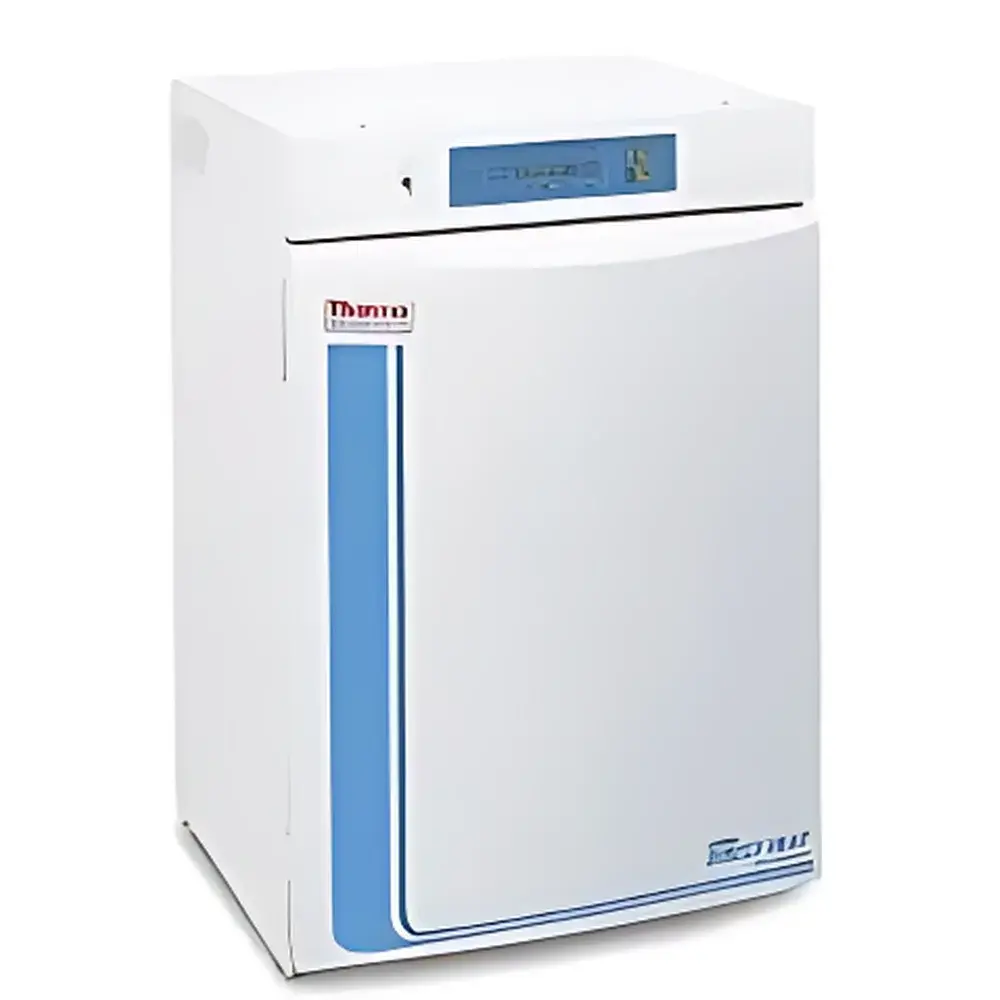
Forma™ 310 Direct-Heat CO₂ Incubator
| Brand | Thermo Fisher Scientific |
|---|---|
| Origin | Imported |
| Manufacturer | Thermo Fisher Scientific |
| Model | 311 |
| Temperature Range & Accuracy | Ambient +5°C to 50°C |
| Temperature Uniformity | ±0.5°C |
| Humidity Control | >90% rH at 37°C |
| Chamber Capacity | 184 L (6.5 cu. ft.) |
Overview
The Forma™ 310 Direct-Heat CO₂ Incubator (Model 311) is a laboratory-grade, microprocessor-controlled incubation system engineered for reliable, long-term mammalian cell culture under physiologically relevant conditions. Unlike water-jacketed or convection-based designs, this unit employs direct-heating technology—where heating elements are integrated into the chamber walls—to achieve rapid thermal response, minimal temperature overshoot, and superior stability across the full operating range (Ambient +5°C to 50°C). The chamber maintains CO₂ concentration via dual-sensor architecture: users may select either a thermocouple (TC)-based CO₂ sensor for extended calibration stability in controlled-humidity environments, or an infrared (IR) CO₂ sensor optimized for robust performance under variable humidity and temperature transients. Integrated Enviro-Scan™ microprocessor control continuously monitors and regulates temperature, CO₂, and relative humidity (rH), delivering high reproducibility essential for sensitive primary cultures, stem cell expansion, and routine passage protocols.
Key Features
- Direct-heat chamber architecture with wall-mounted heating elements ensures fast recovery after door openings and minimizes thermal gradients (±0.5°C uniformity).
- Polished stainless-steel interior with fully rounded corners and seamless welds—designed for autoclavable compatibility and compliance with ISO 14644-1 Class 5 cleanroom maintenance protocols.
- Removable stainless-steel shelves and support rails require no tools for reconfiguration, supporting flexible workflow adaptation across multi-user labs.
- Optional HEPA filtration system provides continuous air recirculation, delivering ≥99.99% particle removal (≥0.3 µm) and complete chamber air exchange every 60 seconds—critical for low-bioburden applications including iPSC culture and co-culture assays.
- Dual independent temperature sensors (one for control, one for overtemperature protection) meet IEC 61010-1 safety requirements and enable fail-safe shutdown if deviation exceeds preset thresholds.
- Humidity management includes a removable stainless-steel humidity pan and optional rH display module, enabling real-time monitoring to prevent desiccation-induced culture failure during extended incubation cycles.
Sample Compatibility & Compliance
This incubator supports standard T-flasks (up to 175 cm²), multiwell plates (6–96-well), Petri dishes, roller bottles, and custom bioreactor inserts. Its chamber geometry accommodates up to six full-size shelves (included) without compromising airflow integrity. All materials contacting the internal environment comply with USP Class VI biocompatibility standards. The system meets key regulatory expectations for GLP- and GMP-aligned workflows: configurable access codes, audit-trail-capable event logging (via optional RS-232/USB interface), and alarm history storage—including timestamps for high/low temperature, CO₂ deviation, and door-open events. While not pre-certified to FDA 21 CFR Part 11, its data logging architecture supports validation documentation when deployed with compliant software platforms.
Software & Data Management
Control is managed through the Enviro-Scan™ alphanumeric LED interface—featuring intuitive menu navigation, programmable setpoint ramping, and simultaneous display of process variables (°C, %CO₂, %rH). Alarms are configurable for audible/visual notification and can be silenced or latched per user preference. Optional serial communication enables integration with LabVantage, STARLIMS, or custom SCADA systems for centralized environmental monitoring. Event logs retain ≥1,000 entries with date/time stamps and are exportable via USB memory stick for QA review. Firmware updates are performed locally using encrypted .bin files distributed via Thermo Fisher’s secure customer portal—ensuring traceability and version control aligned with ISO/IEC 17025 documentation practices.
Applications
- Routine maintenance and expansion of adherent and suspension mammalian cell lines (e.g., HeLa, CHO-K1, HEK293).
- Stem cell culture requiring stringent CO₂ and humidity consistency, including embryonic and induced pluripotent stem cells.
- Microbiological co-culture studies where cross-contamination risk must be minimized via HEPA-filtered laminar flow.
- Long-duration toxicity assays (e.g., 72–96 h exposure) where uninterrupted environmental fidelity directly impacts IC₅₀ determination accuracy.
- Biobanking workflows involving cryopreserved vial recovery and post-thaw expansion under standardized atmospheric conditions.
FAQ
What CO₂ sensing technology does the Forma™ 310 support?
The system offers two interchangeable options: a thermocouple (TC) sensor for stable, low-drift operation in tightly regulated labs, or an infrared (IR) sensor for enhanced reliability under fluctuating ambient humidity and temperature.
Is the humidity system self-regulating?
Yes—the incubator maintains >90% relative humidity at 37°C using passive evaporation from a removable stainless-steel pan; optional rH monitoring allows proactive intervention before desiccation occurs.
Can the door opening direction be modified onsite?
Yes—standard configuration features right-hinged doors, but left-hinge kits are available as field-installable accessories without requiring service technician dispatch.
Does the unit comply with international electrical safety standards?
It conforms to IEC 61010-1:2010 for laboratory equipment, including overtemperature cutoff, ground-fault detection, and double-insulated power supply design.
What validation documentation is provided?
Thermo Fisher supplies factory-as-tested IQ/OQ documentation templates, including temperature mapping protocols, CO₂ linearity verification procedures, and alarm response test checklists—supporting user-led PQ execution per ASTM E2500 and EU Annex 15 guidelines.




