
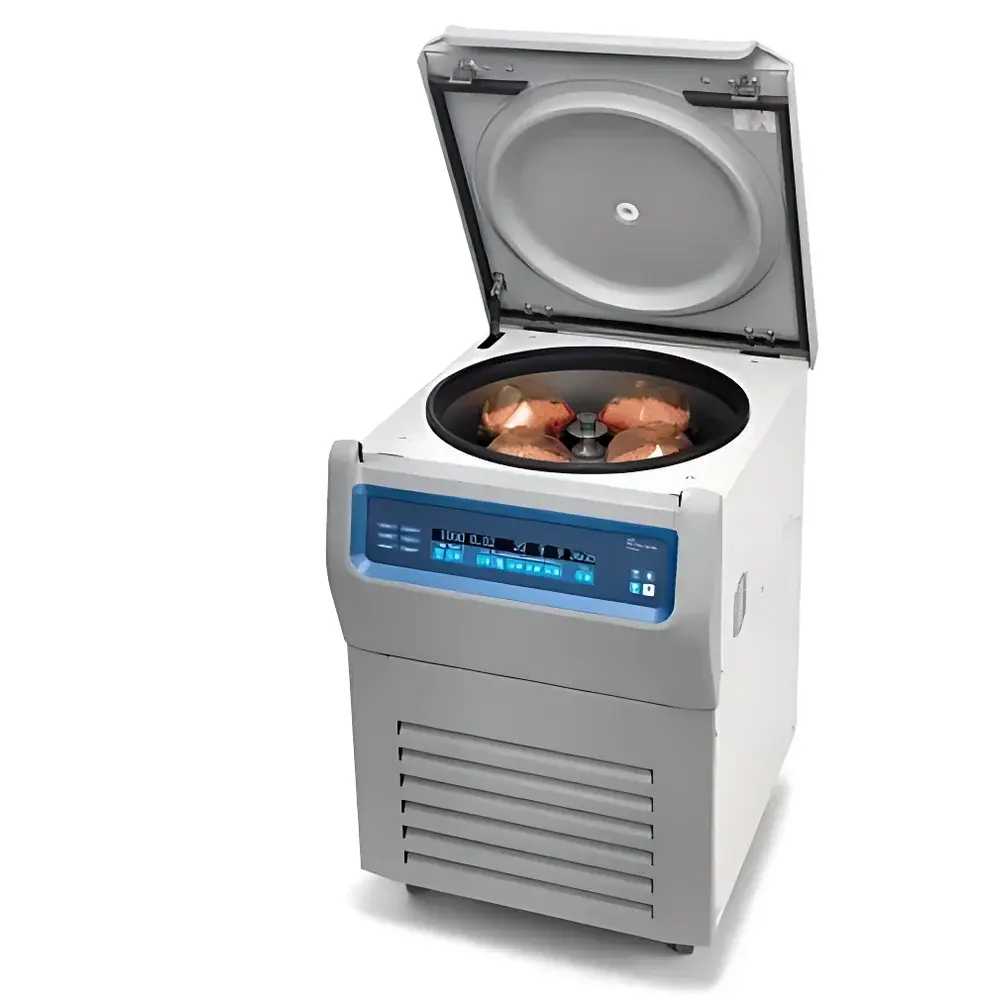
Thermo Scientific Sorvall ST4F/ST4R F Plus Floor-standing Centrifuge
| Brand | Thermo Fisher |
|---|---|
| Origin | Germany |
| Manufacturer | Thermo Fisher Scientific |
| Product Type | Floor-standing centrifuge |
| Model | Sorvall ST4F / ST4R F Plus |
| Centrifuge Category | High-speed centrifuge (10,000–30,000 rpm) |
| Maximum Capacity | 4 × 1000 mL (with TX-1000 rotor) |
| Maximum Speed | 15,200 rpm (with Microliter 30 × 2 rotor) |
| Maximum RCF | 25,830 × g (with Microliter 30 × 2 rotor) |
| Dimensions | 83.5 × 56.6 × 69 cm |
| Rotor Options | 12 interchangeable rotors |
| Control Interface | High-contrast LCD with programmable memory for up to 6 protocols |
| Safety Certifications | CAMR™-certified ClickSeal™ biocontainment system, IEC 61010-1, EN 61326-1 |
Overview
The Thermo Scientific Sorvall ST4F and ST4R F Plus floor-standing centrifuges are engineered for high-throughput, high-reproducibility separation tasks in clinical, diagnostic, bioprocessing, and academic laboratories. Designed around a robust horizontal-axis drive architecture and precision-balanced brushless induction motor, these units operate on the principle of sedimentation under controlled gravitational force (RCF), enabling efficient separation of heterogeneous mixtures—including whole blood, cell suspensions, subcellular organelles, and particulate contaminants—based on density, size, and shape differences. The ST4R variant adds refrigeration capability (–10 °C to +40 °C) for temperature-sensitive applications such as plasma fractionation or enzyme isolation, while the ST4F provides ambient-temperature operation optimized for routine serum/plasma preparation and large-volume processing. Both models meet international safety and electromagnetic compatibility standards (IEC 61010-1, EN 61326-1) and are validated for use in GLP-compliant environments.
Key Features
- Auto-Lock™ III Rotor System: Enables one-handed, tool-free rotor installation and ejection with audible and visual confirmation; eliminates manual threading and torque calibration errors common with legacy screw-type systems.
- ClickSeal™ Biocontainment Lid: A single-action, glove-compatible sealing mechanism certified by the UK Health Security Agency’s Defence Science and Technology Laboratory (DSTL) at Porton Down for containment of BSL-2 agents; eliminates threaded caps and complex latches.
- Fiberlite™ Carbon-Fiber Rotors: Lightweight, high-strength composite rotors offering higher maximum speeds and improved fatigue resistance versus aluminum or titanium equivalents—enabling extended service life and reduced mechanical stress during rapid acceleration/deceleration cycles.
- SMARTSpin™ Intelligent Rotor Management: Dynamically adjusts acceleration and deceleration profiles based on real-time load distribution and rotor inertia; mitigates vibration from minor imbalances and extends bearing longevity without requiring manual rebalancing.
- Ergonomic Floor-Standing Architecture: Optimized height (69 cm working surface) and front-access cavity design reduce operator strain during tube loading/unloading; integrated handgrips and low-profile footprint (83.5 × 56.6 cm) maximize bench space utilization in constrained lab environments.
- Energy-Efficient Operation: Achieves up to 40% lower power consumption per cycle compared to conventional fixed-angle centrifuges handling equivalent sample volumes (e.g., 196 × 5–7 mL blood tubes or 40 × 50 mL conical tubes), verified per ISO 50001-aligned internal benchmarking protocols.
Sample Compatibility & Compliance
The Sorvall ST4F/ST4R F Plus supports a broad spectrum of primary and secondary sample containers—including polypropylene and polycarbonate centrifuge tubes (5–1000 mL), blood collection tubes (EDTA, heparin, serum separator), microtiter plates (2 × 96-well), and custom adapters for cryovials and bioreactor harvest bags. All 12 available rotors—including the TX-1000 (4 × 1000 mL), Microliter 30 × 2 (30 × 2 mL), and HB-6 (6 × 500 mL)—are individually serialized and traceable to manufacturing lot data. Each rotor undergoes full mechanical validation per ISO 15195:2018 (calibration of centrifuges) and is supplied with a Certificate of Conformance documenting RCF accuracy, run-time stability, and thermal performance (for ST4R). The system complies with FDA 21 CFR Part 11 requirements when paired with Thermo Fisher’s optional CentriVero™ LIMS-integrated software suite, supporting electronic signatures, audit trails, and role-based access control.
Software & Data Management
The embedded firmware supports up to six user-defined protocols stored directly on the instrument’s non-volatile memory, each configurable with speed (rpm), time (0–99 min 59 s), temperature setpoint (ST4R only), acceleration/deceleration ramp profiles, and auto-brake selection. Protocol export/import via USB 2.0 enables cross-instrument standardization across multi-site labs. Optional CentriVero™ software provides full GxP-compliant data management: encrypted raw run logs (including real-time RCF, temperature, and vibration metrics), PDF report generation with digital signature fields, and seamless integration with laboratory information management systems (LIMS) via ASTM E1384-compliant HL7 messaging. Audit trail functionality records all parameter modifications, user logins, and rotor usage history—fully compliant with ISO/IEC 17025:2017 clause 7.7 and EU Annex 11 expectations for analytical instrumentation.
Applications
- Clinical diagnostics: High-volume serum/plasma separation from whole blood (up to 196 tubes per run); platelet-rich plasma (PRP) preparation; viral load sample concentration.
- Biopharmaceutical development: Harvesting mammalian cell cultures (CHO, HEK293); clarification of monoclonal antibody harvest streams; purification intermediate hold-step centrifugation.
- Academic research: Subcellular fractionation (nuclei, mitochondria, lysosomes); nanoparticle pelleting (exosomes, liposomes); environmental microbiology (waterborne pathogen concentration).
- Transfusion medicine: Red blood cell washing and buffy coat isolation; platelet storage solution exchange.
- Food & beverage QC: Fat globule separation in dairy emulsions; yeast and bacterial pellet recovery in fermentation monitoring.
FAQ
What is the difference between the ST4F and ST4R F Plus models?
The ST4F operates at ambient temperature and is optimized for high-capacity, non-refrigerated applications such as routine blood banking. The ST4R includes a compressor-based refrigeration system (–10 °C to +40 °C) for thermally sensitive separations including RNA stabilization, enzyme assays, and cold-active protein purification.
Can the Sorvall ST4F/ST4R F Plus be integrated into automated lab workflows?
Yes—via optional RS-232 or Ethernet interfaces, the centrifuge supports bidirectional communication with robotic liquid handlers and track-based automation platforms using Modbus RTU or TCP protocols. Full integration requires CentriVero™ software licensing and hardware interface modules.
Is rotor calibration required before first use?
No—each Fiberlite™ rotor ships with factory-applied calibration data embedded in its RFID tag. The SMARTSpin™ system reads this data automatically upon installation and applies appropriate acceleration/deceleration algorithms.
How often should the ClickSeal™ lid gasket be replaced?
Under normal BSL-2 usage conditions, the fluorosilicone gasket is rated for ≥5,000 sealing cycles. Replacement is recommended annually or after visible compression set, abrasion, or loss of vacuum integrity during biocontainment verification tests.
Does the system support regulatory audit readiness for FDA or ISO 13485 submissions?
Yes—when configured with CentriVero™ software, the platform delivers full 21 CFR Part 11 compliance, including electronic signatures, immutable audit trails, and validation documentation packages (IQ/OQ/PQ templates available upon request).



