
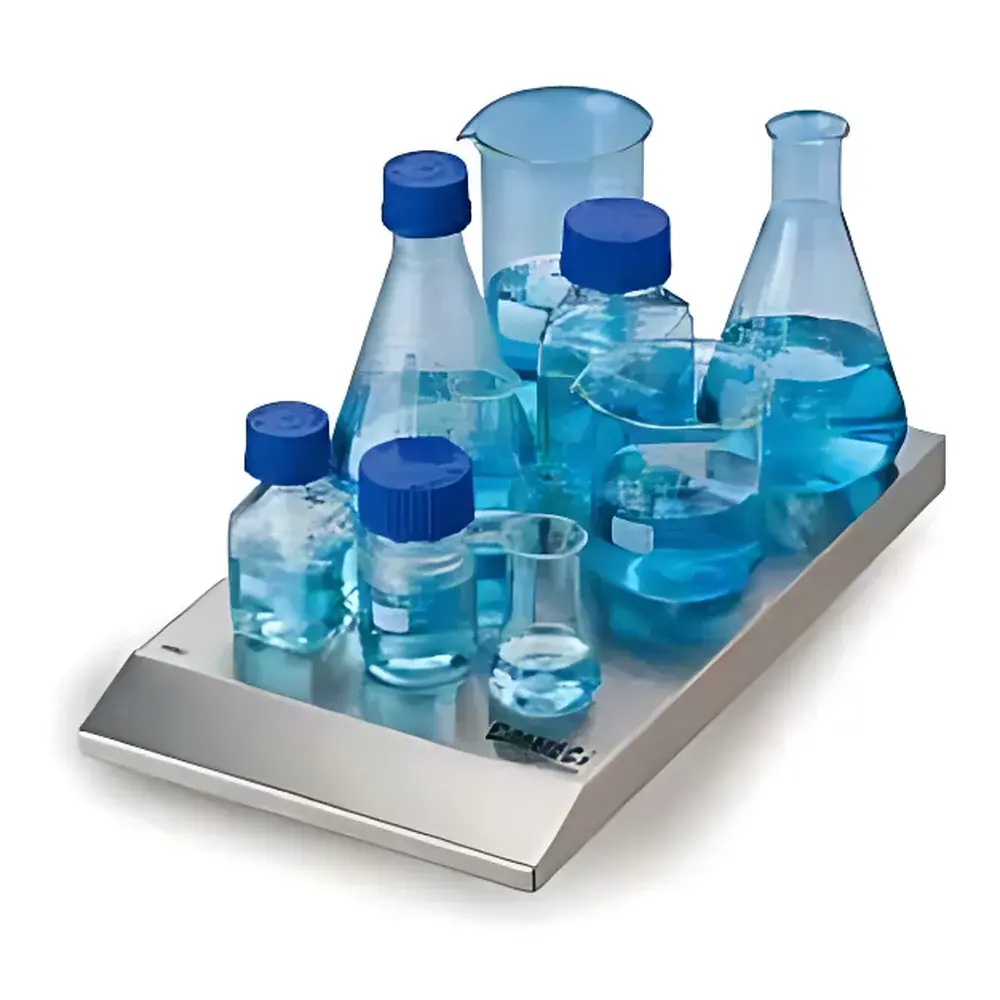
Thermo Scientific Cimarec i Telesystems Multi-Point Magnetic Stirrer
| Brand | Thermo Fisher Scientific |
|---|---|
| Origin | Germany |
| Manufacturer | Thermo Fisher Scientific |
| Model | Cimarec i Telesystems |
| Stirrer Type | Magnetic Stirrer |
| Max. Stirring Volume | 20 L (total, across all positions) |
| Speed Range | 100–2000 rpm |
| Temperature Control Range | −10 °C to +56 °C |
| Enclosure Rating | IP68 |
| Material | Corrosion-Resistant Stainless Steel |
| Controller Options | Telemodul 20 C (basic) or Telemodul 40 C (with RS232 interface for PC connectivity and data logging) |
| Operating Humidity | Up to 100% RH |
| Individual Position Capacity | Up to 2 L per stir point |
| Configurations Available | 6-, 15-, and 60-point platforms |
Overview
The Thermo Scientific Cimarec i Telesystems is a high-performance, multi-point magnetic stirrer engineered for reproducible, scalable mixing in demanding laboratory environments. Designed around the principle of rotating magnetic fields generated by precisely arranged permanent magnets beneath a thermally stable ceramic or stainless-steel platform, it induces controlled rotational motion in PTFE- or glass-coated magnetic stir bars immersed in samples. Unlike single-point units, the Cimarec i Telesystems integrates modular platform configurations—6, 15, or 60 independent stirring positions—each with individual speed regulation and uniform torque delivery. Its operational envelope spans −10 °C to +56 °C, enabling compatibility with chilled baths, ambient benchtop use, and mild heating applications without external hotplates. The system’s architecture supports continuous operation under 100% relative humidity and meets IP68 ingress protection standards—ensuring resistance to liquid immersion and aggressive cleaning protocols common in QC, pharmaceutical, and environmental labs.
Key Features
- Modular multi-position platform (6/15/60 points) with independent speed control per position, supporting parallel processing of multiple samples under identical or differentiated conditions.
- Wide speed range of 100–2000 rpm with digital feedback loop for consistent rotational stability—even at low speeds critical for viscous or shear-sensitive formulations.
- Integrated temperature control capability (−10 °C to +56 °C) compatible with Thermo Scientific Telemodul 20 C (manual setpoint) and Telemodul 40 C (RS232-enabled, programmable controller with real-time data export).
- Corrosion-resistant stainless-steel housing rated IP68—validated for repeated exposure to aqueous solutions, organic solvents, and disinfectants without degradation.
- Energy-efficient power management: automatic load-adaptive motor drive reduces power draw during low-torque operation while maintaining setpoint accuracy.
- Non-volatile memory retains last-used parameters (speed, temperature, duration) after power cycling—supporting GLP-compliant workflow continuity.
Sample Compatibility & Compliance
The Cimarec i Telesystems accommodates standard laboratory vessels—including beakers, flasks, and vials—up to 2 L per position, with total system capacity scaling to 20 L across the full 60-point configuration. Its non-magnetic platform surface prevents interference with sensitive instrumentation (e.g., NMR sample prep areas). The device complies with IEC 61010-1:2010 for electrical safety in laboratory equipment and meets EN 61326-1:2013 for electromagnetic compatibility (EMC). When paired with Telemodul 40 C and validated software, the system supports audit-trail generation and user-access controls aligned with FDA 21 CFR Part 11 requirements for electronic records in regulated environments.
Software & Data Management
The Telemodul 40 C controller provides bidirectional RS232 communication for integration into lab-wide data acquisition networks. It enables remote parameter setting, real-time speed/temperature monitoring, time-stamped event logging, and export of CSV-formatted datasets for traceability. No proprietary drivers are required—standard terminal emulation or custom Python/LabVIEW scripts can interface directly with the controller’s ASCII command protocol. All logged data includes operator ID (via optional password-protected login), timestamp, and environmental context (ambient temperature/humidity if external sensors are connected), satisfying documentation needs for ISO/IEC 17025-accredited testing laboratories.
Applications
- Parallel dissolution testing in pharmaceutical development (USP Apparatus II compliance support via standardized vessel geometry).
- Buffer and reagent preparation across clinical diagnostics workflows requiring strict lot-to-lot consistency.
- Environmental sample homogenization prior to ICP-MS or HPLC analysis—especially for sediment suspensions and soil extracts.
- Cell culture media equilibration under controlled thermal conditions to minimize CO₂ loss and pH drift.
- Long-duration stability studies where uninterrupted, low-shear mixing at sub-ambient temperatures is essential (e.g., protein formulation screening at 4 °C).
FAQ
Can the Cimarec i Telesystems operate inside a cold room or refrigerated incubator?
Yes—the −10 °C minimum operating temperature and IP68-rated enclosure allow safe, continuous use in controlled cold environments, provided ambient condensation is managed.
Is calibration required, and does it support traceable calibration documentation?
Speed and temperature sensors are factory-calibrated per ISO/IEC 17025 procedures; on-site verification kits and calibration certificates (traceable to NIST or PTB) are available upon request.
What stir bar sizes are recommended for optimal performance across the 60-point platform?
Standard elliptical stir bars (20–40 mm length, 6–8 mm diameter) deliver maximum efficiency; Thermo Scientific catalog numbers 88850250 (PTFE-coated) and 88850251 (glass-coated) are validated for all configurations.
Does the system support GMP-aligned user access control?
When used with Telemodul 40 C and compliant LIMS integration, role-based permissions (e.g., operator vs. administrator) and electronic signatures can be enforced through external authentication services.
How is heat dissipation managed during extended 2000 rpm operation across all positions?
A dual-stage thermal management system—comprising passive convection fins and duty-cycled fan assist—maintains internal PCB temperatures below 65 °C even at maximum sustained load.



