
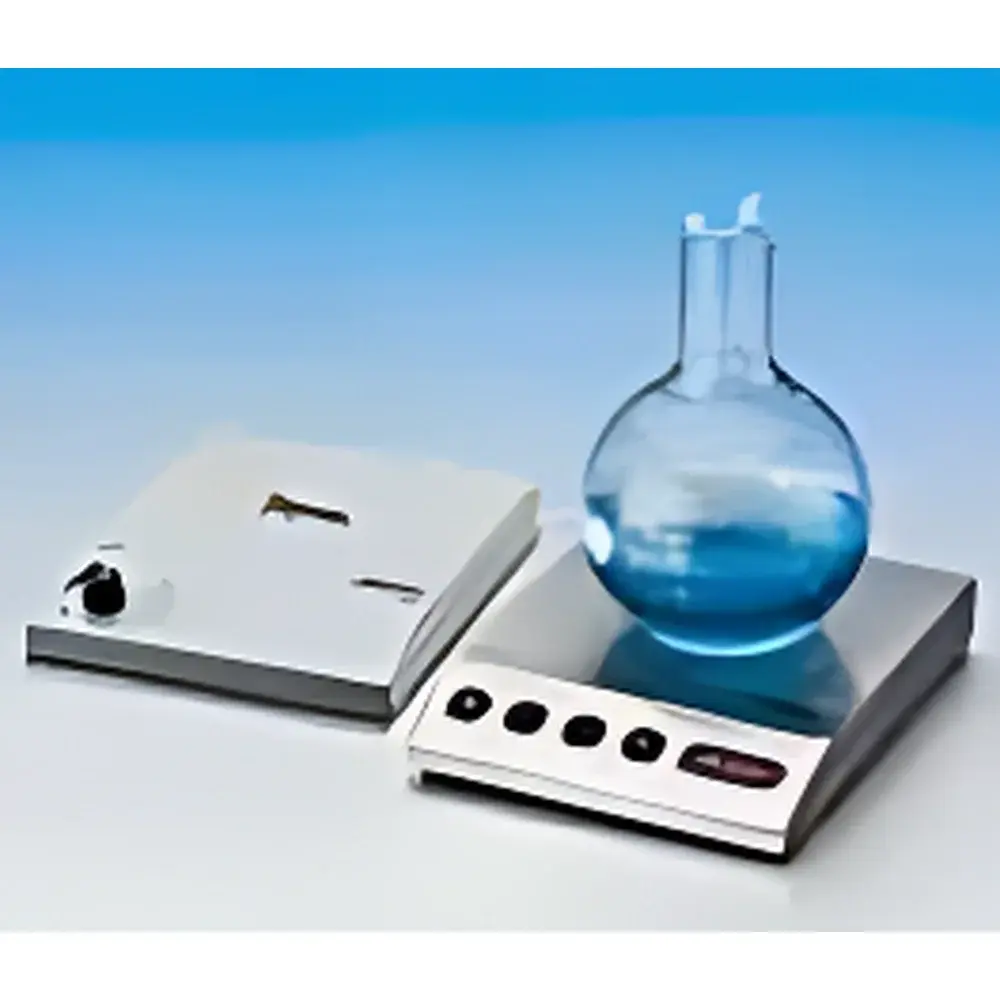
Thermo Fisher Scientific Cimarec i Mono Direct & Maxi Direct Magnetic Stirrers
| Brand | Thermo Fisher Scientific |
|---|---|
| Origin | Germany |
| Manufacturer Type | Original Equipment Manufacturer (OEM) |
| Product Category | Imported Laboratory Equipment |
| Model | Mono Direct / Maxi Direct |
| Instrument Type | Magnetic Stirrer |
| Maximum Stirring Volume | 3 L (Mono Direct) / 5 L (Maxi Direct) |
| Speed Range | 130–1200 rpm (Mono Direct) / 80–2000 rpm (Maxi Direct) |
| Temperature Operating Range | −10 °C to +40 °C |
| Enclosure Rating | IP64 (Maxi Direct only) |
| Construction | Powder-coated or seamless stainless steel housing |
| Control Interface | Analog knob (Mono Direct) / Digital LCD with microprocessor control (Maxi Direct) |
| Compliance | Designed for GLP-compliant environments |
Overview
The Thermo Fisher Scientific Cimarec i Mono Direct and Maxi Direct magnetic stirrers are precision-engineered benchtop instruments designed for consistent, reproducible mixing in analytical, quality control, and research laboratories. Based on the principle of rotating magnetic fields generated beneath a non-magnetic workplate, these stirrers induce controlled rotational motion in PTFE- or ceramic-coated magnetic stir bars immersed in liquid samples. Unlike mechanical overhead stirrers, magnetic stirrers eliminate shaft seal wear, reduce contamination risk, and provide silent, vibration-free operation—critical for sensitive assays, cell culture media preparation, and reagent homogenization. Both models feature thermally stable ceramic-coated aluminum plates engineered to maintain uniform surface temperature distribution across the entire heating area. The Mono Direct serves as an entry-level analog-controlled unit optimized for routine tasks requiring reliable speed stability at moderate throughput, while the Maxi Direct delivers enhanced digital control, extended speed range, and environmental resilience for demanding multi-user lab environments.
Key Features
- Robust stainless steel construction: Mono Direct features a durable powder-coated stainless steel housing; Maxi Direct utilizes a fully sealed, seamless stainless steel enclosure rated IP64—enabling safe rinsing under running water without electrical hazard.
- Dual-speed architecture: Mono Direct operates from 130 to 1200 rpm with analog knob adjustment; Maxi Direct provides broader dynamic control from 80 to 2000 rpm with 1-rpm resolution via digital LCD interface.
- Thermal performance: Both units support ambient operation between −10 °C and +40 °C at ≤95% relative humidity. The heated plate maintains thermal equilibrium within ±2 °C across the full working surface (tested per ASTM E2210).
- Energy-efficient design: Variable power delivery adapts to load conditions, minimizing idle consumption without compromising torque consistency—even at low speeds or high viscosity loads up to 10,000 mPa·s (with appropriate stir bar geometry).
- User-centric functionality: Maxi Direct includes automatic memory recall—reinstating the last-used speed and time settings upon power-up—reducing setup variability across shifts and operators.
Sample Compatibility & Compliance
These stirrers accommodate standard laboratory glassware including beakers (50 mL to 2000 mL), Erlenmeyer flasks, and cylindrical vessels with flat, non-magnetic bases. Compatibility extends to solvents such as aqueous buffers, alcohols, acetone, and diluted acids/bases—provided chemical exposure remains within the inertness limits of PTFE-encapsulated stir bars and the ceramic-coated plate surface. Neither model incorporates integrated temperature sensing or feedback control; external PT100 probes or IR thermometers are recommended for process-critical thermal validation. Units comply with IEC 61010-1:2010 safety standards for laboratory electrical equipment and meet electromagnetic compatibility (EMC) requirements per EN 61326-1. Their design supports alignment with GLP documentation workflows and is routinely validated in GMP-regulated environments where audit trails for equipment parameters are maintained manually or via connected LIMS platforms.
Software & Data Management
While standalone operation requires no software, the Maxi Direct’s digital interface supports optional RS232 or USB-to-serial connectivity (via accessory cable) for integration into centralized lab automation systems. When interfaced, real-time speed output, elapsed run time, and fault codes—including overtemperature alerts and motor stall detection—can be logged externally. Firmware updates are performed offline using Thermo Fisher’s certified configuration utility, ensuring traceability under FDA 21 CFR Part 11 when deployed with electronic signature-enabled data acquisition software. No cloud-based telemetry or proprietary cloud services are embedded—preserving network security and data sovereignty per institutional IT policies.
Applications
- Preparation of homogeneous calibration standards and reference solutions in analytical chemistry labs (e.g., ICP-MS, HPLC mobile phase blending).
- Buffer equilibration and pH adjustment during protein purification workflows.
- Dispersion of nanoparticles and colloidal suspensions prior to DLS or TEM sample preparation.
- Accelerated dissolution testing of pharmaceutical excipients under non-GMP pilot-scale conditions.
- Long-duration enzymatic reaction monitoring where minimal shear and thermal drift are essential.
FAQ
Do these stirrers include built-in temperature measurement or control?
No. They operate as non-contact magnetic mixers without integrated temperature sensors. External monitoring is required for temperature-critical protocols.
Can the Maxi Direct be used inside a cold room at −10 °C?
Yes—both models are rated for continuous operation between −10 °C and +40 °C, provided ambient humidity remains below 95% RH and condensation does not form on internal electronics.
What stir bar sizes are recommended for maximum efficiency at 2000 rpm?
For optimal vortex formation and torque transfer at high speeds, use elliptical or cross-shaped stir bars 40–60 mm in length with PTFE or PEEK coating—avoiding magnetic saturation or mechanical resonance effects.
Is calibration required before first use?
Speed calibration is not mandatory but recommended annually using a NIST-traceable tachometer, especially in regulated environments where speed accuracy impacts method validity.
Are replacement parts and service manuals available globally?
Yes—Thermo Fisher Scientific provides authorized service centers across North America, EMEA, and APAC, with documented spare parts lists (SPLs), firmware archives, and technical bulletins accessible via their global support portal.



