
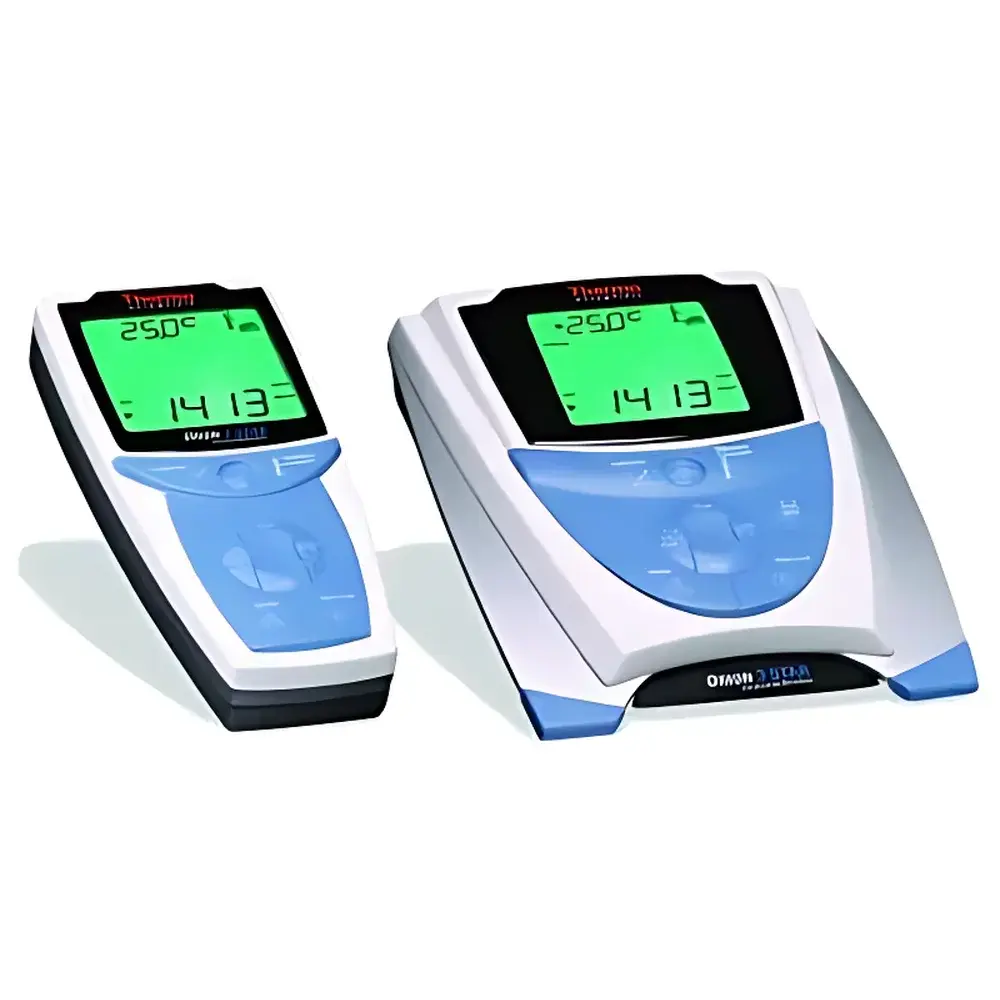
Thermo Fisher Scientific Orion 3-Star Benchtop/Portable Conductivity Meter
| Brand | Thermo Fisher Scientific |
|---|---|
| Origin | USA |
| Manufacturer | Thermo Fisher Scientific |
| Type | Imported Instrument |
| Model | 3-Star |
| Price | Upon Request |
| Conductivity Range | 0.000–3000 mS/cm |
| Resolution | Up to 4 significant digits, down to 0.001 μS/cm |
| Accuracy | ±0.5% of reading or ±0.01 μS/cm (whichever is greater) |
| Resistivity Range | 0.0001–100 MΩ·cm |
| Salinity Range | 0.01–80.0 ppt NaCl |
| TDS Range | 0–19999 mg/L |
| Cell Constant Range | 0.001–199.9 cm⁻¹ |
| Reference Temperatures | 5, 10, 15, 20, or 25 °C |
| Electrode Compatibility | Two-electrode, four-electrode, and planar conductivity cells |
| Calibration Points | 1–5 manual points |
| Temperature Range | −5 to 105 °C |
| Temp. Resolution | 0.1 °C (−5 to 99.9 °C), 1.0 °C (>99.9 °C) |
| Temp. Accuracy | ±0.1 °C |
| Temp. Compensation | Automatic or manual |
| Display | Backlit LCD with icon-driven interface |
| Input Interfaces | pH-BNC, temperature-miniDIN, stirrer-Phono-jack (benchtop only) |
| Communication | Bidirectional RS232, optional USB cable |
| Data Logging | 1000 readings |
| Calibration History | Last 10 calibrations stored |
| Method Storage | 10 user-defined methods |
| Password Protection | 10 independent user profiles |
| Power | 4×AA alkaline batteries |
| Certifications | CE, CSA, UL, TÜV, FCC Class A |
| Operating Environment | 5–45 °C, 5–85% RH (non-condensing) |
| IP Rating | Benchtop: IP54 |
| Portable | IP67 |
| Dimensions (Benchtop) | 9.4 × 17.0 × 22.4 cm (H×W×L) |
| (Portable) | 4.8 × 9.7 × 21.3 cm (H×W×L) |
| Battery Life (Portable) | ~2000 hours |
Overview
The Thermo Fisher Scientific Orion 3-Star Benchtop/Portable Conductivity Meter is a precision-engineered electrochemical instrument designed for reliable, traceable measurement of electrical conductivity, resistivity, salinity, and total dissolved solids (TDS) across diverse laboratory, field, and quality control environments. Based on the principle of conductometric measurement—where conductivity is determined by applying an alternating current across a pair of electrodes and measuring the resulting current flow—the 3-Star platform delivers high reproducibility in aqueous and low-conductivity media. Its dual form factor (benchtop and portable variants) supports both controlled lab workflows and rugged outdoor deployment, while its architecture adheres to foundational electrochemical standards including ASTM D1125 (Standard Test Methods for Electrical Conductivity and Resistivity of Water) and ISO 7888 (Water quality — Determination of electrical conductivity). Though superseded in Thermo Fisher’s current catalog by the Star A series, the 3-Star remains widely deployed in legacy GMP, GLP, and environmental monitoring settings where long-term method stability and regulatory documentation continuity are critical.
Key Features
- Auto-ranging conductivity measurement from 0.000 µS/cm to 3000 mS/cm, with selectable fixed ranges for specialized applications requiring consistent scaling.
- Four-digit resolution capability, enabling detection down to 0.001 µS/cm—essential for ultrapure water analysis in semiconductor or pharmaceutical water-for-injection (WFI) systems.
- Multi-point calibration support (1–5 points) with configurable cell constant entry (0.001–199.9 cm⁻¹), accommodating two-electrode, four-electrode, and planar sensor geometries for optimal accuracy across viscosity and polarization-prone samples.
- Smart Stability™ and Smart Averaging™ algorithms dynamically assess signal convergence and suppress transient noise, reducing operator dependency and improving measurement repeatability.
- Benchtop variant includes miniDIN temperature input and Phono-jack stirrer interface, enabling endpoint-controlled automatic stirring—a key requirement for standardized conductivity titrations per USP <645>.
- IP67-rated portable unit operates continuously for approximately 2000 hours on standard AA alkaline cells, validated for use in wastewater sampling, groundwater surveys, and remote process monitoring under variable ambient conditions.
- Backlit graphical LCD with intuitive icon-based navigation ensures readability in low-light or outdoor settings without compromising ergonomic access to real-time parameters.
Sample Compatibility & Compliance
The 3-Star meter is compatible with a broad spectrum of aqueous matrices—including deionized water, process streams, seawater dilutions, buffer solutions, and industrial effluents—provided sample conductivity falls within the specified range and electrode fouling is mitigated through appropriate cleaning protocols. It accepts all Orion-certified conductivity sensors compliant with IEC 60746-3 (Electrochemical analyzers — Part 3: Conductivity) and supports reference temperature selection (5, 10, 15, 20, or 25 °C) to align with regional or application-specific reporting conventions. The instrument meets CE, CSA, UL, TÜV, and FCC Class A electromagnetic compatibility requirements. When paired with optional Thermo Fisher data management software (e.g., Orion LogRite™), audit trails, electronic signatures, and user-access controls can be implemented to satisfy FDA 21 CFR Part 11 compliance for regulated laboratories operating under cGMP or GLP frameworks.
Software & Data Management
Data integrity is maintained via onboard non-volatile memory storing up to 1000 measurement records, the last 10 calibration events with timestamps and electrode IDs, and 10 password-protected user methods—each supporting configurable units, temperature compensation models, and auto-zero offsets. RS232 serial communication enables direct export to LIMS or Excel-compatible formats; optional USB-to-RS232 adapters facilitate connectivity with modern workstations. While native firmware does not include cloud synchronization, exported CSV files retain full metadata (date/time, operator ID, calibration status, sensor serial number), ensuring traceability during internal audits or regulatory inspections. Firmware updates were historically distributed via Thermo Fisher’s secure customer portal, though no further revisions are issued post-discontinuation.
Applications
- Pharmaceutical water system validation (Purified Water, WFI) per USP <645> and EP 2.2.38.
- Environmental monitoring of surface water, groundwater, and wastewater effluent per EPA Method 120.1 and ISO 10523.
- Boiler feedwater and steam condensate purity assessment in power generation facilities.
- Quality assurance testing of cleaning agents, rinse waters, and electrolyte solutions in electronics manufacturing.
- Educational laboratories requiring robust, serviceable instrumentation for teaching fundamental electrochemical principles.
- Field-based salinity profiling in estuarine and coastal research programs.
FAQ
Is the Orion 3-Star still supported by Thermo Fisher Scientific?
Thermo Fisher discontinued hardware production and firmware development for the 3-Star series in 2012, replacing it with the Star A platform. Limited technical documentation and legacy calibration accessories remain available through authorized distributors.
Can the 3-Star meet 21 CFR Part 11 requirements?
Yes—when used with Thermo Fisher’s optional Orion LogRite software and configured with role-based user accounts, electronic signatures, and audit-trail logging, the system satisfies core Part 11 criteria for electronic records and signatures.
What electrode types are compatible with the 3-Star?
All Orion conductivity electrodes with BNC or miniDIN connectors are supported, including two-electrode cells (e.g., 013005MD), four-electrode cells (e.g., 013010MD), and planar sensors (e.g., 013605MD), provided the correct cell constant is entered manually.
Does the portable version support temperature compensation?
Yes—both benchtop and portable models feature automatic or manual temperature compensation using either built-in thermistors or external ATC probes connected via the miniDIN port.
How is calibration verification performed?
Calibration verification is achieved by measuring NIST-traceable KCl standard solutions (e.g., 84 µS/cm, 1413 µS/cm, 12.88 mS/cm) and comparing measured values against certified reference values; deviation beyond ±0.5% triggers recalibration.
Related Products





