
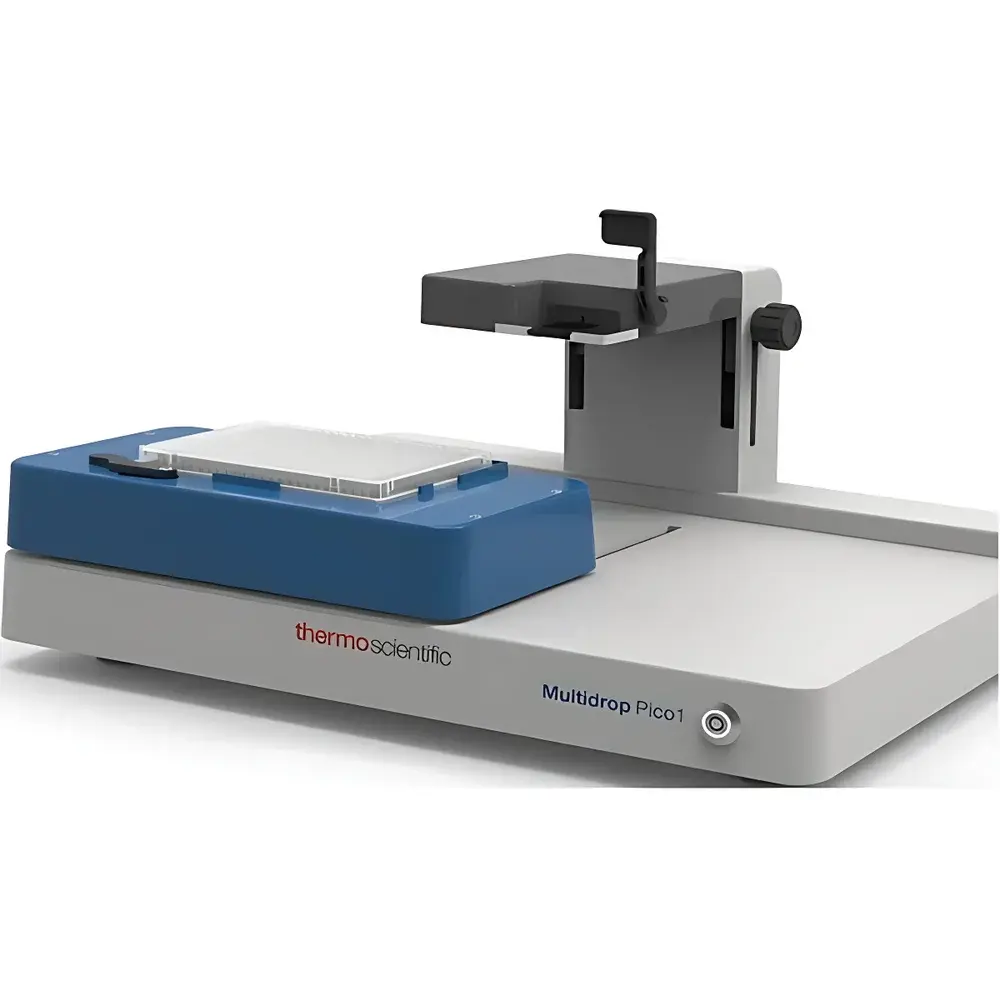
Thermo Fisher Multidrop™ Pico 1 Digital Dispenser
| Brand | Thermo Fisher |
|---|---|
| Origin | USA |
| Manufacturer | Thermo Fisher Scientific |
| Product Category | Imported Instrument |
| Model | Multidrop™ Pico 1 |
| Plate Formats Supported | 12-, 24-, 48-, 96-, and 384-well plates |
| Plate Height Range | 6–47 mm |
| Dispensing Accuracy | ≤8% CV |
| Dispensing Volume Range | 11 pL–20 μL or 1 nL–200 μL (dual-range configuration) |
| Throughput | 1 plate per run |
| Dimensions | 31 cm × 28 cm × 20 cm |
Overview
The Thermo Fisher Multidrop™ Pico 1 Digital Dispenser is a precision-engineered, non-contact liquid handling instrument designed for ultra-low-volume dispensing in high-sensitivity assay workflows. Utilizing positive-displacement digital microdispensing technology—distinct from traditional air-displacement pipetting—the Pico 1 achieves reproducible, calibration-free delivery of discrete droplets as small as 11 picoliters. This mechanism eliminates variability associated with tip wetting, humidity, and liquid surface tension, making it especially suitable for viscous, volatile, or surfactant-containing reagents common in drug discovery and molecular diagnostics. Its compact footprint and single-plate architecture support integration into benchtop assay development environments, automated workcells, and GLP-compliant QC laboratories where traceable, low-volume dispensing is critical.
Key Features
- Ultra-low-volume capability: Dual-range dispensing modes enable flexible operation across two distinct volume windows—11 pL to 20 μL (high-resolution mode) and 1 nL to 200 μL (broad-range mode)—without hardware modification.
- Digital dispensing architecture: No disposable tips required; fluid path consists of a sealed, chemically inert sapphire nozzle and integrated piezoelectric actuator ensuring consistent drop formation and minimal carryover.
- Plate flexibility: Accommodates standard ANSI/SLAS-format microplates from 12- to 384-well configurations, with adjustable Z-height (6–47 mm) to accommodate deep-well plates, PCR tubes, and custom assay carriers.
- Benchtop ergonomics: Compact dimensions (31 × 28 × 20 cm) allow placement inside biosafety cabinets or adjacent to readers and thermal cyclers without spatial compromise.
- Calibration traceability: Factory-calibrated against NIST-traceable gravimetric standards; optional user-performed verification using ISO 8655-compliant procedures.
Sample Compatibility & Compliance
The Pico 1 handles aqueous buffers, DMSO-based compound stocks, glycerol-containing enzyme solutions, and serum-supplemented cell culture media with demonstrated performance across viscosity ranges up to 20 cP. It complies with ISO/IEC 17025 requirements for measurement uncertainty estimation in accredited testing labs and supports audit-ready documentation for FDA 21 CFR Part 11 compliance when paired with Thermo Fisher’s Connect Software Suite. All wetted materials—including the sapphire nozzle, stainless-steel fluid manifold, and PTFE-coated seals—meet USP Class VI biocompatibility standards and are compatible with common sterilization methods (e.g., 70% ethanol wipe-down, UV-C exposure). The system is validated for use in GMP-aligned secondary screening and assay development workflows per ICH Q5C and Q5D guidance.
Software & Data Management
Controlled via Thermo Fisher Connect Software, the Pico 1 supports protocol-driven dispensing with full version control, electronic signature capture, and time-stamped audit trails. Protocols include configurable parameters for drop frequency, dwell time, plate mapping logic (including skip patterns and gradient fills), and real-time volume verification through integrated load-cell feedback during calibration routines. Exported data conforms to ASTM E1914 (Standard Guide for Use of Terms Relating to Computerized Laboratory Systems) and can be ingested directly into LIMS platforms via CSV or XML schema. Software logs retain full metadata—including environmental temperature, operator ID, and instrument firmware revision—for retrospective analysis during regulatory inspections.
Applications
- qPCR and digital PCR assay setup requiring sub-microliter master mix distribution across 384-well plates.
- Dose-response profiling in high-content screening, enabling 10-point titrations with ≤2% inter-well CV at 50 pL increments.
- ELISA and immunoassay development where antigen/antibody dilution series demand minimal reagent consumption and maximal consistency.
- Cell-based assays including viability, cytotoxicity, and reporter gene readouts performed in low-serum or serum-free conditions.
- SAR (Structure–Activity Relationship) studies involving nanogram-scale compound libraries dispensed into multiwell formats for phenotypic screening.
- Diagnostic assay validation under CLIA and CAP guidelines, where low-volume precision directly impacts limit-of-detection calculations.
FAQ
What volume ranges does the Multidrop™ Pico 1 support, and how is range selection managed?
The instrument offers two calibrated dispensing modes: 11 pL–20 μL (high-resolution) and 1 nL–200 μL (broad-range). Mode selection is software-configured and requires no mechanical adjustment or nozzle replacement.
Is the Pico 1 compatible with non-standard or custom plate geometries?
Yes—provided plates conform to ANSI/SLAS dimensional specifications and fall within the 6–47 mm height range, including skirted, semi-skirted, and low-profile variants. Custom plate definitions can be saved in software.
How is accuracy verified post-installation or after extended use?
Users may perform routine verification using gravimetric methods per ISO 8655-5, with results logged automatically in Connect Software and exportable as PDF reports compliant with ALCOA+ principles.
Does the system support integration with third-party automation platforms?
Yes—via RS-232, USB CDC, and Ethernet interfaces, the Pico 1 accepts ASCII command sets compatible with common lab automation middleware (e.g., TECAN FluentControl, Hamilton VENUS).
What maintenance is required for long-term reliability?
Daily cleaning of the sapphire nozzle with recommended solvents (e.g., isopropanol, water) and quarterly inspection of piezoelectric actuator response curves using built-in diagnostic tools. No consumables other than cleaning reagents are required.



