
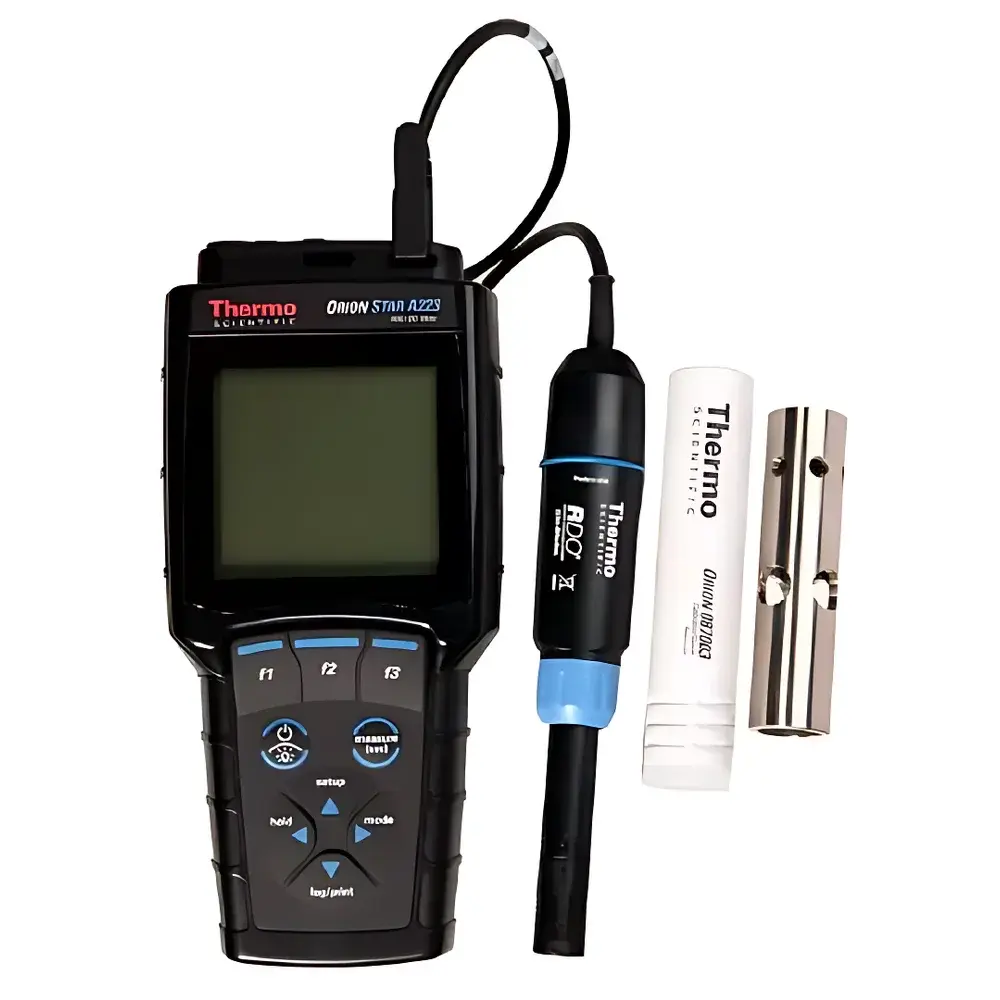
Thermo Fisher Orion Star A223 Portable Professional Dissolved Oxygen Meter
| Brand | Thermo Fisher |
|---|---|
| Origin | Singapore |
| Manufacturer | Thermo Fisher Scientific |
| Product Type | Portable |
| Measurement Principle | Polarographic & Luminescent (RDO) |
| DO Range | 0–90 mg/L (polarographic), 0–50 mg/L (RDO) |
| Accuracy | ±0.2 mg/L (polarographic), ±0.1–±0.2 mg/L + 10% (RDO) |
| Saturation Range | 0–600% (polarographic), 0–500% (RDO) |
| Temperature Range | 0–50 °C |
| Temp Accuracy | ±0.1 °C |
| Atmospheric Pressure Compensation | 450.0–850.0 mmHg |
| Salinity Correction | 0–45 ppt |
| Data Storage | 2000 datasets (GLP-compliant) |
| IP Rating | IP67 |
| Interface | 9-pin mini-DIN probe port, USB, RS232 |
| Power | 4 × AA batteries or AC adapter |
Overview
The Thermo Fisher Orion Star A223 Portable Professional Dissolved Oxygen Meter is an engineered field-deployable instrument designed for high-reliability dissolved oxygen (DO) quantification in environmental monitoring, wastewater treatment, aquaculture, and beverage quality control applications. It supports dual-sensor compatibility—accepting both polarographic and luminescent (RDO) Clark-type electrochemical probes—enabling method flexibility without hardware replacement. The instrument operates on the principle of either oxygen-dependent current generation (polarographic mode) or oxygen-quenched fluorescence lifetime measurement (RDO mode), delivering traceable, temperature- and pressure-compensated results aligned with ASTM D888, ISO 5814, and APHA Standard Methods 4500-OG. Its rugged IP67-rated housing ensures operational integrity under rain, dust, submersion up to 1 m for 30 minutes, and mechanical shock typical of field logistics.
Key Features
- Auto-Read™ stabilization algorithm locks readings only when signal drift falls below user-defined thresholds (configurable stability window), minimizing subjective endpoint judgment.
- Dual-language interface support—including English, Chinese, Spanish, French, German, and Portuguese—facilitates multi-regional deployment and operator training consistency.
- Integrated atmospheric pressure compensation via built-in barometric sensor (450.0–850.0 mmHg range) and manual salinity correction (0–45 ppt) ensure accurate DO conversion across elevation gradients and saline matrices.
- GLP-compliant data management: each stored entry includes timestamp, user ID, sample ID, calibration history, probe serial number, and environmental metadata (T, P, salinity).
- Field-serviceable design: battery compartment sealed per IP67; probe connector rated for >10,000 mating cycles; RDO probe optical surface protected by scratch-resistant sapphire window.
- Flexible power architecture: operates continuously for >1,000 hours on four AA alkaline cells or switches seamlessly to AC adapter during lab-based verification or extended bench use.
Sample Compatibility & Compliance
The Star A223 accommodates heterogeneous aqueous matrices including freshwater, seawater, activated sludge, fermentation broths, and low-conductivity beverages (e.g., beer, wine). Its RDO probe (087010MD/087020MD) eliminates oxygen consumption at the sensing surface—critical for low-flow or stagnant samples—and exhibits no stirring dependence, unlike polarographic alternatives. Polarographic probes (e.g., 083005MD) remain viable for high-precision laboratory BOD incubations where membrane renewal and electrolyte maintenance are controlled. All calibrations—saturated air/water, Winkler titration reference, or zero-oxygen standard—adhere to EPA Method 360.1 and ISO 5815-1 audit requirements. Device firmware and data export logs meet FDA 21 CFR Part 11 electronic record integrity criteria when used with Orion™ software and audit-trail-enabled configurations.
Software & Data Management
Data transfer occurs via USB (mass storage mode) or RS232 (with optional cable), enabling direct import into LIMS or Excel without proprietary drivers. Orion™ software (v5.2+) provides full traceability: calibration curves with residual error plots, drift analysis over time, and automated report generation compliant with ISO/IEC 17025 clause 7.7. Stored datasets include raw mV or phase-shift values, not just final DO concentrations—supporting retrospective reprocessing if new calibration models or temperature algorithms are validated. Firmware updates preserve all user-defined methods and GLP metadata, ensuring continuity during regulatory inspections.
Applications
- Regulatory compliance monitoring: NPDES discharge permits, drinking water source assessment (EPA SW-846), and coastal hypoxia mapping.
- Wastewater process control: aeration basin optimization, nitrification/denitrification staging, and secondary clarifier effluent verification.
- Food & beverage QA: dissolved oxygen profiling in packaged beer (target <50 ppb), wine must deoxygenation validation, and sterile filtration line integrity checks.
- Ecological research: benthic respiration assays, sediment-water interface flux studies, and phytoplankton productivity modeling requiring sub-hourly temporal resolution.
- Educational laboratories: student experiments in aquatic chemistry, sensor physics (Fick’s law, Stern-Volmer quenching), and metrology uncertainty propagation.
FAQ
Does the A223 support both polarographic and RDO probes simultaneously?
No—probe type is auto-detected upon connection, and the meter configures its signal conditioning and calculation engine accordingly. Switching requires physical probe replacement and optional recalibration.
Is atmospheric pressure compensation mandatory for accurate DO reporting?
Yes. Partial pressure of oxygen directly governs saturation concentration; omission introduces systematic bias exceeding ±5% at elevations >500 m above sea level.
How does the instrument handle temperature-induced sensor drift?
It applies Nernstian slope correction using real-time thermistor data and stores temperature-specific calibration coefficients—eliminating need for multi-point temperature calibrations.
Can historical data be exported in CSV format for statistical process control (SPC)?
Yes. Orion™ software exports fully annotated datasets including timestamps, user IDs, and measurement uncertainties—compatible with JMP, Minitab, and Python pandas workflows.
What maintenance intervals are recommended for RDO probes in continuous field deployment?
Optical sensor windows require cleaning every 7–14 days in turbid waters; full probe verification (zero/saturation check) is advised before each sampling campaign or after exposure to H2S or heavy metals.







