
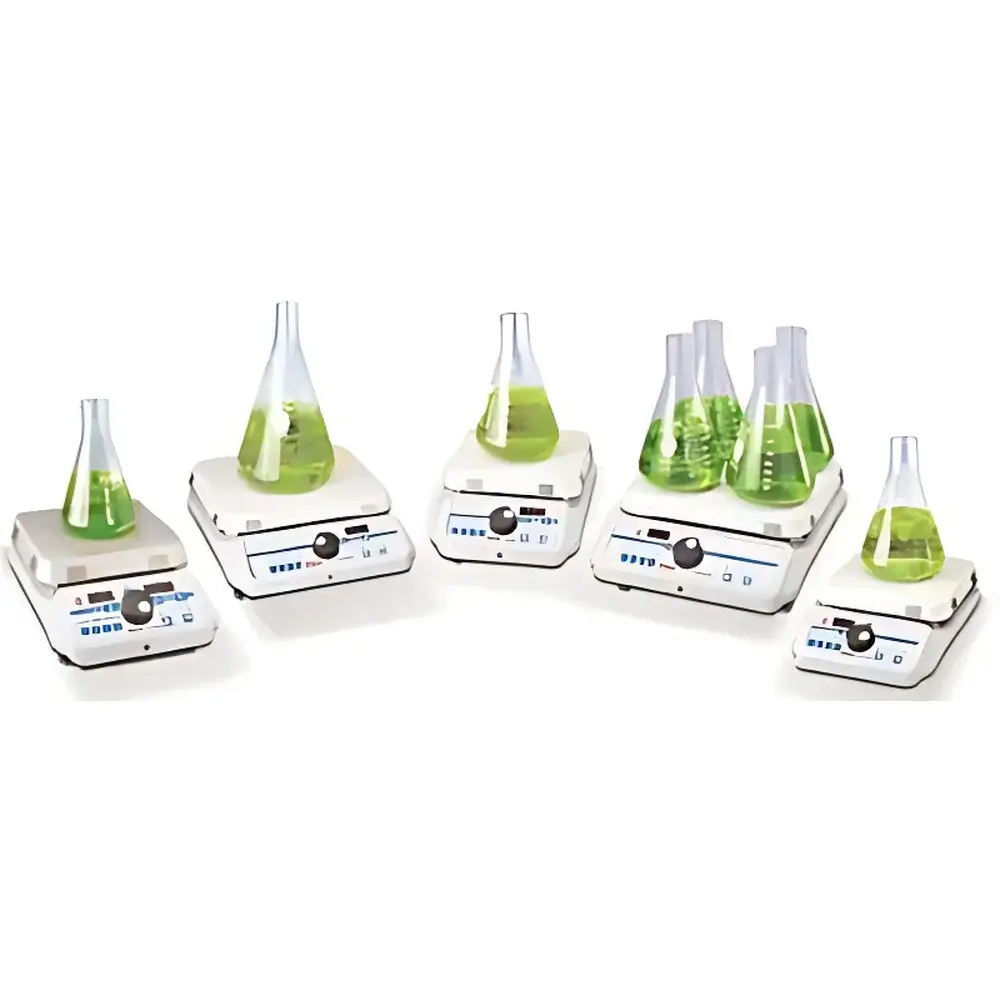
Thermo Scientific Super-Nuova SP131820-33Q Digital Hotplate Magnetic Stirrer
| Brand | Thermo Fisher Scientific |
|---|---|
| Origin | USA |
| Manufacturer | Thermo Fisher Scientific |
| Product Type | Imported |
| Model | SP131820-33Q |
| Instrument Category | Magnetic Stirrer |
| Max Stirring Volume | 4 L |
| Speed Range | 50–1200 rpm |
| Temperature Range | 5–370 °C |
Overview
The Thermo Scientific Super-Nuova SP131820-33Q is a digitally controlled hotplate magnetic stirrer engineered for precision, repeatability, and operational safety in regulated laboratory environments. It integrates a high-performance ceramic heating surface with a robust permanent-magnet drive system, operating on the principle of magnetic coupling—where rotation of an internal magnet induces synchronous motion in a PTFE- or glass-coated stir bar immersed in the sample vessel. This non-contact mixing method eliminates mechanical shaft penetration, minimizing contamination risk and enabling sealed-vessel operation. Designed for applications requiring simultaneous thermal control and homogeneous mixing—including buffer preparation, reagent dissolution, enzymatic reactions, and sample conditioning—the SP131820-33Q delivers stable temperature regulation within ±1 °C and speed control resolution of ±1 rpm across its full operational range.
Key Features
- Dual-parameter digital control via single rotary encoder with tactile feedback—enabling intuitive, independent adjustment of temperature and stirring speed
- Ceramic heating surface (26 × 26 cm) offering chemical resistance, uniform heat distribution, and rapid thermal response up to 370 °C
- StirTrac™ intelligent motor control system ensuring consistent torque delivery and reliable magnetic coupling—even at low speeds or with high-viscosity media
- HOT TOP™ overtemperature warning: visual and audible alert activates when surface temperature exceeds 50 °C, enhancing operator safety during unattended operation
- Programmable timer with start/stop scheduling and interval-run capability; user-definable auto-shutdown function
- Four preset memory slots for frequently used temperature/speed combinations, reducing setup time and inter-user variability
- RS232 serial interface compliant with standard laboratory data logging protocols; supports timestamped export of real-time temperature, speed, and runtime data to external PCs
- Independent adjustable overtemperature protection (OTT) circuit—user-configurable limit separate from setpoint, providing hardware-level thermal fail-safe
- Lockout mode prevents accidental parameter changes during active operation or maintenance
Sample Compatibility & Compliance
The SP131820-33Q accommodates vessels up to 4 L volume (e.g., beakers, Erlenmeyer flasks, reaction vessels), supporting both aqueous and organic solvent-based systems. Its ceramic top plate resists corrosion from acids, bases, and halogenated solvents, making it suitable for QC/QA workflows in pharmaceutical, chemical, and environmental laboratories. The device complies with IEC 61010-1:2010 (Safety Requirements for Electrical Equipment for Measurement, Control, and Laboratory Use) and meets electromagnetic compatibility (EMC) requirements per EN 61326-1:2013. While not inherently 21 CFR Part 11–compliant, audit-trail-capable data acquisition software (e.g., Thermo Fisher’s optional LabTool Suite) may be deployed to support GLP/GMP documentation requirements where electronic records are mandated.
Software & Data Management
Data capture is enabled via RS232 interface using ASCII-based command protocol, compatible with common terminal emulators (e.g., Tera Term, PuTTY) and custom LabVIEW or Python scripts. Timestamped logs include elapsed time, setpoint temperature, actual surface temperature, target speed, and measured RPM. Optional firmware upgrades—available through Thermo Fisher’s authorized service network—support enhanced data formatting and extended memory buffering. For integration into enterprise LIMS or ELN platforms, middleware solutions can map exported CSV/TSV files to structured metadata fields aligned with ISO/IEC 17025 documentation standards.
Applications
- Preparation of standardized calibration standards and reference solutions under controlled thermal conditions
- Heating and homogenization of viscous polymer solutions prior to rheological testing
- Controlled dissolution studies per USP and Ph. Eur. 2.9.3 guidelines
- Cell culture media warming and pH-adjustment workflows requiring gentle agitation
- Extraction protocols involving heat-assisted solvent recovery (e.g., Soxhlet pre-concentration)
- Environmental sample digestion (EPA Method 3050B, 3051A) where precise ramp-and-hold thermal profiles are required
FAQ
What is the maximum load capacity of the SP131820-33Q?
The unit supports containers up to 4 L volume and has a recommended maximum sample mass of 11.3 kg, including vessel weight.
Does the device support external temperature probe input for solution-phase monitoring?
No—the SP131820-33Q measures only surface temperature. For bath or solution temperature feedback control, an external PID controller with thermocouple input must be used in cascade configuration.
Is the RS232 interface optically isolated?
No—RS232 communication is electrically coupled; use of a grounded USB-to-RS232 adapter with surge suppression is recommended in electrically noisy environments.
Can the StirTrac™ function be disabled?
StirTrac™ operates automatically and cannot be deactivated; it is integral to motor commutation logic and ensures stable low-speed performance.
What is the ambient operating specification?
Rated for continuous operation at ambient temperatures between 0–27 °C and relative humidity ≤80% non-condensing. Derating applies above 25 °C ambient due to thermal management constraints.



