
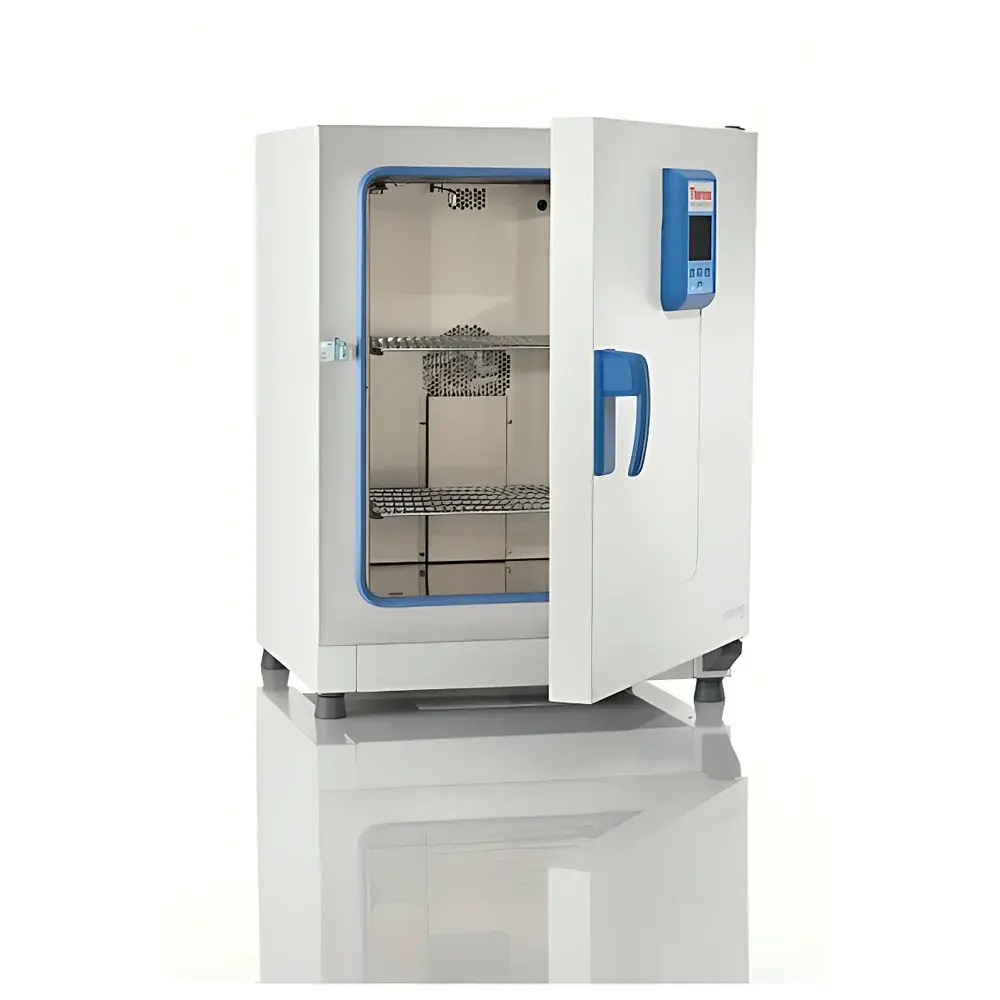
Thermo Scientific Heratherm General Purpose Drying Oven
| Brand | Thermo Fisher |
|---|---|
| Origin | USA |
| Manufacturer | Thermo Fisher Scientific |
| Product Type | Imported Laboratory Equipment |
| Models | 51028150, 51028139, 51028140, 51028141 |
| Chamber Volumes | 60 L, 100 L, 180 L |
| Temperature Range | 50 °C to 250 °C |
| Natural Convection Uniformity | ±4 °C (at 150 °C) |
| Natural Convection Stability | ±0.4 °C (at 150 °C) |
| Forced Convection Uniformity | ±3.3 °C (at 150 °C) |
| Forced Convection Stability | ±0.3 °C (at 150 °C) |
| Control Interface | Microprocessor-based touch-button panel with large VFD display |
| Door Opening Angle | 180° |
| Safety Features | Independent overtemperature protection circuit |
| Data Connectivity | Standard RS232 interface |
| Optional External Sensor Port | Via rear exhaust vent |
| Chamber Material | Corrosion-resistant stainless steel with radiused corners |
| Energy Efficiency | Optimized thermal insulation and airflow design |
Overview
The Thermo Scientific Heratherm General Purpose Drying Oven is an engineered solution for routine laboratory drying, baking, sterilization, and conditioning applications requiring precise, stable, and reproducible thermal environments. Designed around natural convection (still-air) and forced convection (mechanical air circulation) configurations, the Heratherm series delivers consistent thermal performance across its three chamber volumes—60 L, 100 L, and 180 L—without compromising structural integrity or operational safety. Its core architecture relies on high-density mineral wool insulation, a double-wall construction, and a precisely calibrated heating element array to minimize thermal lag and reduce energy consumption without sacrificing temperature fidelity. Unlike fan-assisted ovens that may disturb delicate samples or powders, the natural convection variant ensures gentle, particle-free heat transfer—ideal for moisture loss studies, pharmaceutical stability testing, and polymer curing where airflow-induced sample displacement must be avoided.
Key Features
- Microprocessor-controlled operation with intuitive touch-button interface and large vacuum fluorescent display (VFD) for real-time visibility of setpoint, actual temperature, and timer status—even under ambient lab lighting conditions.
- 180° full-swing door design facilitates unobstructed access to the entire chamber, minimizing operator strain during loading/unloading of trays, Petri dishes, or glassware stacks.
- Corrosion-resistant stainless-steel interior with seamless radiused corners eliminates crevices for residue accumulation and supports rapid, compliant cleaning protocols required in GLP and GMP environments.
- Dual-stage overtemperature protection: primary control loop plus independent mechanical safety thermostat prevents thermal runaway and safeguards both samples and instrument longevity.
- Standard RS232 serial interface enables direct connection to laboratory PCs for automated data logging, remote monitoring, and integration into centralized environmental monitoring systems (EMS).
- Rear-mounted exhaust port doubles as an external sensor access point—allowing optional integration of calibrated reference thermocouples or humidity probes for validation-grade temperature mapping per ISO 17025 or ASTM E2251.
Sample Compatibility & Compliance
The Heratherm General Purpose Drying Oven accommodates standard laboratory ware—including porcelain crucibles, aluminum weighing dishes, stainless-steel trays, and borosilicate glass containers—across all three chamber sizes. Its uniform thermal distribution meets the requirements for routine quality control procedures defined in USP , ISO 9001 calibration support, and ASTM D1654 (corrosion test drying). While not classified as a Class I, Division 1 hazardous location device, it complies with IEC 61010-1:2010 for electrical safety in laboratory equipment and carries CE marking for conformity with EU Low Voltage and EMC directives. The absence of internal fans in natural convection models makes it suitable for use with volatile solvents under controlled ventilation, provided local risk assessments and institutional SOPs are followed.
Software & Data Management
Although the Heratherm oven operates autonomously via its embedded controller, its RS232 interface supports bidirectional communication using ASCII protocol commands. Third-party software platforms—including LabVIEW, MATLAB, and custom Python scripts—can initiate temperature ramps, read live sensor values, trigger alarms, and log timestamped datasets at user-defined intervals. When deployed in regulated environments, the system supports 21 CFR Part 11-compliant audit trails when paired with validated PC-based acquisition software that enforces electronic signatures, role-based access control, and immutable record retention. All firmware revisions are traceable via built-in version reporting, and calibration constants remain stored in non-volatile memory during power cycles.
Applications
- Moisture content determination per AOAC 950.46 and ASTM D2231 (textiles), D4442 (wood), and D6721 (soils)
- Pre- and post-weighing drying of filter papers, gravimetric precipitates, and residual ash analysis
- Pharmaceutical excipient drying and stability-indicating storage at accelerated conditions (e.g., 40 °C/75% RH preconditioning per ICH Q1A)
- Curing of epoxy coatings, adhesives, and composite resins under inert atmosphere (when used with optional nitrogen purge kit)
- Baking of ceramic substrates, sintering aids, and catalyst supports prior to thermal gravimetric analysis (TGA)
- Conditioning of hygroscopic standards and reference materials before analytical weighing per ISO/IEC 17025 clause 7.6
FAQ
What is the difference between natural and forced convection modes in Heratherm ovens?
Natural convection relies on buoyancy-driven airflow for heat distribution and is optimal for heat-sensitive or particulate-laden samples. Forced convection uses an internal fan to accelerate air movement, achieving tighter uniformity—±3.3 °C vs. ±4 °C—and faster equilibration times.
Can the Heratherm oven be validated for GxP use?
Yes—its stable thermal profile, independent safety cutoff, RS232 traceability, and stainless-steel chamber meet foundational requirements for IQ/OQ/PQ execution. Full validation requires documented sensor placement, mapping runs, and software qualification if connected to regulated data systems.
Is external temperature monitoring supported out-of-the-box?
The rear exhaust port is mechanically designed to accept standard 3 mm OD thermocouple sheaths. No adapter is needed, though users must supply and calibrate the external probe separately.
Does the oven support programmable ramp-hold profiles?
No—the Heratherm General Purpose model features fixed-setpoint operation with timer-based dwell only. For multi-step thermal programs, consider the Thermo Scientific Heraeus Vacutherm or Binder FD series.
What maintenance is required to sustain performance?
Routine cleaning of the chamber and door gasket; annual verification of temperature uniformity and overtemperature cutoff function using NIST-traceable references; inspection of insulation integrity every 24 months per manufacturer’s service bulletin 51028-REV-D.



