
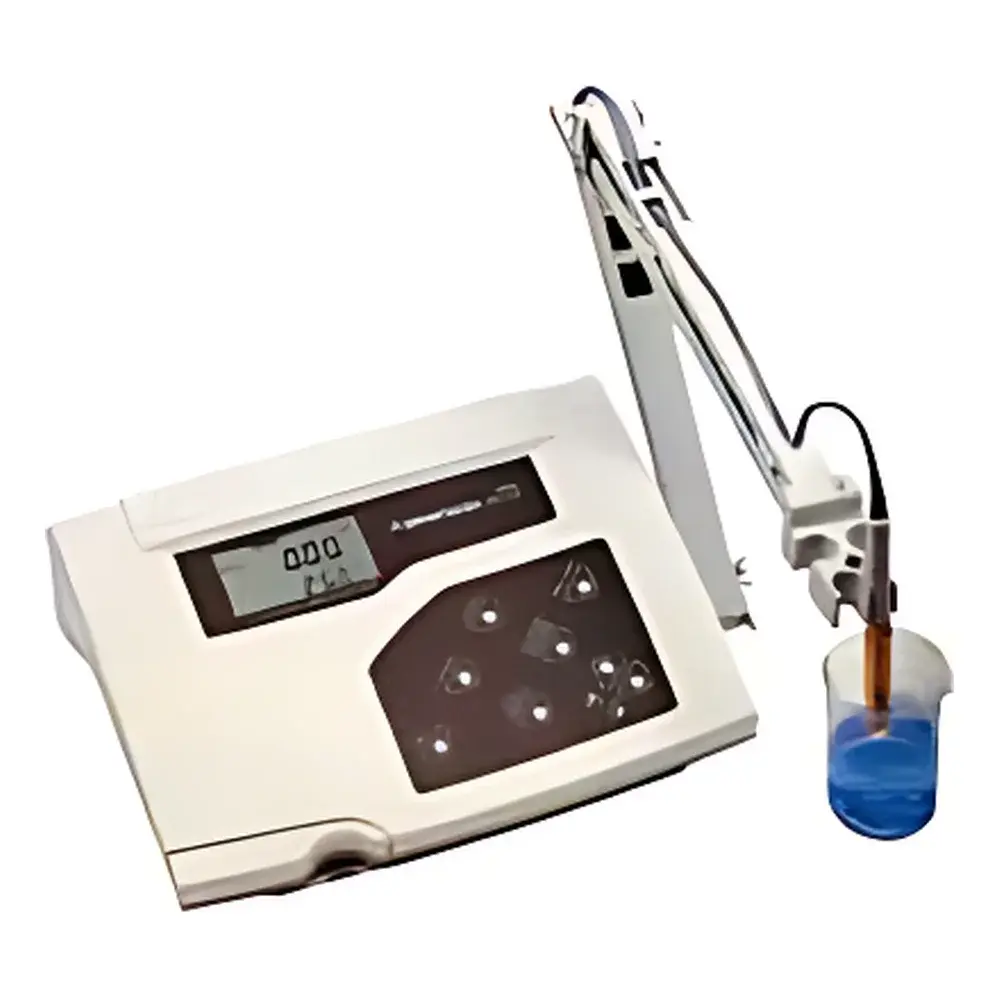
Thermo Fisher Scientific Eutech CyberScan CON510 Conductivity Meter
| Brand | Thermo Fisher Scientific |
|---|---|
| Origin | Singapore |
| Manufacturer | Eutech Instruments (a Thermo Fisher brand) |
| Type | Benchtop Conductivity/TDS/Temp Meter |
| Model | CON510 |
| Key Features | Auto-ranging (5 ranges), 4-point auto-calibration & 5-point manual calibration, built-in temperature compensation (NTC thermistor), 100-data storage, adjustable TDS factor, electrode constant selection (0.1 / 1.0 / 10.0 cm⁻¹) |
| Conductivity Range | 0–19.99 μS/cm, 20.0–199.9 μS/cm, 200–1999 μS/cm, 2.00–19.99 mS/cm, 20.0–199.9 mS/cm |
| Conductivity Resolution | 0.01 / 0.1 μS/cm |
| TDS Range (user-selectable factor) | 0–9.99 ppm, 10.0–99.9 ppm, 100–999 ppm, 1.00–9.99 ppt, 10.0–99.9 ppt, 0–199.9 ppt |
| TDS Resolution | 0.01 / 0.1 / 1 ppm |
| Conductivity Accuracy | ±1% full scale |
| Temperature Range | 0.0–80.0 °C |
| Temperature Resolution | 0.1 °C |
| Temperature Accuracy | ±0.5 °C |
| Temp. Compensation Coefficient | 0.0–10.0 %/°C |
| Reference Temperature | 15.0–30.0 °C |
| Display | LCD (5.9 × 3.2 cm), backlit |
| Power | 9 V DC regulated adapter (100–220 VAC input, linear supply) |
| Dimensions (H×W×D) | 23 × 18 × 6 cm |
| Weight | 750 g (instrument only) |
Overview
The Thermo Fisher Scientific Eutech CyberScan CON510 Conductivity Meter is a precision benchtop instrument engineered for reliable, repeatable measurement of electrical conductivity, total dissolved solids (TDS), and temperature in aqueous solutions. Based on the fundamental principle of conductance measurement—applying an alternating current across two or four electrodes and quantifying the resulting current flow—the CON510 delivers high reproducibility across five auto-recognized conductivity ranges (0–199.9 mS/cm). Its dual-mode temperature compensation (automatic or manual, 0.0–80.0 °C) utilizes an integrated NTC thermistor embedded within the conductivity sensor, minimizing thermal lag and eliminating the need for separate temperature probes. Designed for routine QC labs, environmental monitoring stations, and academic teaching laboratories, the CON510 complies with core metrological requirements for traceable conductivity measurement under ISO 7888 and ASTM D1125 standards. While not validated to 21 CFR Part 11 out-of-the-box, its audit-ready data logging architecture supports GLP-compliant workflows when deployed with documented procedures.
Key Features
- Five auto-ranging conductivity spans—from ultra-low 0.01 μS/cm resolution in pure water applications up to 199.9 mS/cm for brine or industrial effluent analysis
- Configurable electrode constants (0.1, 1.0, or 10.0 cm⁻¹) enabling accurate measurements across diverse sample matrices, including deionized water, seawater, and aggressive chemical process streams
- Four-point automatic calibration with optional five-point manual calibration—supporting multi-standard verification per ISO/IEC 17025 internal quality control protocols
- Adjustable TDS conversion factor (0.4–1.0), allowing alignment with solution-specific ionic composition (e.g., NaCl, KCl, or CaCO₃ equivalents)
- Integrated temperature sensor with user-definable compensation coefficient (0.0–10.0 %/°C) and reference temperature range (15.0–30.0 °C) for compliance with regional regulatory reporting conventions
- Non-volatile memory storing up to 100 measurement records—including conductivity, TDS, temperature, date/time stamp, and calibration history—with power-loss protection
- LCD display (5.9 × 3.2 cm) featuring dual-parameter simultaneous readout and intuitive icon-driven navigation for rapid operator training
Sample Compatibility & Compliance
The CON510 accommodates standard 2-electrode conductivity cells (e.g., ECCONSEN91W) and is compatible with both aqueous and mildly corrosive solutions. Its design excludes pressurized or hazardous vapor environments; operation is restricted to ambient laboratory conditions (0–50 °C, <85% RH non-condensing). The instrument meets IEC 61010-1 safety requirements for electrical equipment used in laboratory settings. While not intrinsically safe, it is suitable for use in general-purpose analytical zones compliant with ISO 17025 Clause 6.4 (environmental conditions). For pharmaceutical water testing (Purified Water, Water for Injection), users must validate method equivalence against USP using appropriate cell geometry and calibration standards. Regulatory documentation—including factory calibration certificates traceable to NIST SRMs—is available upon request.
Software & Data Management
Data export is performed via direct USB-to-PC connection using optional Eutech PC Link software (v3.x), enabling CSV-formatted reports with timestamped metadata. Each stored record includes raw conductivity, computed TDS, measured temperature, electrode constant setting, and calibration status flags. Audit trails are maintained through sequential memory indexing and immutable timestamping (real-time clock battery-backed). Though the CON510 lacks native network connectivity or electronic signature capability, its deterministic data structure supports retrospective validation under FDA 21 CFR Part 11 when paired with controlled access procedures and documented change management practices. All firmware updates are distributed via Thermo Fisher’s secure support portal and require physical USB key authentication.
Applications
- Environmental field and lab testing: surface water, groundwater, wastewater, and stormwater conductivity profiling per EPA Method 120.1
- Pharmaceutical water system monitoring: Purified Water (PW) and Water for Injection (WFI) conductivity verification at specified temperatures (e.g., 25 °C or temperature-uncompensated 90 °C test points)
- Food & beverage QC: brine concentration control, syrup density estimation, and cleaning-in-place (CIP) rinse water verification
- Academic instruction: electrochemistry labs demonstrating Kohlrausch’s law, ion mobility relationships, and temperature dependence of electrolytic conduction
- Industrial process support: boiler feedwater purity checks, desalination plant reject stream analysis, and electroplating bath conductivity stabilization
FAQ
Is the CON510 compliant with 21 CFR Part 11?
The instrument does not include built-in electronic signatures, audit trail encryption, or role-based access controls. However, its deterministic data logging and time-stamped records can be incorporated into a validated Part 11 environment when supported by procedural controls and third-party data integrity software.
Can I use a 4-electrode cell with the CON510?
No—the CON510 is designed exclusively for 2-electrode sensors. Four-electrode cells require dedicated instrumentation (e.g., Thermo Fisher Orion A215) due to distinct excitation and sensing circuitry.
What calibration standards are recommended?
Use certified KCl solutions traceable to NIST SRM 3600 series: 84 μS/cm (25 °C), 1413 μS/cm (25 °C), and 12.88 mS/cm (25 °C) for multi-point verification across ranges.
Does the CON510 support GLP/GMP documentation?
Yes—when operated with documented SOPs, calibrated reference standards, and periodic performance verification, the CON510 satisfies core GLP data integrity requirements for non-clinical laboratory studies.
How often should I recalibrate the instrument?
Calibration frequency depends on usage intensity and regulatory context: daily for high-throughput QC labs; before each analytical batch in regulated environments; and after electrode cleaning or replacement.
Related Products






