
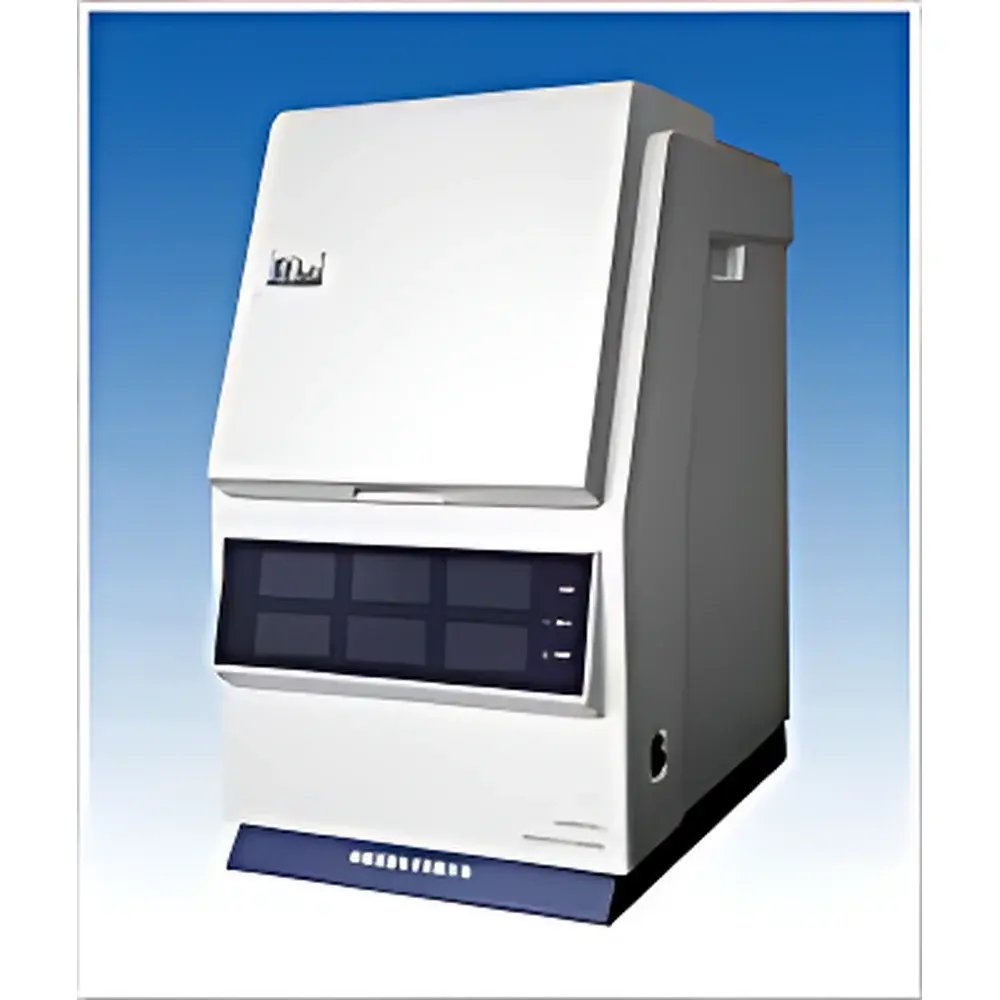
HOGON HG-20001 Microfluidic Chip Detection System
| Brand | HOGON |
|---|---|
| Origin | Shanghai, China |
| Manufacturer Type | Original Equipment Manufacturer (OEM) |
| Country of Origin | China |
| Model | HG-20001 |
| Instrument Category | Microfluidic Chip System |
| Detection Principle | Laser-Induced Fluorescence (LIF) with Confocal Optical Path |
| Sensitivity | 10⁻⁹ M (FITC) |
| Migration Time Repeatability | RSD ≤ 1.54% (n = 10, FITC) |
| High-Voltage Power Supply | 0–6000 V (no current display) |
| Optical Alignment Resolution | 0.25 arcmin per 360° rotation |
| Operating Temperature | Ambient |
| Laser Source | Solid-State Laser |
| Filter Set | Bandpass, High-Pass, Low-Pass (complete set) |
| Photomultiplier Tube (PMT) | Single-Photon Detection Capability |
| Electrode Configuration | 4/6/8 Pt electrodes |
| Inverted Microscope | 40× magnification |
| Power Requirement | 220 V, 50 Hz |
| Software Compatibility | Windows 98/2000/XP |
| Dimensions (W × D × H) | 28 × 33 × 45 cm |
| Weight | 20 kg |
Overview
The HOGON HG-20001 Microfluidic Chip Detection System is a fully integrated laser-induced fluorescence (LIF) detection platform engineered for miniaturized total analysis systems (µ-TAS), commonly referred to as “lab-on-a-chip” devices. It implements confocal optical geometry to achieve single-photon-level sensitivity and high spatial resolution in real-time electrophoretic separation monitoring. Designed around microscale fluidic handling and electrokinetic transport principles, the system enables quantitative analysis of biomolecules—including amino acids, nucleic acids, proteins, and chiral pharmaceuticals—within glass, quartz, or polymer-based microchips. Its operational architecture supports capillary and channel-based electrophoresis under controlled electric fields, leveraging precise voltage sequencing and thermal stability at ambient conditions. The instrument serves as a core analytical module in regulated research environments where low sample consumption, rapid assay turnaround, and reproducible migration time data are critical—particularly in early-stage drug discovery, forensic toxicology, environmental contaminant screening, and point-of-care diagnostic development.
Key Features
- Laser-induced fluorescence detection with confocal optical path, delivering detection sensitivity up to 10⁻⁹ M for fluorescein isothiocyanate (FITC)—approximately five orders of magnitude higher than conventional UV-Vis absorbance detectors.
- High-voltage control system with independent regulation across six channels (0–3 kV, floating ground configuration), enabling programmable electrokinetic injection and separation optimization for diverse chip geometries.
- Three-axis precision optical alignment stage (angular resolution: 0.25 arcmin/360°), allowing sub-micron positioning of the detection focal point relative to microchannel cross-sections.
- Adjustable platinum electrode array (4/6/8 electrodes), each individually positionable in X-Y-Z axes to accommodate variable channel depth, width, and inter-electrode spacing across heterogeneous chip substrates.
- Integrated inverted microscope (40× objective) with calibrated field-of-view for real-time visual verification of chip loading, bubble formation, and electrophoretic band progression.
- Modular filter set comprising narrow-band, high-pass, and low-pass interference filters, supporting spectral discrimination from 500 nm emission onward—compatible with common fluorophores including Cy3, Cy5, Alexa Fluor dyes, and quantum dots.
- Single-photon-counting photomultiplier tube (PMT) with thermoelectric stabilization, ensuring stable gain response over extended acquisition periods without drift-induced baseline artifacts.
Sample Compatibility & Compliance
The HG-20001 accommodates standard microfluidic chip formats fabricated from fused silica, borosilicate glass, cyclic olefin copolymer (COC), and poly(methyl methacrylate) (PMMA). It supports both open-channel and sealed-channel configurations with nominal channel depths ranging from 10 to 100 µm and widths from 20 to 200 µm. Sample introduction volumes are scalable from 10 nL to 500 nL per run, minimizing reagent costs and biological material requirements. While the system operates at ambient temperature and does not include active thermal regulation, its design conforms to general laboratory safety standards for Class I laser devices (IEC 60825-1:2014) and complies with electromagnetic compatibility (EMC) directives per EN 61326-1:2013. Data integrity features align with GLP/GMP documentation practices; however, native software lacks FDA 21 CFR Part 11-compliant audit trail functionality—custom integration with third-party LIMS or ELN platforms is recommended for regulated workflows.
Software & Data Management
The HG-20001 is operated via native Windows-compatible acquisition software (Windows 98 through XP), providing real-time electropherogram visualization, voltage sequencing setup, and basic peak integration tools. Raw signal output is saved in ASCII text format for post-processing in MATLAB, Python (NumPy/Pandas), or commercial chromatography data systems (CDS). The interface supports manual trigger synchronization with external event markers (e.g., syringe pump start, valve switching), facilitating multi-step assay automation. Although the software does not implement electronic signatures or role-based access control, exported datasets retain timestamped metadata—including applied voltages, acquisition duration, PMT gain settings, and filter selection—enabling traceable reconstruction of experimental conditions. For laboratories requiring long-term archival compliance, integration with validated enterprise data management solutions is advised.
Applications
- Rapid genotyping and fragment analysis of PCR amplicons in molecular diagnostics and agricultural biotechnology.
- Chiral separation and enantiomeric purity assessment of synthetic intermediates during pharmaceutical process development.
- High-throughput screening of kinase inhibitors using fluorescently labeled peptide substrates in microchip-based enzymatic assays.
- Single-cell lysate profiling for intracellular metabolite quantification (e.g., ATP, NADH) with minimal dilution bias.
- Environmental monitoring of pesticide residues and mycotoxins in food extracts following on-chip immunoaffinity cleanup and derivatization.
- Forensic analysis of illicit drug metabolites in urine or blood plasma samples with nanoliter-scale injection precision.
FAQ
What types of microchips are compatible with the HG-20001?
The system supports standard planar microchips made of glass, quartz, or transparent polymers (e.g., PMMA, COC) with embedded electrophoretic channels. Custom chip designs with electrode ports and detection windows are supported via mechanical alignment fixtures.
Is temperature control available during electrophoresis?
No—the HG-2001 operates at ambient laboratory temperature only. Active thermal regulation is not integrated but may be implemented externally using Peltier-cooled chip holders.
Can the system perform multi-color fluorescence detection?
Yes—by swapping filter sets and adjusting PMT gain, sequential detection of multiple fluorophores (emission >500 nm) is feasible, though simultaneous dual-channel acquisition requires hardware modification.
What is the minimum detectable analyte concentration using FITC-labeled compounds?
Under optimized confocal alignment and signal averaging, the limit of detection is 1 × 10⁻⁹ M for FITC, measured as peak height above baseline noise (S/N ≥ 3).
Does the software support automated method validation protocols?
No—method validation (e.g., linearity, LOD/LOQ, precision) must be performed manually using exported electropherogram data and external statistical packages.
Related Products



