
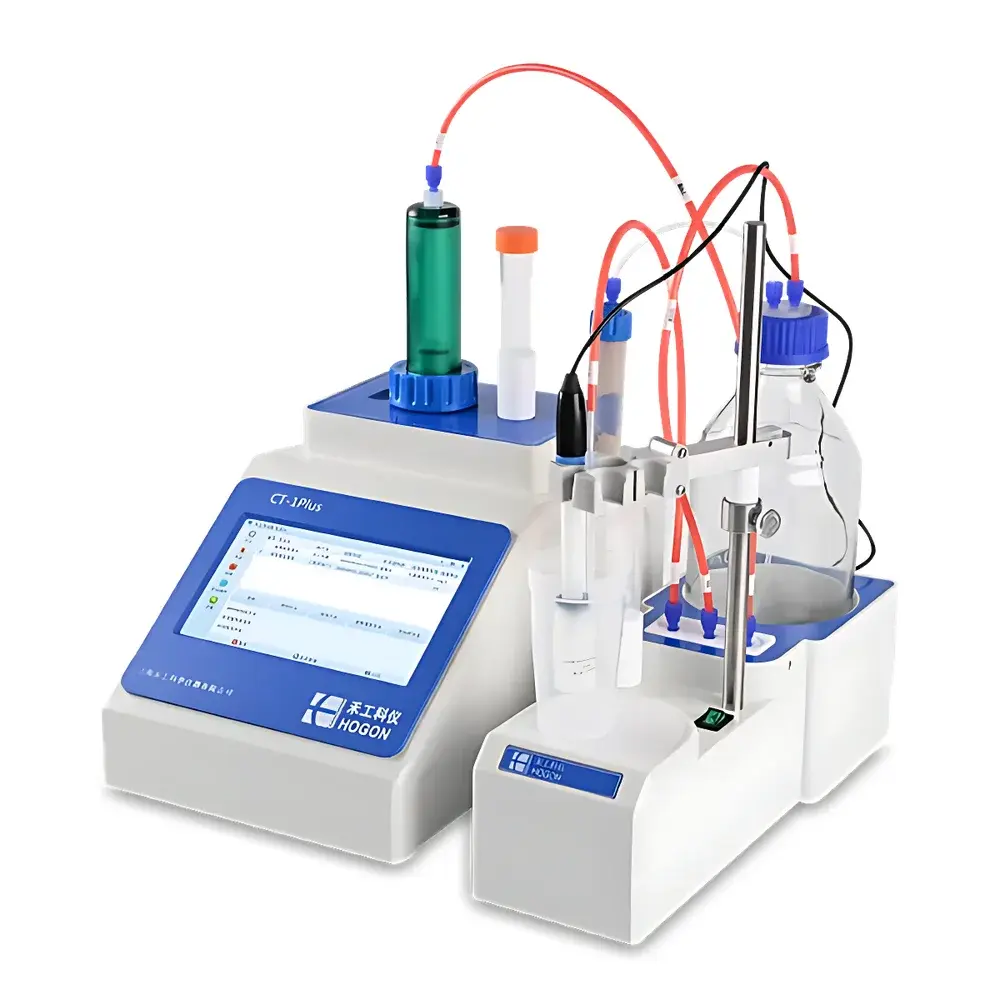
HOGON CT-1Plus Automatic Potentiometric Titrator for Yttrium Oxide (Y₂O₃) Content Determination in Rare Earth Ores
| Brand | HOGON |
|---|---|
| Origin | Shanghai, China |
| Manufacturer | HOGON Scientific Instruments Co., Ltd. |
| Type | General-purpose Automatic Potentiometric Titrator |
| pH Range | 1–14 |
| Potential Resolution | 0.1 mV |
| Potential Measurement Range | ±2000 mV |
| Potential Accuracy | ±0.2 mV |
| Burette Precision (20 mL standard) | 0.001 mL |
| Burette Resolution (10 mL optional) | 0.0005 mL |
Overview
The HOGON CT-1Plus is a fully automated potentiometric titrator engineered for high-reproducibility quantitative analysis of yttrium oxide (Y₂O₃) in rare earth ores and geological samples. It operates on the fundamental principle of potentiometric endpoint detection—measuring the potential shift across a redox or complexometric reaction system using a reference electrode and an indicator electrode (e.g., platinum or ion-selective electrode). In Y₂O₃ determination, the instrument typically supports EDTA-based complexometric titration under controlled acidic conditions, where Y³⁺ forms a stable 1:1 chelate with EDTA; the inflection point in the dE/dV curve—calculated via first-derivative analysis—defines the stoichiometric endpoint. Unlike conventional manual or semi-automated titrators, the CT-1Plus integrates real-time colorimetric monitoring as a secondary, orthogonal endpoint confirmation modality—leveraging a high-resolution CMOS camera to capture subtle chromatic transitions (e.g., from violet to blue in xylenol orange–Y³⁺ systems), thereby enhancing method robustness in matrix-rich ore digests where ionic strength or turbidity may affect electrode response stability.
Key Features
- Integrated dual-mode endpoint detection: Potentiometric (dE/dV derivative algorithm with configurable threshold, up to 2000 units) combined with real-time colorimetric imaging for cross-validated endpoint identification.
- High-precision burette system: Standard 20 mL glass syringe burette with 0.001 mL dispensing precision and <0.2% volumetric repeatability (RSD); optional 10 mL burette offers 0.0005 mL resolution for ultra-low-volume titrations.
- Dedicated titration cell design: 100 mL PTFE-coated magnetic stirrer vessel with adjustable stirring speed (50–600 rpm), optimized for homogeneous mixing of viscous ore digestates without splashing or vortex-induced air entrapment.
- Automated sequence control: Pre-programmable method templates support multi-step protocols—including pre-titration acidification, reagent addition, timed reaction pauses, and post-titration rinse cycles—ensuring full GLP-compliant process traceability.
- Electrochemical measurement engine: High-impedance (>10¹² Ω), low-drift potentiometer with 0.1 mV resolution and ±0.2 mV absolute accuracy across ±2000 mV range, compliant with ASTM E2087 and ISO 8655-5 calibration requirements for volumetric apparatus.
Sample Compatibility & Compliance
The CT-1Plus is validated for use with solid and liquid samples derived from rare earth mineral processing streams—including bastnäsite, monazite, and xenotime concentrates—as well as synthetic standards and certified reference materials (CRMs) such as GBW(E) 010249 (Y₂O₃ in rare earth oxides). Sample preparation follows standardized digestion protocols (e.g., ISO 11885 or USP ) using HCl/HNO₃/HF mixtures, followed by pH adjustment and masking of interfering ions (e.g., Fe³⁺, Al³⁺) with triethanolamine or ascorbic acid. The system meets essential regulatory expectations for analytical instrumentation used in quality control laboratories: data integrity safeguards (audit trail, electronic signatures), 21 CFR Part 11 readiness (when paired with HOGON TitraLab™ v4.2 software), and alignment with ISO/IEC 17025 clause 6.4.7 on equipment verification and intermediate checks.
Software & Data Management
Controlled via HOGON TitraLab™ v4.2—Windows-based, FDA 21 CFR Part 11–enabled titration software—the CT-1Plus delivers full lifecycle data governance. Each titration run generates a timestamped, user-attributed record containing raw potential vs. volume curves, derivative plots, endpoint coordinates, calculated Y₂O₃ mass percentages, and metadata (burette ID, electrode calibration status, ambient temperature/humidity). All data are stored in encrypted SQLite databases with immutable audit trails; export options include CSV, PDF reports (with embedded chromatograms), and XML for LIMS integration. Method validation parameters—including linearity (r² ≥ 0.999 over 5–99.9% Y₂O₃), intermediate precision (RSD ≤ 0.15% for n=6), and recovery (98.7–100.3% per ICH Q2(R2))—are automatically computed and archived.
Applications
Beyond Y₂O₃ quantification in rare earth ores, the CT-1Plus supports a broad spectrum of regulated titrimetric assays: chloride by Mohr or Volhard methods; total acidity in leach liquors; peroxide concentration via iodometric back-titration; calcium/magnesium hardness in process water; and redox titrations using Ce⁴⁺ or KMnO₄. Its modular architecture allows seamless adaptation to pharmacopeial methods (USP , EP 2.2.20), environmental testing (EPA 300.0), and metallurgical QC workflows requiring trace-level metal speciation. In rare earth refining facilities, it serves as a primary release test for Y₂O₃ purity prior to sputtering target fabrication or phosphor synthesis.
FAQ
What electrode configurations are recommended for Y₂O₃ determination?
A platinum indicator electrode paired with a double-junction Ag/AgCl reference electrode (3 M KCl + 0.1 M KNO₃ outer fill) is optimal for EDTA titrations of Y³⁺ in acidic media. For colorimetric mode, no electrode is required—only the integrated camera module.
Can the CT-1Plus comply with ISO/IEC 17025 accreditation requirements?
Yes—when operated with documented calibration procedures (electrode slope verification, burette gravimetric checks), version-controlled methods, and TitraLab™ audit-trail logging, it satisfies ISO/IEC 17025:2017 clauses 6.4 (equipment) and 7.2 (method validation).
Is method transfer from manual titration straightforward?
Yes—TitraLab™ includes a “Manual Mode Emulation” function that replicates drop-by-drop addition kinetics (e.g., 1200 ms interval, 200 rpm stir speed) and applies identical derivative thresholds, enabling direct comparison of historical manual data with automated runs.
What maintenance intervals are specified for long-term reliability?
Burette seals require replacement every 12 months or after 5000 dispense cycles; electrode storage solution must be refreshed weekly; camera lens cleaning is recommended before each batch of 20 samples to prevent optical drift.
Does the system support remote operation and monitoring?
Via optional Ethernet/Wi-Fi module and TitraLab™ Remote Access Server, authorized users can initiate runs, view live titration curves, and download reports from any networked workstation—without compromising local data sovereignty or audit-trail integrity.




