
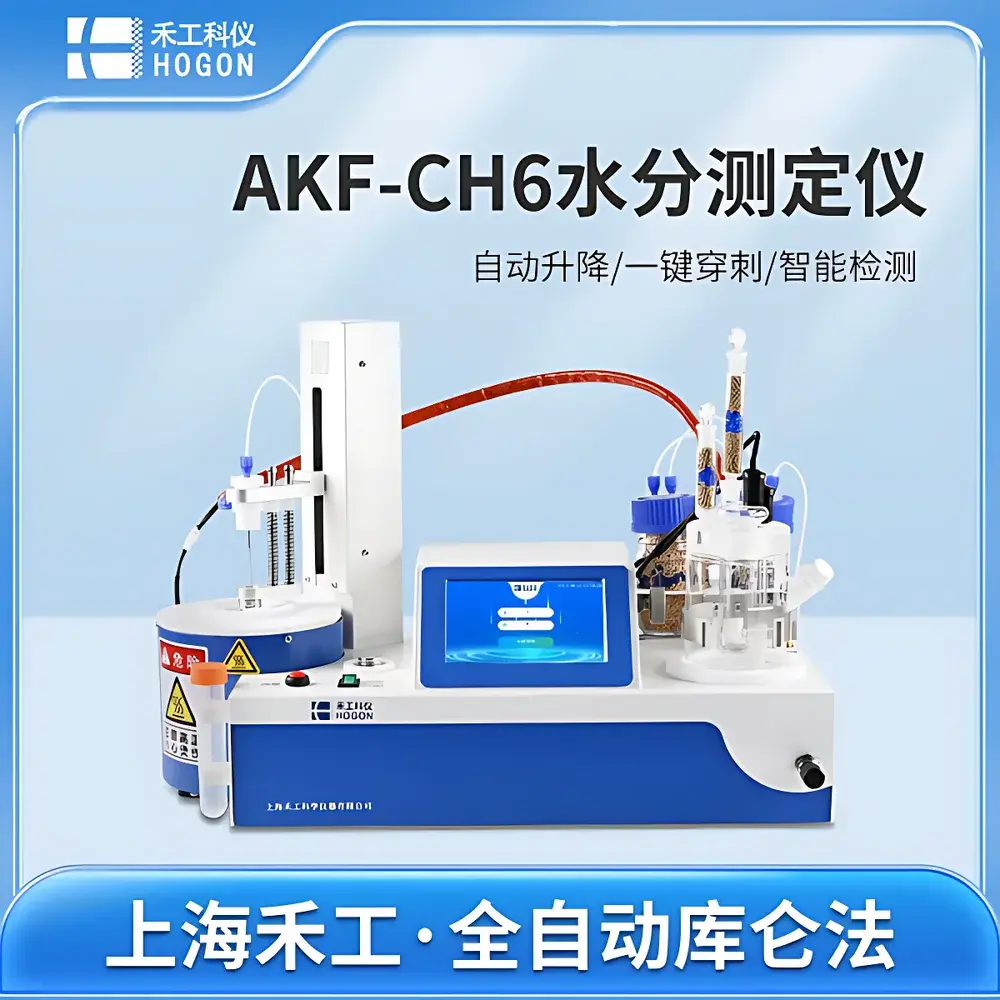
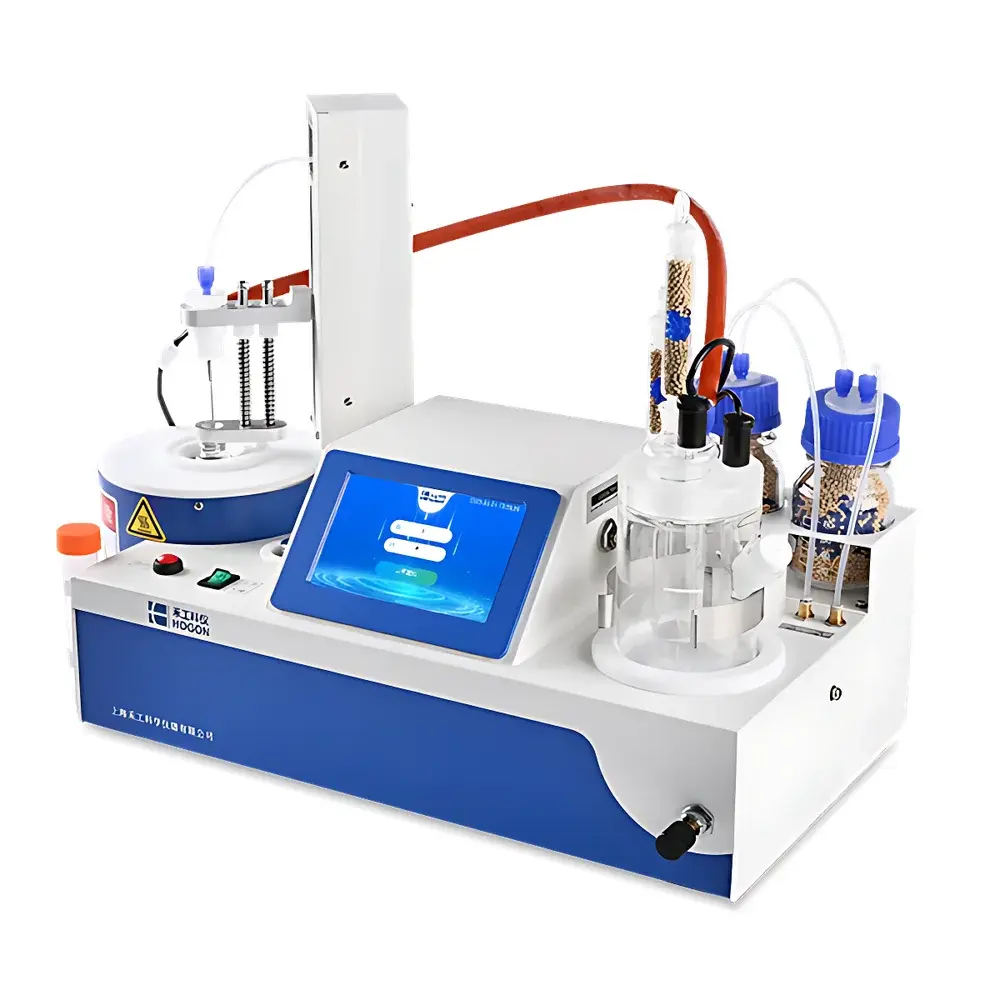
HOGON AKF-CH6 Coulometric Karl Fischer Moisture Titrator
| Brand | HOGON |
|---|---|
| Origin | Shanghai, China |
| Manufacturer | HOGON Scientific Instruments Co., Ltd. |
| Type | CH6 |
| Measurement Principle | Coulometric Karl Fischer Titration |
| Detection Range | 1 µg – 100 mg H₂O |
| Resolution | 0.1 µg |
| Accuracy | ±2 µg (for <100 µg), ±0.2% (for >100 µg) |
| Electrode System | Dual-platinum indicator electrode + Membrane-separated generator electrode |
| Sample Heating | Adjustable up to 250 °C (default 120 °C for lactide) |
| Carrier Gas Flow | 5–100 mL/min (preset 20 mL/min for lactide) |
| Stirring Speed | 1–10 level (preset level 5) |
| Blank Value Compensation | Yes (e.g., 55 µg typical background) |
| Compliance | ASTM E203, ISO 760, USP <921>, EP 2.5.12, GLP-compliant data audit trail capability |
Overview
The HOGON AKF-CH6 is a fully automated coulometric Karl Fischer moisture titrator engineered for trace-level water quantification in hygroscopic, thermally sensitive, and chemically reactive organic compounds—particularly lactide monomers used in polylactic acid (PLA) synthesis. Unlike volumetric KF systems, the AKF-CH6 employs coulometric generation of iodine at the anode via Faraday-controlled electrolysis, enabling high-precision determination of water content from 1 µg to 100 mg with sub-microgram resolution. Its closed-cell titration architecture eliminates ambient moisture ingress, while integrated sample heating (up to 250 °C) and programmable carrier gas flow ensure complete volatilization and quantitative transfer of bound water from solid or viscous matrices. Designed for compliance-critical environments, the instrument supports full traceability per FDA 21 CFR Part 11 requirements when paired with HOGON’s optional LIMS-integrated software suite.
Key Features
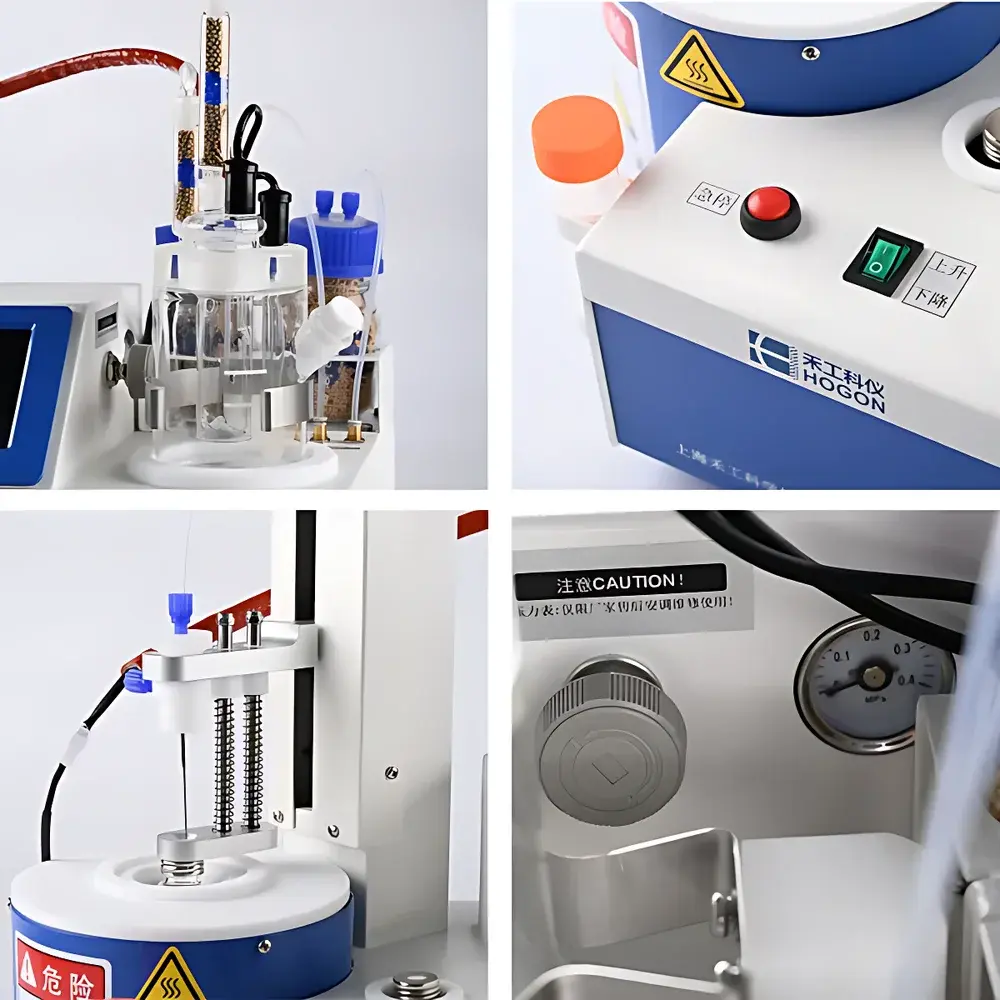
- Hermetically sealed coulometric titration cell with PTFE-coated glassware and inert gas purging interface
- Dual-electrode configuration: platinum-indicator pair for endpoint detection and membrane-isolated generator electrode for stable iodine generation
- Programmable sample heating module (range: ambient to 250 °C, ±0.5 °C stability) optimized for lactide dehydration at 120 °C
- Adjustable carrier gas flow (5–100 mL/min, factory-calibrated mass flow controller) ensuring reproducible sample headspace sweeping
- Intelligent auto-ranging electrolysis current control—dynamically modulates voltage and current based on real-time reaction kinetics
- Stirring speed regulation (1–10 levels) with magnetic stirrer feedback loop for homogeneous reagent-sample interaction
- Automatic blank compensation with user-definable baseline drift correction (e.g., 55 µg typical for dry solvent systems)
Sample Compatibility & Compliance
The AKF-CH6 accommodates solid powders (e.g., L-, D-, and meso-lactide), crystalline intermediates, polymer pellets, pharmaceutical excipients, and small-molecule APIs. Its heated oven interface enables direct analysis of low-volatility samples without pre-extraction. Method validation adheres to ASTM E203 (“Standard Test Method for Water Using Volumetric and Coulometric Karl Fischer Titration”), ISO 760 (“Determination of Water—Coulometric Titration Method”), and pharmacopeial standards including USP and Ph. Eur. 2.5.12. All measurement records include timestamped audit trails, operator ID, method parameters, raw current/time curves, and post-run calibration verification—fully compliant with GLP and GMP documentation requirements.
Software & Data Management
The embedded HOGON MoistureControl v3.2 firmware provides intuitive method setup, real-time current curve visualization, and automated endpoint recognition using second-derivative slope analysis. Data export supports CSV, PDF, and XML formats compatible with enterprise LIMS and ELN platforms. Optional PC-based HOGON DataStation software adds multi-user role management, electronic signatures, electronic batch record (EBR) generation, and 21 CFR Part 11 compliance modules—including secure user authentication, change history logging, and immutable archive storage.
Applications
- Quantitative moisture analysis of lactide enantiomers (L-, D-, meso-) prior to ring-opening polymerization—critical for controlling PLA molecular weight distribution and thermal stability
- QC testing of biodegradable polymer precursors, including glycolide, ε-caprolactone, and cyclic carbonate monomers
- Residual solvent and hydration assessment in lyophilized biologics, vaccine adjuvants, and sterile APIs
- Moisture mapping in battery-grade lithium salts (e.g., LiPF₆), cathode precursors, and solid-state electrolyte formulations
- Quality release testing of hygroscopic catalysts, metal-organic frameworks (MOFs), and porous silica carriers
FAQ
What is the minimum detectable water mass using the AKF-CH6?
The instrument achieves a lower limit of detection of 1 µg H₂O under optimal conditions (dry environment, fresh reagent, calibrated electrodes).
Can the AKF-CH6 analyze samples that decompose below 120 °C?
Yes—temperature profiles can be customized down to ambient heating; optional cryo-trap accessories enable cold-headspace analysis for thermally labile compounds.
How frequently must the generator electrode membrane be replaced?
Under standard use with non-aggressive solvents (e.g., Hydranal-Coulomat AG), membrane service life exceeds 6 months; replacement is indicated by rising background current or delayed endpoint response.
Is method validation support available from HOGON?
HOGON provides IQ/OQ documentation templates, system suitability test protocols, and on-site qualification assistance aligned with ISO/IEC 17025 and ICH Q2(R2) guidelines.
Does the instrument support automatic sample changers?
The AKF-CH6 features RS-232 and Ethernet interfaces compatible with third-party autosamplers (e.g., Metrohm 867, Hanna HI902C) via Modbus TCP or ASCII command protocol.
Related Products





