
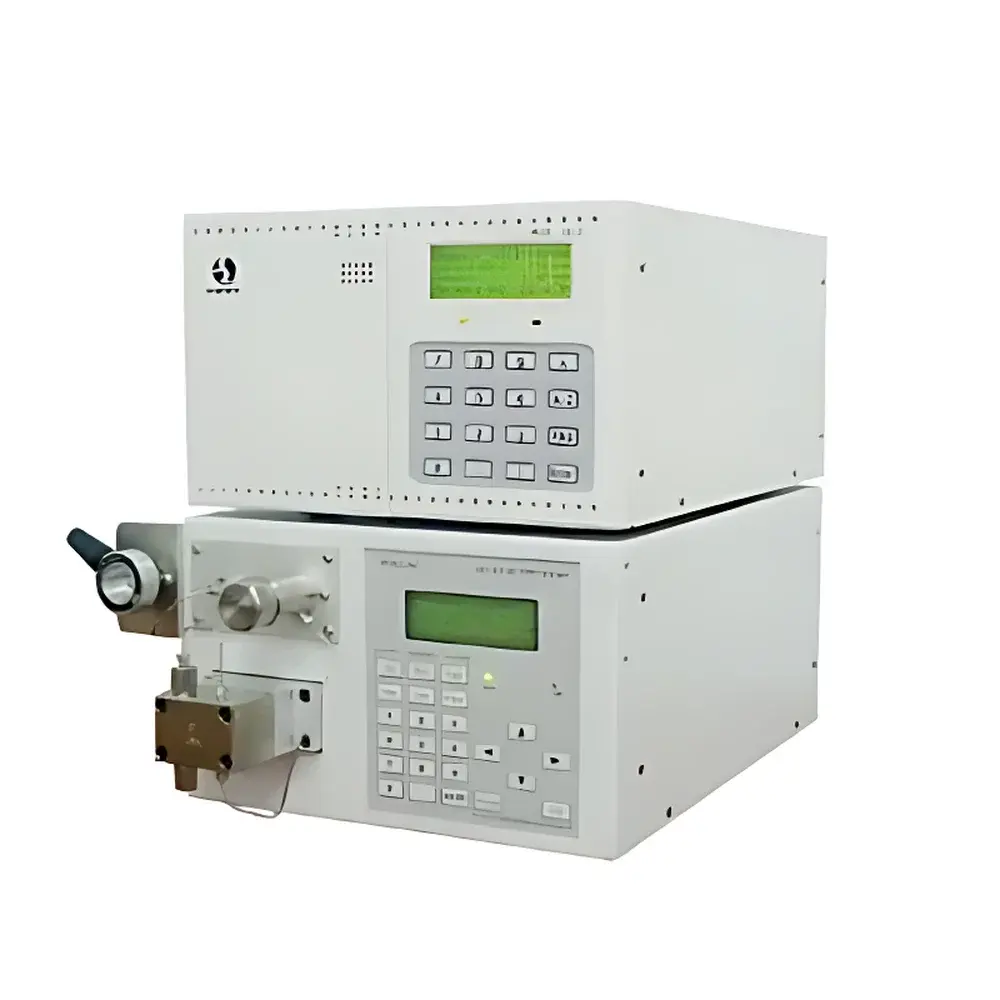
VERTEX STI500 Isocratic High-Performance Liquid Chromatograph
| Brand | VERTEX |
|---|---|
| Model | STI500 |
| Instrument Type | Isocratic HPLC System |
| Flow Rate Range | 0.003–9.999 mL/min |
| Maximum Operating Pressure | 42 MPa |
| Injection Volume Range | 0.1–100 µL |
| Number of Injection Positions | 1 |
| Wavelength Range (UV-Vis Detector) | 190–700 nm |
| Data Acquisition Rate | 100 Hz |
| Column Temperature Control | Ambient Only |
| Compliance | ASTM D4294, ISO 13877, USP <621>, GLP/GMP-ready software architecture |
Overview
The VERTEX STI500 Isocratic High-Performance Liquid Chromatograph is a robust, domestically engineered HPLC platform designed for routine quantitative and qualitative analysis in QC laboratories, environmental testing facilities, and academic research settings. Built upon proven isocratic separation principles—where mobile phase composition remains constant throughout the run—the system delivers high reproducibility for targeted compound identification and concentration measurement without gradient programming complexity. Its architecture integrates a dual-piston, microprocessor-controlled high-pressure pump (VERTEX P5000), a low-noise UV-Vis detector (VERTEX UV5000), and a network-enabled chromatography data system (STI NetChrom). All major subassemblies—including the pump head, flow cell, optical bench, and electronics—are manufactured to ISO 9001-certified production standards at VERTEX’s Zhejiang facility, with critical components (e.g., precision sapphire plungers, fused-silica flow cells, and thermally stabilized optical housings) sourced from tier-1 global suppliers under strict OEM specifications.
Key Features
- Isocratic pump system with dual-servo-controlled plunger rods, achieving flow accuracy ≤±0.15% at 1.000 mL/min (water, 8.5 MPa, 25°C) and RSD ≤0.075% for long-term stability
- Real-time pressure monitoring via high-fidelity piezoresistive sensors (resolution: 0.01 MPa; full-scale error <±0.5 MPa), with programmable high/low pressure alarms and automatic shutdown
- UV-Vis detector featuring a deuterium/tungsten dual-lamp source, 5 mm pathlength flow cell (10 µL volume), and digital signal processing that reduces baseline noise to ≤±7.5×10⁻⁶ AU (methanol, 1 mL/min, 254 nm)
- OLED-based human-machine interface with local control, real-time chromatogram preview, and fault diagnostics—including automatic lamp alignment verification and leak detection logic
- RS-232 and USB 2.0 digital output interfaces eliminate analog-to-digital conversion losses, ensuring direct, noise-immune communication with host PCs
Sample Compatibility & Compliance
The STI500 supports standard 4.6 mm ID analytical columns (up to 250 mm length) and accommodates common reversed-phase (C18, C8), normal-phase (silica), and ion-exchange media. It meets operational requirements for pharmacopeial methods including USP (Chromatography) and EP 2.2.46, with documented traceability for flow rate, wavelength accuracy (±0.5 nm), and photometric linearity. The NetChrom workstation implements audit-trail functionality compliant with FDA 21 CFR Part 11 for electronic records and signatures, supporting role-based access control, electronic signatures, and immutable raw data archiving. System suitability tests (SST) are fully configurable per ICH Q2(R2) guidelines, and hardware validation packages (IQ/OQ/PQ) are available upon request.
Software & Data Management
STI NetChrom is an Ethernet-native chromatography data system (CDS) engineered for multi-instrument scalability. Unlike legacy serial-based workstations, it natively handles up to 5000 concurrent data acquisition channels across distributed lab environments. Key capabilities include: automated folder generation by instrument ID and acquisition timestamp; sequence-driven file naming using autosampler parameters (e.g., “SampleID_Inj03_20240512_1422”); and export-ready reporting with PDF, CSV, and XML outputs. Remote data transmission protocols include MODBUS/TCP for LIMS integration, TLS-secured HTTP(S) for cloud synchronization, and optional GPRS/3G modules for field-deployed environmental monitoring stations. All raw chromatograms are stored in vendor-neutral .CDF format (compatible with OpenChrom and Chromeleon), ensuring long-term data portability.
Applications
The STI500 is routinely deployed in food safety testing (e.g., melamine quantification per GB/T 22388–2008), pharmaceutical assay validation (tablet dissolution, excipient purity), environmental water analysis (PAHs, phenols per EPA Method 8310), and polymer additive screening (antioxidants, UV stabilizers). Its ambient-temperature-only column compartment suits applications where thermal degradation is a concern—such as analysis of thermolabile vitamins or natural product extracts. The system’s low detection limit (≤1×10⁻⁸ g/mL for naphthalene in methanol) enables trace-level impurity profiling in API release testing, while its pressure stability (<0.15 MPa pulsation at 5–10 MPa) ensures consistent retention time precision across 100+ injections without column backpressure drift.
FAQ
Does the STI500 support gradient elution?
No—the STI500 is configured exclusively for isocratic operation. Gradient capability requires the STI5000 series with dual-pump binary mixing module.
What column oven options are available?
The base STI500 includes no active column heating; however, third-party ambient-stabilized column compartments (e.g., Supelco Column Oven CO-100) can be integrated via mechanical mounting rails and external temperature feedback loop.
Is the UV5000 detector compliant with pharmacopeial wavelength accuracy requirements?
Yes—verified wavelength accuracy of ±0.5 nm (NIST-traceable holmium oxide filter calibration) satisfies USP , EP 2.2.25, and JP 17 General Test 2.03.
Can NetChrom generate 21 CFR Part 11-compliant audit trails?
Yes—enabled by default, with configurable retention periods, electronic signature workflows, and tamper-evident hashing of all raw and processed data objects.
What maintenance intervals are recommended for the P5000 pump seals?
Under typical aqueous/organic mobile phase use (pH 2–8, ≤40 MPa), seal replacement is recommended every 5,000 operating hours or 18 months—whichever occurs first—based on accelerated life testing per ISO 13485 Annex A.




