
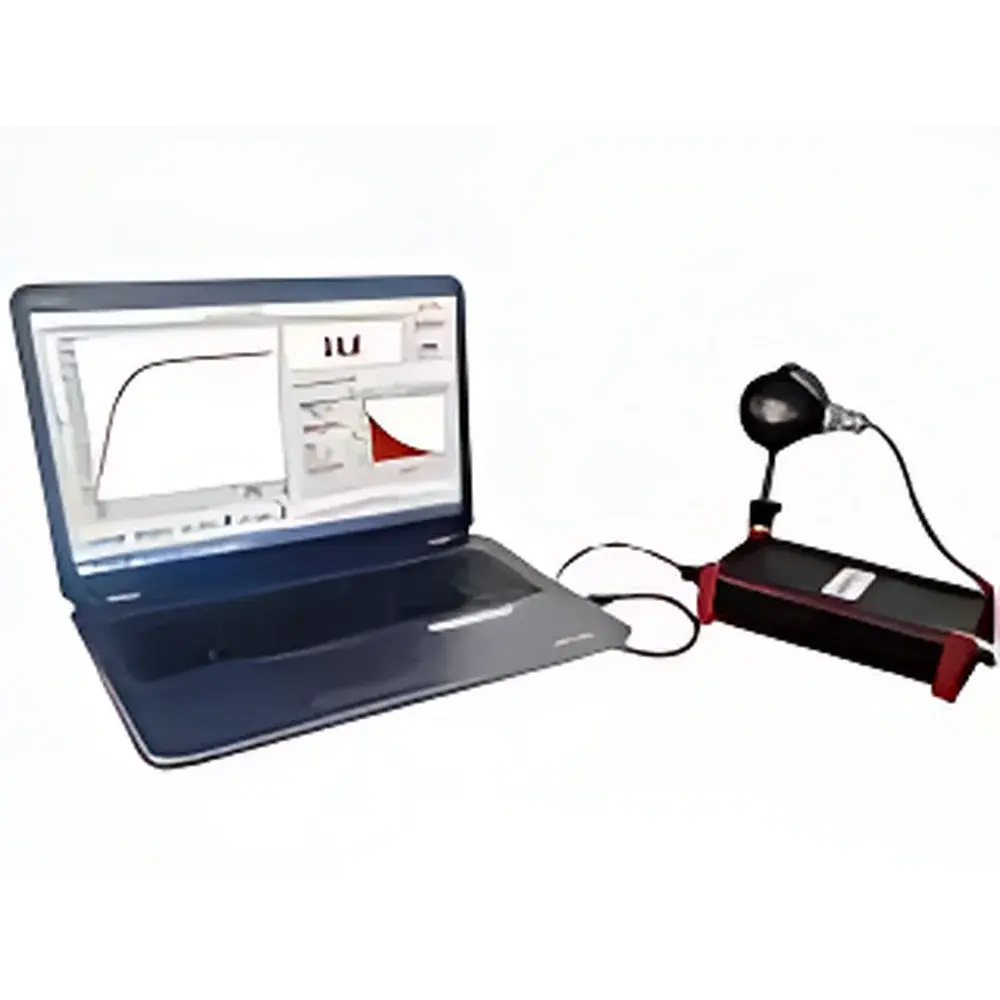
Terapower THz and Multi-Spectrum Laser Power Meter
| Origin | USA |
|---|---|
| Manufacturer Type | Authorized Distributor |
| Origin Category | Imported Instrument |
| Model | Terapower |
| Price Range | USD 14,000 – 42,000 (FOB) |
| Core Components | Thermopile-based detector modules with calibrated semiconductor laser-compatible absorbers |
| Spectral Ranges | Terapower-UV (1.1–25 µm), Terapower-IR (25–3000 µm), Terapower-THz (0.1–3000 µm / 0.1–3 THz), Terapower (0.05–1 µm) |
| Power Range | 50 µW – 1 W (standard head) |
| A-P-THz + Vega variant | 15 µW – 3 W (CW), 20 µJ – 2 J (pulsed) |
| Measurement Uncertainty | ±3% (k=2, traceable to NIST SRMs) |
| Aperture Diameter | 25 mm (Terapower series), 12 mm (A-P-THz + Vega) |
| Dimensions | 60 × 60 × 70 mm³ (Terapower), ~70 × 30 mm² footprint (A-P-THz + Vega, thickness not specified) |
| Compliance | CE, RoHS, ISO/IEC 17025-accredited calibration certificate supplied |
Overview
The Terapower is a precision thermopile-based laser power meter engineered for absolute radiometric measurement across an exceptionally broad electromagnetic spectrum—from deep ultraviolet (0.05 µm) through visible and near-infrared, into mid- and far-infrared, and extending into the terahertz regime (0.1–3 THz, equivalent to 0.1–3000 µm). Unlike photodiode-based sensors limited by wavelength-dependent responsivity and saturation thresholds, the Terapower leverages a blackened, vacuum-sealed thermopile detector architecture that delivers spectrally flat absorption (>96% average across its designated bands) and true power-integrating behavior. This enables traceable, calibration-invariant measurements of continuous-wave (CW) and quasi-CW sources—including solid-state lasers, fiber lasers, quantum cascade lasers (QCLs), molecular gas lasers, backward-wave oscillators (BWOs), free-electron lasers (FELs), and thermal blackbody emitters—without requiring spectral correction factors or recalibration per source type.
Key Features
- Multi-spectral modular design: Interchangeable detector heads (Terapower-UV, -IR, -THz, and broadband visible/NIR) allow seamless adaptation to distinct source classes while maintaining common electronics and interface protocols.
- NIST-traceable calibration: Each unit ships with a certificate compliant with ISO/IEC 17025, including uncertainty budgets referenced to NIST Standard Reference Materials (SRMs) for both power and energy modes.
- Low-noise analog front-end: High-resolution 24-bit ADC with auto-zeroing and dual-slope integration ensures stable baseline performance down to 15 µW (A-P-THz + Vega configuration) and sub-10 µW resolution in low-power averaging mode.
- Thermal drift compensation: Real-time ambient temperature monitoring coupled with internal reference thermistor networks actively correct for thermal gradients across the thermopile junction array, enabling <±0.2% drift over 8-hour continuous operation at 25 °C ambient.
- Ruggedized optical interface: 25 mm aperture (standard) features fused silica window with AR coating optimized for 0.2–20 µm; optional ZnSe or polyethylene windows available for THz-specific transmission optimization.
- Compliance-ready firmware: Supports audit trails, user access levels (admin/operator), electronic signatures, and data export logs conforming to FDA 21 CFR Part 11 and EU Annex 11 requirements when paired with validated PC software.
Sample Compatibility & Compliance
The Terapower accommodates diverse beam geometries and source modalities without beam attenuation or spatial filtering. Its large active area (25 mm Ø) supports collimated beams up to 20 mm diameter and divergent outputs from QCLs or FELs without vignetting. For pulsed THz systems (e.g., photoconductive antenna arrays), the A-P-THz + Vega variant provides synchronized energy measurement with 20 µJ minimum detectable pulse energy and <10 ns rise time. All configurations meet IEC 61000-6-3 (EMC emission) and IEC 61000-6-2 (immunity) standards. Calibration intervals are defined per ISO/IEC 17025:2017 §7.8.3, with recommended re-certification every 12 months under GLP/GMP laboratory conditions.
Software & Data Management
Terapower Control Suite (v4.2+) provides real-time power/energy logging, statistical analysis (mean, std dev, min/max, trend charts), and batch export to CSV, HDF5, or XML formats. The software implements full 21 CFR Part 11 functionality—including role-based login, electronic signature capture for calibration reports, and immutable audit logs recording all parameter changes, measurement triggers, and export events. Raw sensor output is stored with metadata (timestamp, ambient T, serial number, calibration ID), enabling retrospective metrological traceability. API support (LabVIEW, Python via PyVISA, MATLAB) permits integration into automated test benches and LIMS environments.
Applications
- Quantitative characterization of THz sources in time-domain spectroscopy (TDS) setups, including peak power, average power, and pulse energy validation against theoretical models.
- In-line power monitoring of industrial fiber lasers during material processing (cutting, welding, cladding), ensuring process repeatability within ISO 11554-defined tolerances.
- Calibration transfer between primary standards (e.g., cryogenic radiometers) and secondary lab instruments in national metrology institutes.
- Reflectance and transmittance measurements of metamaterials, phononic crystals, and 2D materials (e.g., graphene, hBN) using dual-beam differential power ratio techniques.
- Laser alignment verification via beam centering and stability assessment over extended duty cycles (>10⁴ s).
- Blackbody radiation studies in astrophysical instrumentation labs, where spectral flatness and low drift are critical for emissivity modeling.
FAQ
Is the Terapower suitable for measuring femtosecond pulsed lasers?
Yes—when configured with the A-P-THz + Vega head and appropriate trigger synchronization, it measures single-shot energies from 20 µJ to 2 J with <2% linearity deviation across the dynamic range.
Can I use the same detector head for both IR and THz measurements?
No—spectral response is determined by absorber composition and window material. Terapower-IR uses a metal-black thermopile with KRS-5 window (25–3000 µm); Terapower-THz uses a specialized carbon-loaded polymer absorber with high-resistivity silicon or polyethylene window optimized for 0.1–3 THz.
Does the instrument require warm-up time before achieving specified accuracy?
Yes—30 minutes of thermal stabilization at constant ambient temperature (±0.5 °C) is required prior to initial calibration verification; subsequent measurements maintain specification without additional warm-up if ambient drift remains <0.3 °C/h.
How is calibration traceability documented?
Each unit includes a hardcopy and digital calibration certificate listing measurement points, uncertainties (k=2), reference standards used (NIST SRM 2210a, 2211), and technician accreditation status per ISO/IEC 17025.




