
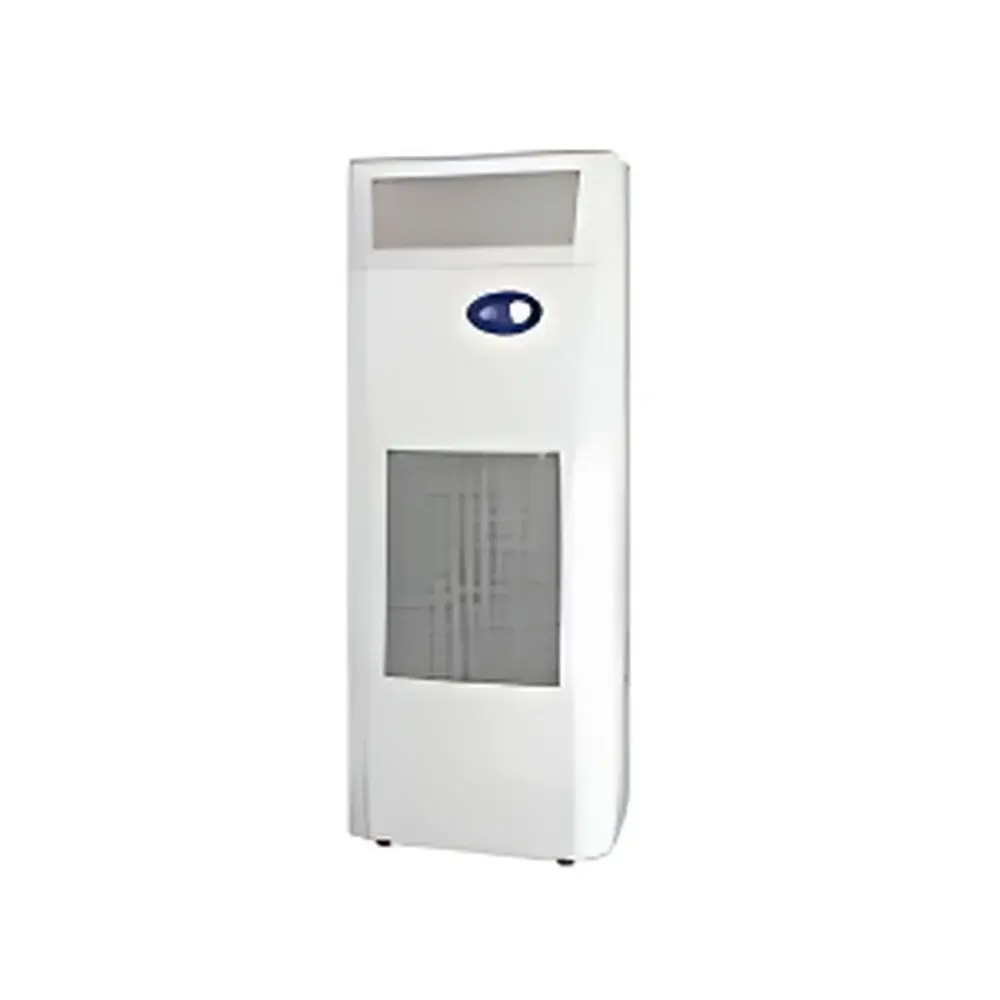
Senmao CH1680RB Commercial-Grade Industrial Dehumidifier
| Brand | Senmao |
|---|---|
| Origin | USA |
| Model | CH1680RB |
| Dehumidification Capacity | 168 L/day (30°C, 80% RH) |
| Airflow Rate | 1500 m³/h |
| Power Supply | 220 V AC / 50 Hz |
| Rated Power | 2500 W |
| Rated Current | 12 A |
| Operating Temperature Range | 5–35°C |
| Noise Level | 60 dB(A) |
| Net Weight | 91 kg |
| Dimensions (H×W×D) | 1600 × 620 × 460 mm |
| Applicable Area | 300 m² (Ceiling Height: 2.8 m) |
| Voltage Tolerance | 198–242 V |
| Activated Carbon Filter | Yes |
| Drainage | Side-mounted Continuous Drain Port |
| Casters & Adjustable Feet | Yes |
| Auto-Defrost | Yes |
| Compressor Protection | Yes |
| Microprocessor Control | Yes |
| High-Precision Humidity Sensing | Yes |
| Remote Monitoring & Security Integration | Yes |
| Circuit Protection System | Yes |
Overview
The Senmao CH1680RB is a high-capacity, microprocessor-controlled industrial dehumidifier engineered for continuous, reliable moisture removal in large-scale laboratory, pharmaceutical manufacturing, precision instrument storage, and controlled-environment facility applications. Utilizing refrigerant-based condensation technology with optimized heat exchange architecture, the unit achieves stable dew point suppression and precise relative humidity (RH) regulation across demanding operational conditions. Its design prioritizes thermal stability, electrical safety, and long-term operational integrity—critical requirements for environments where ambient humidity directly impacts material integrity, analytical repeatability, and regulatory compliance. Unlike residential-grade units, the CH1680RB incorporates industrial-grade compressors, reinforced structural housing, and redundant protection circuits to sustain uninterrupted operation under extended duty cycles and variable load conditions.
Key Features
- High-efficiency dehumidification capacity of 168 liters per day at standard test conditions (30°C, 80% RH), validated per AHAM DH-1 protocol
- Microprocessor-based control system with ±2% RH sensing accuracy and programmable setpoint range (30–80% RH)
- Integrated activated carbon pre-filter for adsorption of volatile organic compounds (VOCs), ozone, and airborne odors—essential in cleanrooms and chemical storage areas
- Auto-defrost functionality with intelligent frost detection algorithm to maintain performance during low-temperature operation (down to 5°C)
- Compressor thermal overload protection, high/low pressure cut-off, and short-circuit safeguard circuitry compliant with IEC 60335-1
- Side-mounted continuous drainage interface enabling wall-adjacent installation without compromising airflow or service access
- Four-point leveling system with heavy-duty casters and adjustable feet for stable placement on uneven concrete or raised access floors
- Remote monitoring capability via RS-485 or optional Ethernet module, supporting integration into BMS (Building Management Systems) and security surveillance platforms
Sample Compatibility & Compliance
The CH1680RB is designed for use in non-explosive, non-corrosive indoor environments classified under IEC 60079-0 Zone 2 and UL 1995 Class II, Division 2. It meets electromagnetic compatibility (EMC) requirements per EN 61000-6-3 and EN 61000-6-1. While not intrinsically safe, its construction and control logic align with GMP Annex 1 environmental control expectations for Grade C/D cleanroom support spaces. The unit supports documented environmental qualification protocols—including IQ/OQ—and maintains traceable calibration logs when paired with validated external hygrometers. All electrical components are certified to UL/CSA 60335-1 and CE marking standards.
Software & Data Management
The embedded controller stores up to 30 days of operational history, including runtime hours, compressor cycles, average RH deviation, and fault event timestamps. Optional firmware upgrades enable CSV export via USB interface for audit trail generation. When integrated into enterprise SCADA or LabVantage systems, the device transmits real-time humidity, temperature, and status data with configurable alarm thresholds. Audit trail functionality satisfies FDA 21 CFR Part 11 requirements when deployed with validated identity authentication and electronic signature modules. Data retention policies and user access levels can be configured to comply with ISO/IEC 17025 clause 7.5.2 (data control).
Applications
- Environmental stabilization in analytical laboratories housing HPLC, GC-MS, and XRD instrumentation sensitive to condensation and humidity-induced drift
- Moisture control in pharmaceutical packaging lines and cold chain staging areas requiring ≤45% RH to prevent tablet caking or excipient hydrolysis
- Preservation of calibration standards, reference materials, and optical components in metrology labs
- Humidity mitigation in server rooms, battery testing chambers, and composite material curing bays
- Support of ASTM D618, ISO 291, and USP environmental conditioning protocols for material property testing
FAQ
What is the minimum ambient temperature at which the CH1680RB maintains rated dehumidification performance?
The unit is rated for continuous operation between 5°C and 35°C. At temperatures below 15°C, auto-defrost frequency increases; however, full capacity is maintained down to 10°C under 80% RH load.
Can the CH1680RB be integrated into a centralized HVAC monitoring system?
Yes—via Modbus RTU over RS-485 or optional BACnet/IP Ethernet gateway, supporting interoperability with Tridium Niagara, Siemens Desigo, or Honeywell WEBs platforms.
Is the activated carbon filter replaceable, and what is its service life?
The filter is field-replaceable with standardized 300 × 300 × 50 mm dimensions. Under typical lab air quality (ISO 14644-1 Class 7), replacement is recommended every 6 months or after 2,000 operating hours.
Does the unit include validation documentation for GxP environments?
Factory-installed units ship with a Certificate of Conformance (CoC) and electrical safety test report. Full IQ/OQ documentation packages and calibration certificates are available as optional services.
What maintenance intervals are recommended for optimal long-term reliability?
Compressor oil analysis every 12 months, coil cleaning quarterly, and annual verification of sensor calibration against NIST-traceable hygrometers are advised per manufacturer’s technical bulletin TB-CH1680RB-REV4.



